
Mark Brown
October 3, 2021
The barbell deadlift is my best lift among the 3 mains that powerlifters are measured by. My squat 1 rep max is equal to my deadlift but my form isn’t as clean at higher weight. My bench press is improving but still very much a work in progress, especially at max weights. The deadlift is an exercise that is both respected and feared, as it should be, because injury is always one rep away. Yes, that could be said about every lift but danger is far closer in the deadlift and squat than others. My evolution with this particular lift isn’t just a story about my progress doing it at the gym but it is also about how it has changed how I view strength sports in general.
I didn’t know deadlifts were a thing until I became a gym member in 2013. Even then I didn’t really understand them until a few years later. Deadlifts were not done in our high school. The main power lifts we did we squat and hang cleans. I didn’t understand for a long time a clean involves a deadlift at the start. When I started doing them in 2015-16 my back strength was quite poor and my form was pretty terrible. That math leads to a deadlift that ends up in injury so it was a lift I didn’t keep in the rotation all the time. It is a lift that requires the body to move in proper order to do it well and safely. I have heard it described as being lifted by the legs and finished with the back. That is largely accurate. Training is required to deal with the points where the load is moved up the chain to the, hopefully, inevitable lockout position. Pulling from the floor helps train the central nervous system to respond to the full range of motion but partial range of motion movements help train specific muscle groups for the load that is going to be on them. The lift is the goal and the process simultaneously.
As my back strength improved in 2017-18, I was more dedicated to leg and back strength than upper body. I believe very firmly that if one takes care of those two muscle groups the rest fall into place for strength training. That’s not the case with bodybuilding. By the time I stopped putting active effort into legs and lower back in late summer of 2018, I had worked up to a 1 rep max of 335. It was such a grind every week that was wearing me down mentally and physically. In my experience, squats and deadlifts are far more exhausting than upper body work. A lot of that is the the muscle groups involved and how much they can be loaded compared to the front upper body can be. Two factors are at play here. First, legs do more than arms do for the vast majority of humans so they require more loaded weight to be effective. My job has me on my feet for anywhere from 8-11 hours a day with light to medium sized loads so it is an effective warm up for heavy leg work. Those who don’t have that level of workload in regular day to day life will find that heavier weight is just that much more taxing on the muscles and the central nervous system. Second, the shoulder joints are less loadable than the hips. I have never really experienced hip problems but I have had shoulder pain at various times. I have never really looked into what exactly was causing the pain but it has never been enough to pause training. It’s just a pain in the ass joint to deal with. The tricep being the main support for any shoulder movement is another driving point in this factor. For comparison sake, my current 1 rep max at deadlift/squat is 405 pounds and my max overhead strict press is 161 and my 1 rep max bench press is 285. Another factor in my deadlift being my best lift is that my height and frame help me quite a bit, I believe. I am 6 foot and 270-285 pounds on any given day currently with an all around medium sized build. It allows me hold the bar then pull it up my legs right from my shin so I have the best possible leverage point available to me. The length of my legs is also the right length for me to really get my quads and hamstrings into the lift from the start.
Strength training is very slow process and shifts in goals have consequences. I don’t know where my deadlift and squat would be right now if I had stayed with them as I hit upper body a bit harder to gain strength and mass. When I started lifting in buddy’s garage in April-May 2020, deadlifts came back into the regular rotation after I decided barbell rows weren’t working for me. My experience of having lifted only in a commercial gym made me have to think how I could attack lower back training. A barbell can work every muscle group in the body but it does compound movements best. The deadlifts started around 185 pounds and topped out around 245. I didn’t fit in my lifting belt anymore so I was limited in what I felt comfortable lifting without it so the loaded weight stayed down. I ordered a 13 mm lifting belt from Rogue Fitness and it came around July. That allowed me to really start training legs and back much harder. My squat was improving at a higher rate than my deadlift. It is important to note that I was doing more hypertrophy training than strength training during the summer and early fall in 2020. That shifted a bit after my belt arrived. I knew from my lifts of 245 that there was much more in the tank, but I just wanted to be safe about it.
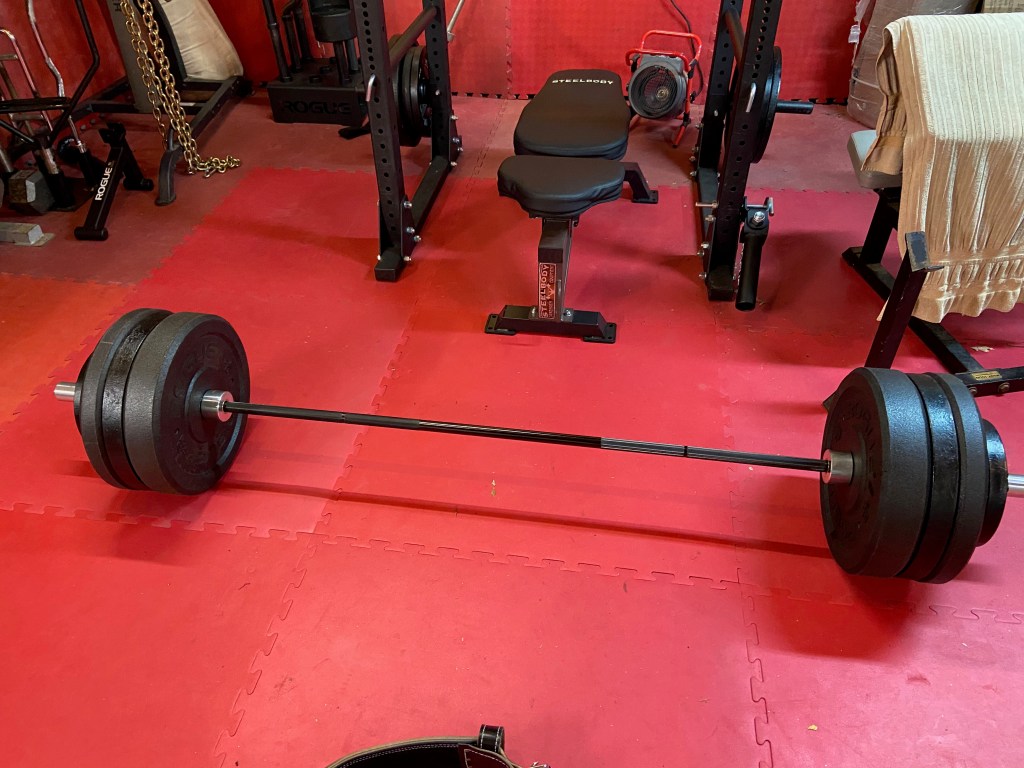
Muscle memory started to kick back in from 2015-2018 and I started to make strides in my weekly deadlifts as summer 2020 lead into fall. I accomplished a 405 pound 1 rep max in squat in late August last year. Equipment has also played a big role in deadlift development. I bought a Rogue Deadlift Bar in early September and started to deadlift only with that when I did it at the garage. It helped development by forcing me to adapt to it. A deadlift bar is thinner and far less stiff than a normal power bar so it has more bend in it. The effect that has is that there is less weight in the hands at the very beginning of the lift. That can be the difference between a successful rep and a failed one. I also discovered how round plates helped in the lift during this time. The commercial gym that I am a member of has 8 sided rubberized plates that don’t roll so easily. I found one of the ways to help the movement was to bring the barbell into position by rolling it to my shins before I started the lift. Round iron plates are much easier to roll than 8 sides plates. Deadlifts are also one of the greatest tests of grip strength. Poor grip strength like mine, relatively speaking, can mitigated a number of ways. I use all the tricks necessary to do so. The aggressive knurling on deadlift bars helps the bar stay in hand, chalk makes hands instantly dry, and straps looped around my wrist and the bar allow me to hold the bar using a pronated grip for longer and at heavier weights. When I am not using straps, weight is easier held with a mixed pronated-supinated grip. Many lifters use what is called a hook grip for deadlifting without straps. That is executed by gripping the barbell and holding the thumb down on the pointer finger. I cannot do that because my fingers aren’t long enough.
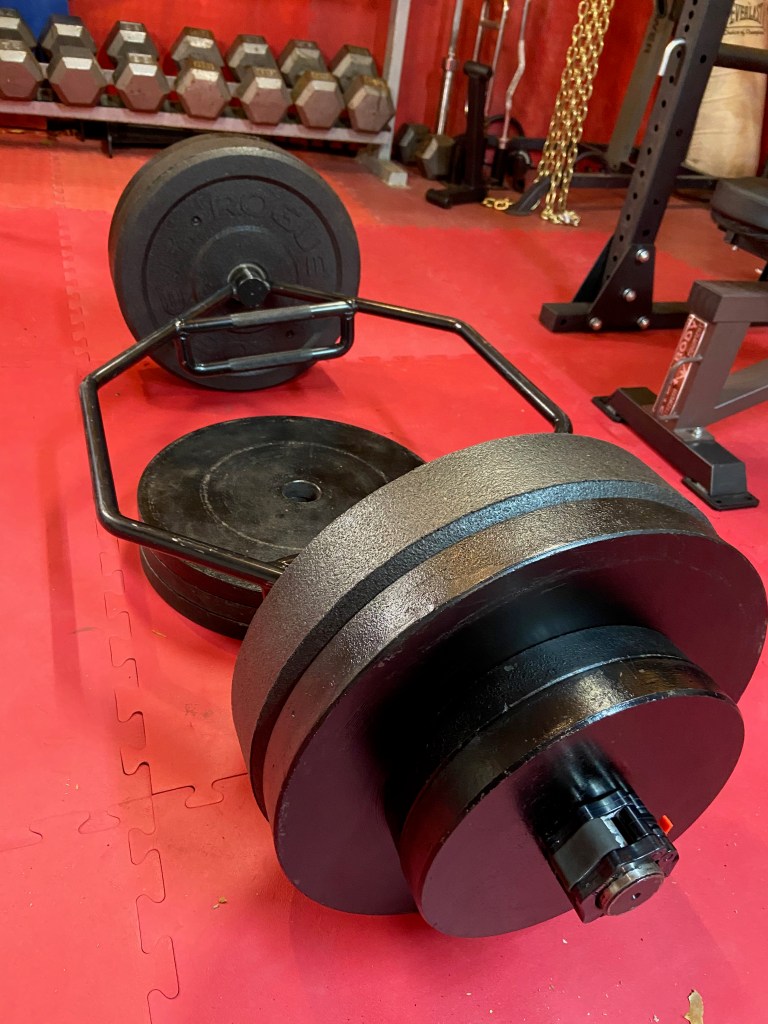
I mentioned that deadlifts are feared by lifters, especially new ones, because the threat of injury is increased due to the movement involved. I have suffered some minor tweaks on a 3 different occasions involving pulls. One was December 2016 while doing straight leg deadlifts, a variation where legs are kept as close to straight as possible to isolate hamstrings when pulling from the floor. That kept me out of the gym for about 2-3 weeks. In August 2020, I tweaked my back again on a traditional form deadlift. I felt the twinge right below my belt on the 4th rep doing a set of 315 pounds. However, I believe I put myself there in the lead up to it. I was at a point in my progress where I didn’t need the belt for 275 pounds anymore, and was getting close to not needing it for 295. I decided to see if that was the case so I did a set without the belt at 295 and it went fine. I’m not entirely sure what caused the tweak to happen. I didn’t even stop the lifting session. Probably should have but just shows where my mind was at. Early December is the last time I felt my back go after performing this lift. I did it doing a deficit trap bar dead lift. A trap bar, or hex bar, deadlift feels like a front squat to me so I just amped it up by setting two iron plates under my feet inside the trap bar. At this point, my deadlift max was 375 pounds with the straight bar. The neutral grip trap bar allowed me to lift slightly more without a belt. I worked all the way to my top weight of 340 and did the lift without the belt. There was no tweak to indicate injury but just an overwhelming feeling of stiffness in my back that told me I had gone a little too far. I did 8 reps at that weight and distinctly remember pausing to decide if I wanted to do that last rep or not before doing it. This one kept me out of the garage for about a week or so. Before the end of the year I was back to deadlifting my normal planned weight.
The deadlift is a major part of my program, which as I discovered through watching various videos from people I trust on Youtube that my programming was a powerbuilding one. It has not always occupied the same space in said programming. In 2020, I put the lift at the end of a hard leg session because I wanted to work hard into fatigue and force myself to use everything I had. Now I realize that kind of programing is best for competition prep. In the past I have split up squats and deadlifts but was unsure how to get the best out of both so I condensed them into one day. I typically squat first then deadlift second because I feel the squat primes my legs and lower back for the movement. I view deadlifting as my main back power movement so I use it both for strength gain and muscular development so I tend to be higher volume in the lower weight range and low volume in the higher weight range. Currently that means 315 – 365 pounds for 5-6 and anything above that for 1 to 3 reps. I could do more at the low range of the former but I know that has a price at the top end. One only has so many deadlifts in them in given session.
I also do more partial range of motion work than before. It is done to work more on the back portion of the lift and the lockout. First came rack pulls. I discovered the lift having watched it on Youtube and doing it when my spotter arms for my squat rack arrived. It was a lift I could load heavier than pulls from the floor because the lift started at my knees plus or minus a few inches. I started with bare weight to start but I added band tension in mid-September. I got 70 pound and 100 pound bands arrived from Rogue and found immediately the value in banded rack pulls. The added tension made lockouts hard to achieve unless max effort was given and proper form was kept up. It is one of my favorite lifts because I feel it all the way up into my lats. I recognize now where they belong in the week’s layout of lifts. I now employ them when I do chest, as that is when I do lat work. They are probably the dominant reason why I feel a lot stability in my upper back. When I turned my squat rack into a power rack in mid-October, I used safety straps I bought at the same time I got the equipment to turn the former into the latter. Those safety straps allowed me to really pull a lot of weight without damaging the safety pins that came with my power rack. Second, July 2021 saw the arrival of deadlift mats from EliteFTS. They were 3/4 inch thick rubberized mats that allow me to perform block pulls. I probably will be getting more in the future, because they make doing heavy hamstring work easier. I use 4 on each side to raise the barbell off of the floor an extra 3 inches from the normal 9, the distance from the bar to the floor when loaded with 45 pound plates. The difference between the rack pulls I was doing from the straps and the block pulls from the pads was immediate. The starting position difference of the bar was about 3-4 inches lower than the rack pull. That made it a harder lift and involved my legs a lot more. Rack pulls have their place, especially when banded, but they are not even remotely the same lift.
I would be remiss if I didn’t tell about how seeing strong deadlifts has effected me. Alexander Bromley, a powerlifter and strongman, called squats the “king of lifts” in a video I watched about leg training programming and I think he is right but the deadlift is bigger in popular culture. A lot of that is derived from the feud dating back to the 2017 World Strongest Man contest involving Eddie Hall and Hafþór Júlíus Björnsson, aka Thor. The Strongman deadlift record over the decade of the 2010s surged to astronomical heights. Brian Shaw and Laurence Shahlaei set the standard at 430 kilograms (948.98 pounds) then Zydrūnas Savickas deadlifted 440 kgs (970 lbs) at the 2011 WSM cap a year a major growth for the record. Hall took it all the way to 500 kgs (1102.31 lbs) in 2016 at the World Deadlifting Championships using a suit and straps. The difference between Strongman and Powerlifting is that the latter has more rules about how a lift must be completed than the latter. The two main differences in the deadlift is strongman allows grip enhancement through straps and allows lifters to hitch the bar up to lock out position after momentum has been lost and Powerlifting doesn’t allow either. Strongman is essentially Equipped Powerlifting on wild amounts of steroids. The feud sparked a lot of animosity between Hall and Björnsson, the latter having felt cheated out of victory at the contest, and it simmered for years. Many powerful lifters tried to best Hall’s 2016 lift but all failed until Björnsson successfully lifted 501 kg (1104.52 lbs) in 2020 as part of Rogue Fitness’s Feats of Strength initiative during the pandemic. Björnsson’s role as The Mountain in Game of Thrones definitely had something to do with the popularity of the pursuit of it. There have been many attempts to deadlift 505 kgs (1113.13 lbs) but none have yet succeeded. Strongman, as a sport, has come a long way over the last 10 years and has brought the deadlift with it.
Other deadlifts have inspired me to awe and continue my training. Benedikt Magnusson’s 460.4 kilogram (1015 pounds) raw deadlift in 2011 is mind-blowing because of how easy it looked. The Hummer Tire Deadlift is always fun to watch. It was a lift I originally saw that the Arnold Strongman Classic and Brian Shaw has used it at his event he started last year, The Brian Shaw Classic. It is a partial range of motion deadlift but the weights involved are still mind blowing. I watched JF Caron shatter Savickas’s lift of 1155 pounds at the 2014 Arnold Strongman Classic. His lift of 1202 pounds is still crazy to me. My best partial range of movement pull is 415 from the deadlift pads and 425 from the safety straps for comparison sake. Seeing the best do it makes me want to do it more. Strongman just makes watching people lift things fun because one never knows what they are going to see lifted.
The deadlift is my best lift. I don’t know if that will always be the case. It would probably benefit me more if my squat was better but I always get excited for leg and back days because I get to lift heavier than the other days. The element of danger being higher and the prospect of getting stronger that gets me more excited. The lift has made me my legs and back stronger and more stable. That has helped on the golf course as well.
 Life Through Lifting