
Mark Brown
November 9, 2021
The bench press historically been my hardest lift to make progress on. I even actively avoided it for about a year and a half fairly recently. That time taught me how to train chest and shoulders effectively without the use of a barbell. The lift itself has gotten significantly better over the last 2-3 years as I have put forth a much more serious effort. It’s been quite a winding road to where I am currently with the bench press. I have learned both from videos watched and experience with this lift more how to make more sustained jumps in both strength and muscular development. Today I am writing about my experiences with the lift, what I have done to get where I am now, what I am currently doing with bench press training, things I have learned revolving around it, and chest training in general.
I remember bench pressing in high school and never really making it past 135 pounds. If I did, it wasn’t much more than that. Looking back on it now it makes sense that I never made progress with it. I was never consistent enough in my approach to strength training in that time period. I loved lifting and was serious about trying to get stronger for baseball but there was hardly any kind of plan to actually see improvement. Even after I joined Aspen in 2013, strength progress on the bench was always hard to achieve. A lot of that was I was either doing it too much or not enough. Once again, the lack of a plan for getting better at the specific skill that is bench pressing with a barbell got in the way. The “organic build” phase in my strength training from 2013-18 I have referenced before helped build the library of knowledge I use now but it certainly didn’t help strength development of the barbell flat press. I struggled at or below 185 pounds for a what felt like an eternity. In reality it was for about 4 years. It was lagging far, far beyond the other two lifts in powerlifting competition: The squat and the deadlift. To put it all in perspective, in the middle of 2018 my unofficial gym total for powerlifting was about 885 pounds and only 185 of it came from bench press.
During the years from 2015-18, I did a lot of lifts with dumbbells. Dumbbell presses, both on a flat bench and overhead, are both key supplemental lifts for the bench press. Those two lifts is where I saw the most steady growth in progress. I pushed through all the way to the 100 pound and above dumbbells on the flat press and to the 55 pound dumbbell on overhead press by the end of 2018. In this time frame I rarely pushed myself when doing a barbell bench press because I didn’t have a training partner and I was resistant to ask for spotting help. Looking back now I’d say that was a major impediment to progress in that time frame. Dumbbells are safer for heavy press movements when one lifts on their own because the odds of injury when lifting to failure are lower. They make lifting to failure a far more manageable proposition than barbells do on the whole.
In the late summer or early fall part of 2018 I took action on my lack of upper body development and spent almost all of my time in the gym doing it. Prior to 2018, I lifted shoulders and chest in the same session but I split them up now and gave them their own session. I broke down the week to 2 chest sessions a week, 2 shoulder sessions a week and 2 arm days a week. No more leg or back work. By the end of 2018, I could reliably hit 205 for a couple but I noticed something that pushed me more towards dumbbells than barbells. If I bench pressed heavy, I felt it sapped my ability to dumbbell press heavy as I wanted and vice versa. That makes sense to me now based on current experience level and everything I have learned from listening to podcasts and videos on training. I didn’t take that as positive sign so I decided to focus on dumbbells and maximize the gains I could make there. When I made my mind up to move that direction, development in dumbbell press was pretty quick all things considered. I can’t be sure when or how it happened but the way I do dumbbell presses helps chest development overall. I don’t push the dumbbells straight up from their starting position. I angle the press inward so the dumbbells meet directly above the middle of my chest. I think it’s mostly a mental cue I have to know when to begin the eccentric part of the lift. By the end of 2019, I was capable of pressing the 125 pound dumbbells a few times. I generally followed the dumbbell press with a cable crossover for 4-5 sets of 8-10 reps from 35 pounds all the way to 62.5 depending on how I felt. I feel cable crossovers are very good for muscular development in the chest, especially when the lockout is held for a few seconds before returning back to base position. A gym friend offered advice in how to do the crossovers that really helped. It was to not allow the arms from the elbow to the hand to get past 90 degrees on the way back to starting position. It helped keep tension stay on the muscles. Most of the time, after heavy dumbbell press and cable crossovers I felt I needed to let my chest rest for about 10-15 minutes before I did another chest based lift. That mostly took the form of triceps pushdowns and other triceps lifts. I was working primarily a bodybuilding split after all.
Shoulder development was also progressing nicely during this period as well. When I started the upper body focus I was using 50 pound dumbbells for dumbbell presses and by the end of 2019 I could use the 70 pounders for the same lift. Shoulder press with a barbell, also known as military press, was and still is quite difficult to get into proper starting position for me so I tended to favor dumbbells for it. Dumbbells still have the issue of getting into proper front rack position but it’s not as restrictive in my estimation. Plus, the dumbbells allowed me to go deeper than the shoulder if I wanted to. I also did Arnold Press. It’s a compound lift that focuses effort on all 3 heads of the deltoid by starting with a curl of the dumbbell up to a front rack position in front of the chest, turning the dumbbells so they are held a few inches outside of the shoulders and then pressed upward with a inward path so they meet above the head. It is a very useful lift for getting all 3 deltoid heads hit simultaneously. The change in the front rack position from regular dumbbell press and the Arnold press means I can’t do the latter at the same weight. From there was doing isolation movements like lateral raises and rear deltoid flies.
During the span of 2018-19, I occasionally bench pressed as heavy as I could to find out where my maxes were. I was still very much only really doing dumbbell presses. When I was reliably pressing 215 for about 4-5 I was nervous about pushing to 225 because I didn’t want to get stuck under the bar. It had happened once before on an incline press sometime between 2016-17 at 135 pounds. The progress was slow but steady. By the end of 2019, I could press 235-240 pounds about 3-4 times but I rarely went beyond that because I wasn’t sure where the failure point was. Finding the failure point is great, but only if its done safely. The gym closings in March 2020 put a serious wall up in my progress. When I joined my buddy from work, Pete, in his garage for lifting I found that even the 75 pound dumbbells felt heavy as hell. That was eye opening. I worked extremely hard to push all the way up where I did and it all disappeared in 4 weeks of inactivity. I thought perhaps it was just the difference between the shape and size of dumbbells from Genesis, which have rubberized dumbbells with knurled handles made by Iron Grip, and Pete’s, which are metal hex dumbbells. I found when I went to the gym on a day where we weren’t lifting together that my hypothesis was wrong. I knew then the road back to where I was before the closings was going to be longer than I thought.
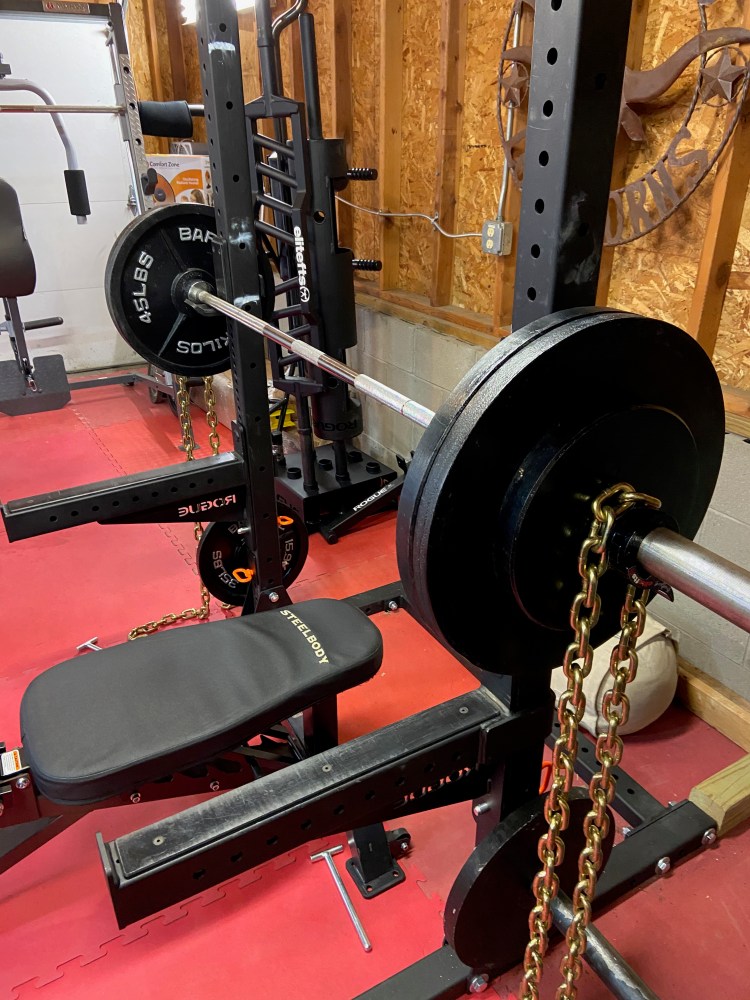
The closings did force me to make necessary changes to my plans to accommodate the equipment that was in the garage. One of the things that had always held my bench press back was not lifting with a steady partner or not asking for spots. I realized that key after I added bench pressing back into the program I was creating on the fly with Pete. I added equipment to the garage gym he had already built up. The major pieces of equipment I purchased that helped me make gains in the bench press were the logical ones. The squat stand, now converted into a power rack, from Rogue Fitness and the spotter arms for it were the first key pieces I got to help me train better in the garage. Pete and I started with just regular bench press and a pause press, holding the bar down to either the count of 3 or 5 before pressing back up. That was useful for making progress before the spotter arms arrived, which had been out of stock for a few months like everything else fitness related. Once they got to the garage pinned dead presses, max effort lifts solo and training specific parts of the bench press all became possible. Pin presses are performed by starting the lift from a “pinned” position above the chest so that only the concentric part of the lift is done. It prevents the pectoral muscles from be loaded prior to the press by starting from a dead position at the bottom. I did them for a few months last year and use them to re-rack the bar at 225 pounds after failed lifts currently. I’ve experimented with a pin press halfway up to help train the upper part of the press to help train the upper half of the concentric and lockout phases, but it isn’t major part of my current plan. Benches were difficult to come by last year. Pete bought a taller, narrower adjustable bench first but then replaced it with a shorter, wider bench that had a higher weight rating which we both prefer.
I have bought accessory pieces to enhance or make it more difficult: A pair of 70 and 100 pound Rogue Monster bands, a pair of matching 30 pound chains (with eyes on getting more) and an EliteFTS shoulder saver pad. Banded press is the hardest lift I have ever done. I can’t overstate how much effort it requires and how dangerous it can be. From the lifter’s perspective, it’s a lift that taxes the body at a higher level. What I found most interesting was that grinding out reps was just about impossible. It was consistent that I would get 4-5 good, smooth reps at 60-70% 1 rep max then the last attempt would fail miserably. I call that concept the “door shutting.” From the spotter’s perspective, it’s a challenging lift to spot because it’s essentially a banded pull if help becomes necessary to give. There truly is no just reaching down and pulling the thing up. The lifter must help the spotter in a way that isn’t like a regular bench press. I got chains last year to for speed work. Chains work by lowering the weight at the bottom part of the lift, ideally helping it become faster and more powerful. I tend to go on and off chains every 6-8 weeks. It gives a lot of “theoretical” possibilities for what can be lifted. The shoulder saver is pad that can attached to the bar to serve as a 2 board press, then removed when the lift is done. Shoulder saver bars exist but are quite expensive so the pad is a great to help save the shoulders. I used it on combination with the bands on the above mentioned band press so I could never get to the least possible resistance.

I bought quite a few bars last year, mostly specialty varieties. Two of them were purchased with bench press in mind. The first of the bars was the American Cambered Bar by EliteFTS. It has 4 pairs of slightly pronated grips with a 2 inch camber in the middle portion of the bar. There is no knurling on any of the handles but it doesn’t really need it. When I first started using it, I found out how much of an ego killer this bar is. I can’t press anywhere near my 1 rep max on a straight bar with this one. It feels like an offset dumbbell press. Where this bar shines is cluster sets and supersets because the way the bar allows for a lot of volume to be done in a relatively short amount of time. That makes it extremely useful for both strength and hypertrophy work. The second was Rogue Ohio Power Bar. This bar opened my eyes because it took some getting used to and that fact didn’t entirely make sense to me at the time. Prior to me getting the new bar, we used Pete’s powerlifting bar that he’s had for 25 years. It’s a good, old bar. I was motivated to get a “regular” power bar for two reasons. In the first few weeks of lifting together, one of ends the bar where the plates are loaded became loose on a deadlift. We got it tightened the event highlighted a need to have another non-specialized straight bar around as a back up. The other reason was that I just wanted one going forward as a straight bar. It has an aggressive knurling pattern, but it’s not as sharp as the Ohio Deadlift Bar. That took some getting used to because the knurling on Pete’s bar has eroded over the years. What really puzzled me was the fact that the bar seemingly suppressed my bench press. By this point, I could bench press 265 2-3 times on Pete’s bar and with the new power bar I was struggling with 235-245. It stayed that way for weeks and I was just miffed that a transition from a straight bar to a different one was that difficult. Obviously, I’ve gotten the hang of it now but it took a long time to do it.
This will be continued later in the week. I would put it all on here but that would be absurdly long for this format.

 Life Through Lifting
You ought to be a part of a contest for one of the highest quality sites on the web. I’m going to recommend this website!
LikeLike