
Mark Brown
November 16, 2021
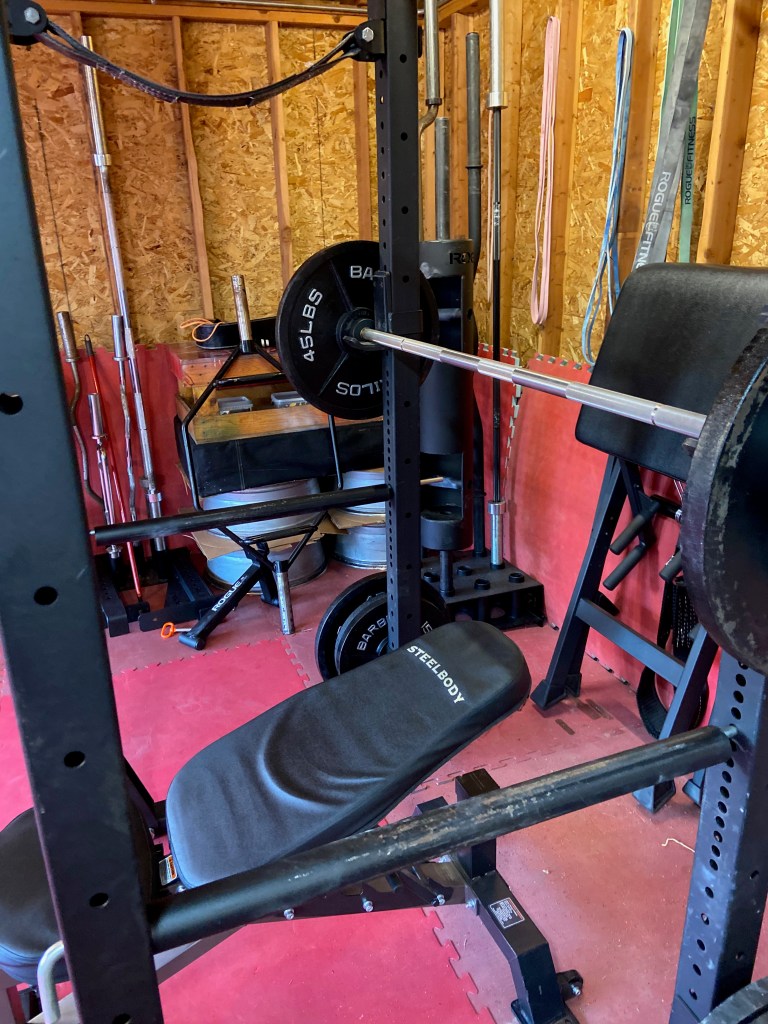
Putting bench press back into the program in summer of 2020 made me recognize some instincts and forced me re-think my process. My hand placement on the bar was quite narrow. I gripped the bar a full thumbs length from the inner bare steel part of the bar. I realized it was that way because that’s how I press dumbbells, which I did almost exclusively for almost 2 years. I prefer to hold dumbbells at about 45 degrees and press them so the weight part of the dumbbell hits my outer pectoral or just outside it. I like it that way to get more tricep focus on the lift because that muscle group is what finishes the lift. It’s that extra push right at the lockout. I was gripping the bar instinctively far too narrow to push the most weight I could. Forcing myself to use a wider grip just felt weird and I had less power. Generally speaking, the more narrow the grip the less power will come from the lats in the back and more will come from triceps. I had to break my instinct to grip the bar so narrowly. It has now widened now that my pinky now rests just inside the bare steel ring that separates the knurling on a power bar and it feels comfortable. It’s not as far out as I could have it but that would take more training on that to make me comfortable with it. Another thing about transitioning to the garage for almost all of my upper body work was how dependent I was on isolation machines and movements for chest training. I’ve already mentioned some of them: cable crossovers, other chest cable related movements, and pec deck flies. Going to the garage for training has pushed most of my lifts to compound movements, not isolated ones. Pete acquired a lat pulldown machine that allows me to lat pulldowns, cable rows, tricep pushdowns, and even belt squats if I could weigh down machine down enough. However, being that there’s only one cable makes cable movements for chest inefficient at best. I figured that out last year when in an effort to focus on inner chest I employed a single arm cable crossover for a few weeks before I found that a close grip press with the ez curl bar was far, far more effective. Eventually, I decided to make a heavy lift instead of one done for high reps and it was the much better choice. The fact that the ez curl bar he owns isn’t rackable meant that the spotter had to do multiple heavy pulls to get it to the person lifting, which isn’t ideal but that’s training. I have since purchased a rackable ez curl fat bar, which is basically an axel bent in the shape of an ez curl bar, for that kind of lift now. I use it for JM presses and tricep extensions primarily.
I have said before I watched and listened to more training and fitness content over the past two years and have drawn some ideas for training from them. For the purposes of this essay I will keep it to what I have learned from Youtube and podcasts about bench pressing and chest training. Prior to 2020, I had bench pressed a lot but never really focused on how I was doing it. I just never thought about it those terms. So when I heard about all the parts of the bench press being broken down in various ways, mostly by EliteFTS owner and former powerlifter Dave Tate and former powerlifter JM Blakely, I took it in kind of mindblown. The two biggest physical things I’ve learned was what my lats should be doing and feeling like during the lift and what my feet should be doing. Effectively I learned how I should be using my entire body to perform the bench press, and that I need to be training every part of it. Information I was learning is why I even thought of pin and band presses in the first place. As I watched more I heard the thought processes around things I was had already discovered through experience lifting. In many ways I felt validated in my approach. I know that might sound stupid but I also know that one who is serious about strength training is constantly thinking of ways to get more of it so it just builds confidence in oneself.
The biggest impact where I felt this new found information was in the programming of my training. One word I haven’t said a lot of yet is “incline.” This year is the most I have ever incline pressed. That is because it was a lift I was always weak at and wasn’t that interested in getting it stronger. I had incline press in the program for Pete and I in 2020 for a few weeks before pulling it from the plan. I pulled it because neither of us was getting much out of it. We were both pretty dead after flat bench press. That changed as a result of learning the value from a different view. That credit is largely due to 2 people: Greg Doucette, a champion bodybuilder and bodybuilding coach, and the above mentioned Tate. I started following Doucette’s channel last year and it’s full of good information. He did a video about what he thought the best chest exercises and his top was incline dumbbell press. He made a point to say how much incline was necessary and said that only 17 degrees of incline. For most adjustable benches that’s just the first hole up from flat. It made me think about putting back in play at that angle, and I did that when I returned to the gym at the start of 2021 because the weather was starting to become too cold to lift in the garage. I made it the main lift of my second chest day for those 3-4 months I was lifting primarily in the gym and has been a big supplemental lift since then. I’m an avid listener of Dave Tate’s Table Talk podcast. A few weeks ago he and Sam Brown were talking about training accessories and referenced a video he made years ago on the EliteFTS Youtube channel about the subject. I watched it and I implemented some of the ideas to programming in general. The concept of main lift-supplemental-accessory programming really struck me and the lift he talked about as a main on chest day was a chest a narrow grip incline press. My prior experience with incline press has always made me leery of it but I trusted the information and it’s turned out well. I use it as a supplemental lift, right after a heavy flat press variety from roughly 65-80% 1 rep max bench press. The narrow grip priorities the triceps over the lats.
From January to March of this year I was at Genesis full time doing everything. From April to May I was half in the gym and half in the garage. I used my old lifting program at the start of 2021 and added some lifts to it. Day 1 consisted of flat dumbbell press, cable crossovers, wide iso lateral jammer machine, and a seated chest press machine at the end to burn out. I did triceps and shoulders in the middle of them to break them up after crossovers. The other chest day was more incline based: Incline dumbbell press, crossovers, incline iso lateral jammer machine, and pec deck flies. All of these were done as heavy as I could get them to go. I changed up how I did the dumbbell presses in mid-March after I watched a Youtube video by Robert Oberst, an American Strongman and former NFL player, on his channel uploaded in mid-June 2020. In it, he outlined how upper body strength built by football players. By putting the heaviest sets of 2-4 reps first and volume to failure after to build strength and muscle. He did using incline press and bench press. I was doing neither of those at the time and I decided to apply it to dumbbells. I started with 100 pound dumbbells did sets of 5-6 reps to about 110 then from 115-125 3-4 reps. I would finish with sets at 90 then 85 to failure, which was normally 10-12 reps. The incline press version involved starting lower and finishing on the higher end lower. I noticed a difference immediately. The first few weeks went very well and could press the 120s 5 solid reps and the 125s 4 solid reps on flat press. I could feel it in the muscle as well. I did it for about 8 weeks. About the 6th week I started to notice my sets at 120 and 125 were limited to 2-3 or less. The plateau had arrived. It was an interesting experiment and I learned a lot from it and got stronger but perhaps took the premise a bit too far in the lack of recovery time. It was very heavy training. By then it was mid-May and time to move back into the garage.
I have written about my summer 2021 powerbuilding program before so I won’t go into ton of detail here about it. It was built around primarily successfully deadlift 405 pounds. One major goal also was to get my bench press back up to where it was at the end of 2020, which was 275 pounds. I didn’t realize that would be a goal until after I started bench pressing and having a lot of trouble with getting 245 pounds back up. I’ve been well aware of the past that dumbbells and bench press don’t translate all the way but the bench press struggling that much surprised me. It took me to week 8 of the 12-week program to successfully put back up 275. I did a normal bench press down to the chest on Mondays and a chain press on Thursdays. Mondays I supplemented with presses using the American cambered bar on all 4 handles and dumbbell pressed on a flat bench. Thursdays I supplemented with heavy tricep extensions or JM presses and incline dumbbell press. Both days involved doing accessory work in the 6-12 rep range on arms. Wednesday was the day I did shoulders. I many ways it could also be seen as an “event” day for strongman. I did a seated overhead press with the American cambered bar from 128 to 148 pounds for the most part, standing overhead press with a log up to about 141 pounds and viking press to almost 200 including chain weight. Shoulder strength definitely increased over the last 5 months. Perhaps they’ve seen the most growth over that time. I learned in 2020 that the best way to do military press, regardless of bar, was best done from a pinned position so I have been doing that ever since. After week 12 of the program I did a test week in late August and successfully bench pressed 285 pounds for 1 rep twice. I felt in the prior weeks more could be there because I was putting up multiple reps at 275. I tried and failed both 295 and 290 so I know my true 1 rep max was 285.
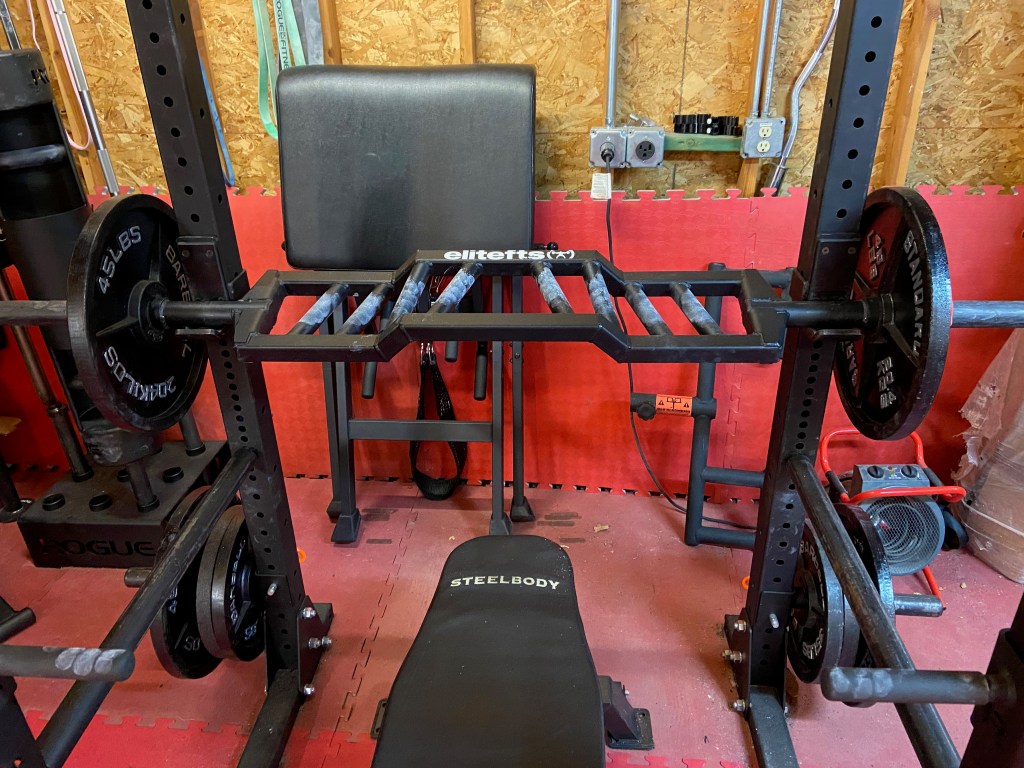
I began to immediately plan my next few months of lifting, and will be starting week 10 of it this week. I initially thought to go back to more hypertrophy as a body break from the intensity of what I had just done but I just like lifting heavy and pushing upward. Mentally, it’s more stimulating. I took a full week of rest off and began the new program, which all can follow via logs I post on Friday or Saturday so I will keep the following short. Mondays I started doing chain presses down to the chest for the main lift followed by narrow grip incline press, overhead press with the American press bar and flat dumbbell press. I have since replaced chain work with a two board press with the shoulder saver attachment. Wednesdays stayed the same but replaced a seated barbell press with a seated dumbbell overhead press. Thursday started out as mainly a volume day, as I was still thinking in terms of power building. I do two different cluster sets using the American cambered bar and incline dumbbell presses as a supplemental lift for chest. The biggest difference between the summer and fall programs is in the accessories. I started the program with the intent of building bigger arms but haven’t done much with curls and I have done lighter, limited work with triceps in isolation. I moved isolated lat work from back to chest centric days and don’t do a lot of it. Most of the lifts are large compound movements. I noticed immediately that the week and half of not lifting had put me behind making more progress by the end of the calendar year, not that means much but it’s a good line of demarcation. I could feel the lack of strength compared to just weeks before in every lift I did. It stayed that way till about week 4-5 and it’s been going up since. I’ve believed for awhile now that in order to keep building strength I have to do more lifts at the heavy end of the spectrum than the lighter end. That has held up over the last couple weeks. I’ve even felt that with the American press bar. I think getting to 300 pounds on a bench press to the chest is a bit aggressive to say but I think I can for sure raise my 1 rep max by the end of the year.
I’ve noticed some changes to my thought process and programing over the last couple years. Some have been conscious decisions and some have been some have been changes I’ve made within the flow of things. Note that these apply to just about every muscle group not just chest. The first is that I do less exercises than I did before. Prior to 2020, I used to do a lot more sets than I do now. That was largely due to my tendency to find more exercises to do and do them to about 4-5 sets. Around 2019 I really started to hone in on what I thought were the most valuable lifts and just did a lot of sets of those instead of doing a lot of different ones. Moving to lifting in the garage deserves credit for a shift towards powerlifting. The strategy has stayed the same in terms of number of exercises so my total number of sets is lower. The second is the focus on barbells over the last couple years. I love lifting with dumbbells but I have done a lot more with barbells recently. Lifting with them is just different, and if one is going to get better at lifting barbells it has to be done consistently. As a result, the 3 core powerlifting lifts (bench press, deadlift, squat) and overhead press have become the focus of strength building. Third, and this one is the most recent of the changes, is that I am doing less accessory work than I ever have. I started summer of 2020 very firmly in the powerbuilding camp, even though I didn’t know that term at the time. That is using powerlifting principles in correlation with bodybuilding principles to become both stronger and more muscular. What that means for lifting sessions is that they will take longer to complete because accessories are a bigger part of the program. Muscular development is just as valuable to powerbuilding as building strength is. Regardless of how many sets of accessories are done, that is time off the clock. I have never minded longer sessions but I have found myself valuing the 3 core lifts and bigger supplemental lifts than accessories so my programming has become far more powerlifting based over the months. Fourth, and last, I have done some thinking lately and came to conclusion that my programming for the last couple years, even going back to 2018-19 has been chest centric. Now which the shift to the garage, it’s bench press centric as a result of it, even as I lift very hard on legs and back. If I were to try to pin down a reason why is because I know bench press is the weakest of the 3 main lifts. I have made a lot of progress since 2018, about an 100 pound improvement, but to think of it in terms of time commitment is kind of mind-blowing. I have put a lot of hours into deadlift and squat training over the last year and seen a lot of progress there but it’s very different. I do far more chest exercises than leg and back lifts primarily because the latter two are physically more taxing.
I feel like I am making major progress in bench press and chest training. I might even be making more in that than I am any of my other lifts. I have noticed it both in strength and muscular development and look forward to putting more work in.
 Life Through Lifting