Bonus Review of Rogue Fitness SML-2 90’

Mark Brown
July 19, 2022
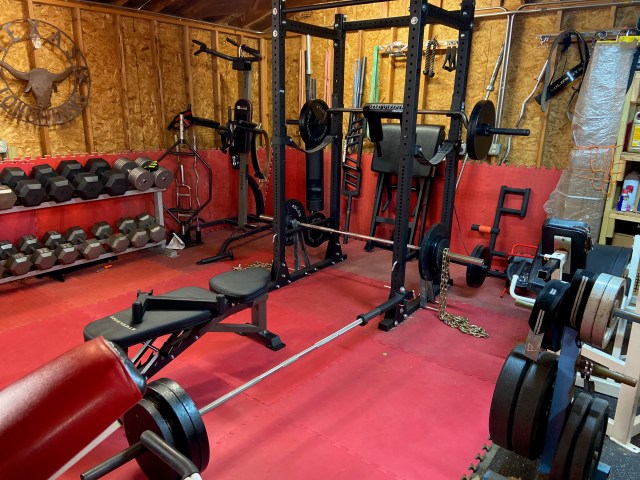
It’s about damned time I do this review. I have had my power rack in its current state since the middle of October 2020 so I have given it enough time to give a healthy review. It started out life as a squat rack, specifically the Rogue Fitness SML-2 90’, then got converted into the RML-390F (short for Rogue Monster Lite). The squat stand worked well for what I needed at the time of purchase in July of 2020. I will detail that information below. It was literally the first piece of gym equipment I bought. It was a major step towards my current collection of equipment. I never thought I’d have a home gym. It all started with the power rack.
The SML-2 came about because Pete had one of those all-in-one cage Frankenstein type racks. It worked well enough for the first couple months of lifting from March till May. We both noticed the effect racking the barbells did on it. I decided to get a sturdy rack that could be used for squatting and benching. We were doing leg days together at one of the Genesis we are both members of. I decided that squatting during the week would take some pressure off the leg routine on Saturday mornings because we both knew how busy it could get. It did the job admirably, especially after the spotter arms finally came back in stock. They had been out for a few months, like everything else. The big thing I remember about it is that the rack is quite light. Pete used a couple heavy bags to weight the back support down before I got some plate storage pins. I distinctly remember almost tipping it doing 225 pound banded pin pulls. That’s when I learned about counterbalancing a rack. Plates stayed on it at all times after that.
There were a few reasons to transition to a full blown power rack. The first was that plate storage was a pain the ass. The size of the spotter arms made it difficult to place the storage pins and vice versa on it. I needed a rack that could store plates permanently without moving them every damn time. The second is that that I was moving into a phase of lifting where I needed more safety from my rack. The spotter arms work well, but to have safety pins and be fully inside the power rack structure is much safer. The third is that are vastly more options for the full rack than the squat rack, most notably the safety straps. The squat rack was a good piece of equipment to start with and a worthwhile investment given the budget and need.
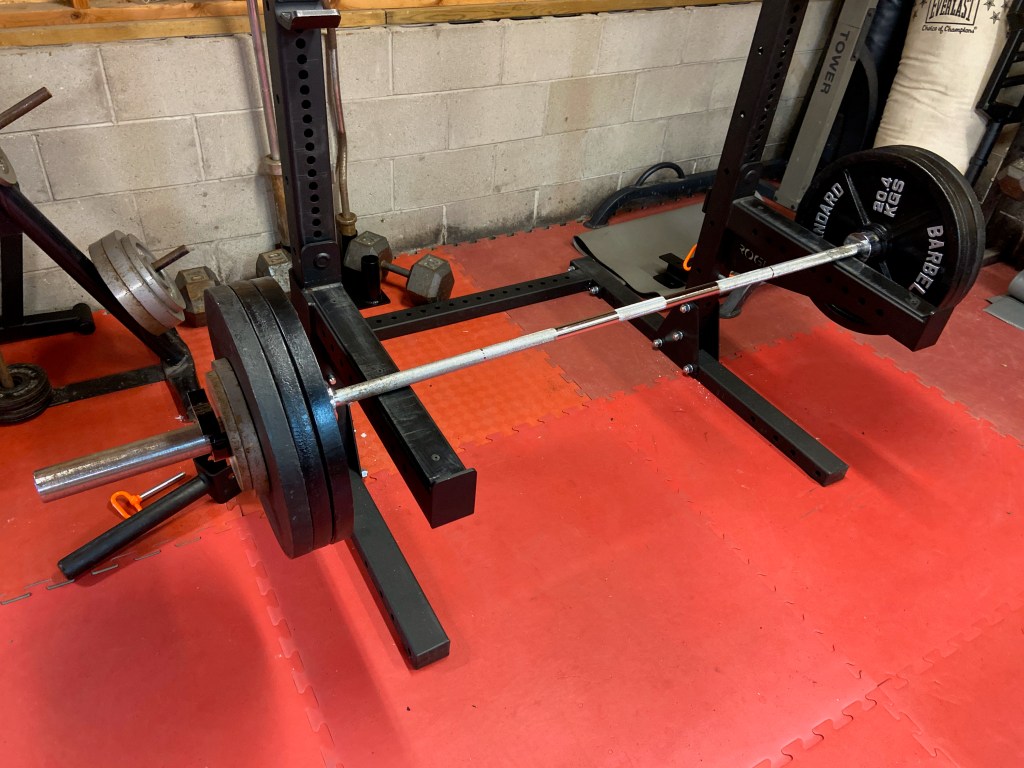
I briefly thought bout upgrading to a half rack, but ultimately the transition to a full rack was the best choice. The end result was the RML-390F. It is the only one that Rogue makes that is flat footed. A vast number of their power racks have feet with the lower horizontal support beam about 3 inches from the ground. The difference between the flat footed and regular footed more effects bands because there’s an extra space for them to wrap around. The flat footed nature of the RML-390F means bands can only be used in correlation with pegs that push through holes located in the support beams. They can be a pain to get the bands on to them as a result of them being so close to the floor but it’s ultimately not that annoying.
The main thing the power rack gives me is the ability to do a wide variety of lifts safely at max effort and intensity solo. It does that through being a well constructed rack that has a lot of attachable extras. It’d be very easy to go nuts and get a lot of them. I got the spotter arms, safety straps, handles, and a land mine in addition to the safety pins that came with the converter kit. Max intensity and max effort squats and bench presses are made safe by heavy duty J cups, safety pins and safety straps. The pins allow for partial range of motion movements on presses or squats that are designed to concentrate effort on the concentric part of the lift. The pins allow for pulls that take the quads almost entirely out of the lift to emphasize the back, glutes, hips and hamstrings
The holes for the band pegs are in the middle of the rack and at the end. The band peg holes on the end are almost exclusively for banded deadlift work, which I have only recently started adding to the program. The band peg holes in the middle are for banded bench press, squat or pin pulls. Bands are really helpful, especially when training lockouts. For band work on the vertical supports there are holes all the way up them for the other attachments. One thing to remember about using bands in a rack is that enough counterweight is needed on the other side of the rack to not tip the rack so that the banded pin pull I referred to earlier doesn’t happen.

Another thing to note is the 3×3” vertical supports are very strong and can take a serious beating. The structure itself will move with hard racking of weights. It doesn’t move a lot but it might need to be moved back into place at some point. That could be because I during most bench or squat sessions I only have 140 pounds of weight on the plate storage pins. There’s no real way to bolt the the floor if that is what someone wants to do. The 3×3” vertical supports make racking weights a precision task when dealing with specialized bars. Most standard Olympic, Power or Combo bars clear the outside of the frame by half an inch to an inch. Specialized bars are much closer and can really require precision when racking without hitting the frame. Racking the weight with my EliteFTS American Cambered Bar and Fat Grip EZ Zig Zag bar, aka “wavy bar” on my training logs, is made harder because the plate sleeve on those bars starts so close to the outside edge of the vertical supports. There are ways around this but they are not great pairs with this rack as constructed.
This rack best performs with standard length barbells in general. Some specialized barbells it just won’t work with at all. The Rogue Fitness Cambered Bar I own doesn’t really work inside the power rack itself because the bar’s design doesn’t allow for the safety pins in while doing full reps either free or with a box. That goes for both squats and bench press lifts so I perform both of those lifts outside the safety of the power rack. Once again, there are ways to help those lifts be safe as possible but not as the rack is both constructed. I would have to get a Monster series rack to make the Cambered Bar work inside of a rack.
I can see myself with this rack for a long time. I can also see myself going for a Monster series rack with more plate storage options just as easily. The RML-390 is a good rack that will serve a lifter well, like it has me. They are easy to add more supports onto to make a series of cages. If someone out there is looking for a Monster Lite series rack, then one of the footed racks is probably a better option. However, if they have a SML-2 already, the conversion kit to the RML-390 is a very good way to go. I have probably $1,600 +/- $100 total invested in the RML-390 I use in the garage. There are definitely add-ons that I am tempted by. Rogue Fitness is good as what they do. A good power rack is a major investment. Expect to put in at least $1,000.
 Life Through Lifting