
Mark Brown

July 26, 2022
Cooking brisket was one of my main introductions into barbecue. Learning how to prepare and cook it well has helped me learn multiple kitchen skills I wouldn’t have learned otherwise. All of those skills can be applied to other meats. This has been done many times over. That knowledge is important to me because I know I can reach back into the archives, so to speak, and produce what I did 7 years ago. Learning brisket has been a major touchstone in my cooking life. I wish to pass along some of what I have learned.
This story starts around 2010. I had heard it was the hardest to learn so I went after it. It can be an intimidating piece of meat to cook because it is a big investment and would be feel like such a kick in the gut if it didn’t turn out well. When I started smoking them in 2010, they cost $2.19 to $2.49 per pound for USDA Prime whole briskets at Costco. A guy I worked with who smoked a lot of me barely believed me when I told him that. The “whole” is important because a brisket has different muscle groups in it. The flat is the vast majority of it, is leaner, is a bit drier and has a grain that runs along the length of it. That last part is extremely important when it comes cutting time. A beautifully cooked brisket can ruined if not cut correctly. Cutting against the grain in 1/4” slices pretty dang perfect. The point sits above the flat, is fattier and its grain runs perpendicular to the flat. All told, those muscle groups produce a cut of meat that can be hard to nail perfectly without experience. That is part of the reason why the point cut is cut off the brisket and put back into the smoker to cook more to make Burnt Ends at restaurants.
When it comes to seasoning a brisket, a cook has to be fairly aggressive because beef’s flavor profile on its own is much more in one’s face than pork or chicken. A brisket has a serious fat cap covering the flat in addition to the intramuscular fat. That cap is used by the cook to keep the lean flat from drying out in the cooking process, which is absurdly easy to do. Keeping it moist all the way through to service is a lot of what makes it the challenge that it is. Most of the cuts of beef available in grocery stores, in general, are most tender when cooked to medium rare. That means about 130-140 degrees internal temperature. Brisket gets cooked all the way to at least 185-190. I pull them from the oven or smoker at 177 degrees because I know the internal temperature will keep raising for quite awhile. A piece of meat that size doesn’t cool down fast. That must be accounted for. The meat in a brisket when done is dry, but the fat cap helps it “feel” like it’s moist. Pork shoulders produce the same effect. Sauces are employed to make the meat feel moist in the mouth. The fat plays a role in the way seasoning is done on the roast itself. It produces that “heavy” signature flavor one associates with beef. I have seen many rubs for brisket that include the entire spice shelf, but I use just freshly ground tellicherry black peppercorns and kosher salt. That may sound simple but it’s all the brisket needs. People underestimate how powerful black pepper is because grocery stores don’t carry high quality black peppercorns or pre-ground black pepper. It is a powerhouse spice when freshly ground that can be very, very dominant in a dish. It’s necessary to cut through the fat of brisket. Salt is used to bring out the essence of what is being cooked. Don’t be shy with it it here. A brisket will need a lot of it. How much? I’ve never measured but it’s always more than I think. If a cook under salts a brisket, the flavor will be flat and somewhat muted.
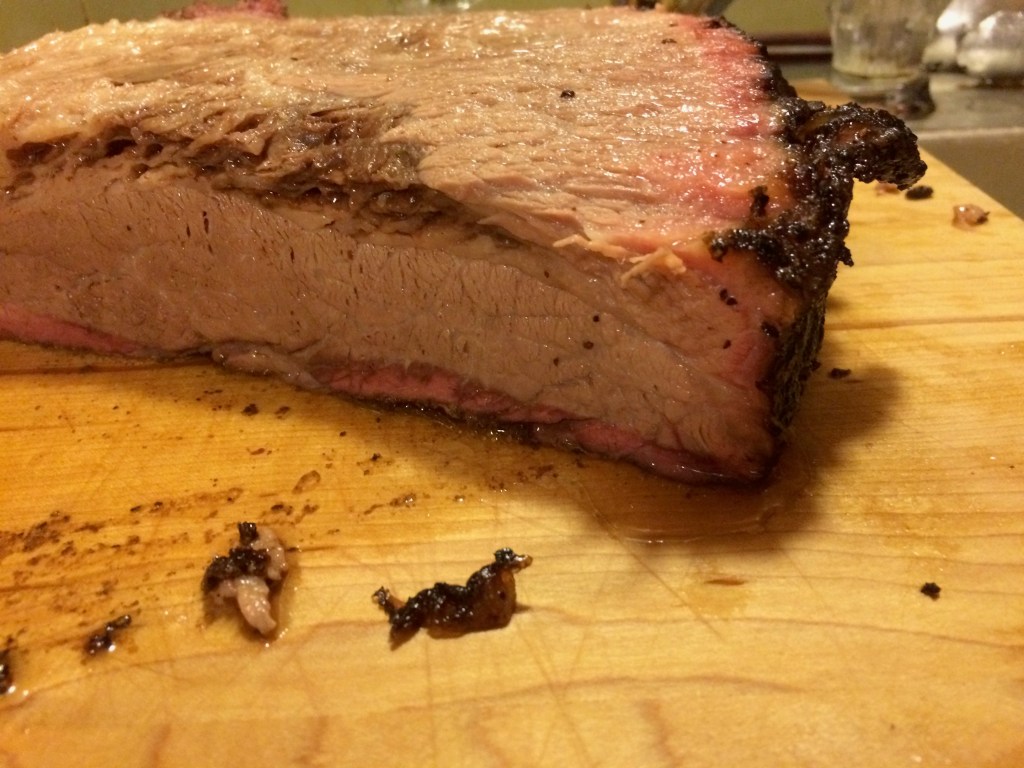
I have cooked brisket using 3 different cooking methods and enjoyed all of them. At least half of the briskets I have cooked in my life were just smoked. My heat of choice is a hardwood chunk charcoal because it is consistent in temperature and burns completely to ash. I prefer to smoke with cherry wood chunks. Chips will do fine but chunks last longer, especially when soaked. I don’t soak them all the time. Unsoaked wood chunks and chips produce a different smoke when used. The easiest way to put it is that soaked wood produces a “softer” smoke than unsoaked wood. It’s fascinating what different processes bring out in the same organic material. It does take 10-12 hours to get done, especially for briskets in excess of 15 pounds, when cooked below 250 degrees. That has been an impediment to making them often since I moved into my house in July of 2016. That is a long time to maintain a fire. Automated feeder smokers have become more popular over the last couple years for that very reason. I consider it cheating, but that’s my pride of learning how to maintain a low fire for long periods of time well coming through. I typically pull the brisket from the smoker after 8 or so hours and finish in the oven because it just needs to finish cooking at that point.The smoke fills the air so be ready for it. Starting the cooking process from fridge cold will just add time that isn’t necessary.
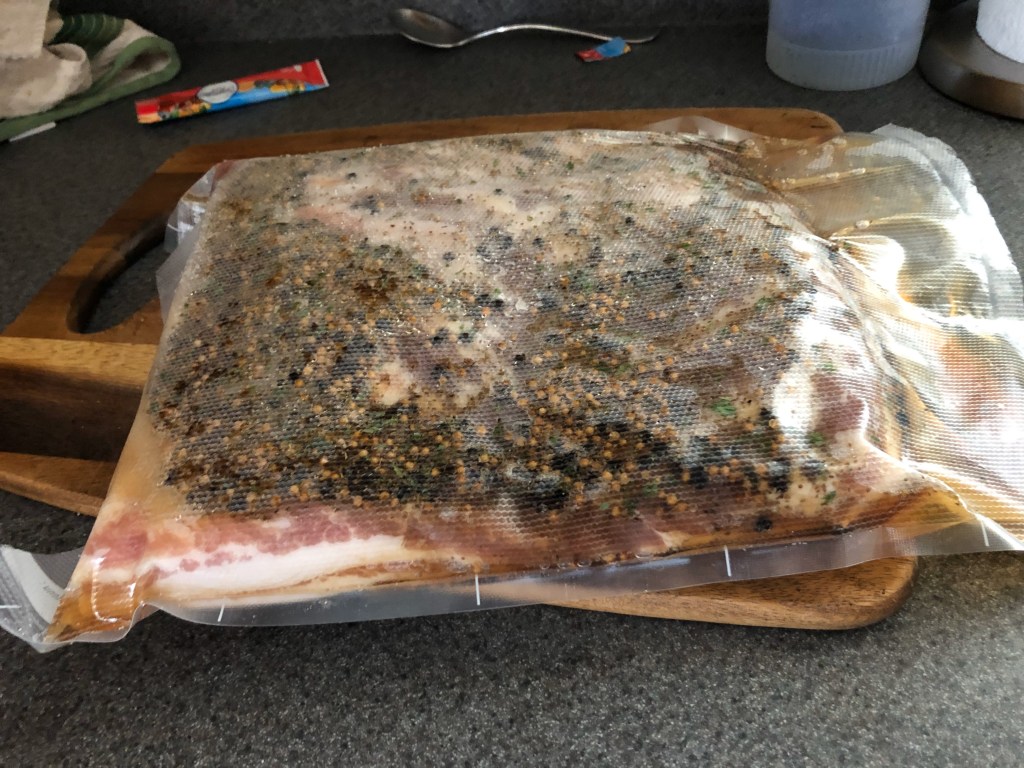
The second method I have employed is to cure the brisket using a a corning spice mix. I This is my favorite way to eat brisket. It also requires a bit more learning and experimentation to do. I have seen cooks on television shows get the process of curing meat done with a brine. A dry cure will work just as effectively as a brine. It is the same thing minus the water, after all. The issue with a brine for a piece of meat as big as a brisket is the space the container would take up in a fridge to do it. Restaurants have coolers so such large containers and regular houses don’t. The way I get around the space problem is to use sealed bags to put the brisket into, put the salt and corning spice on it after working the meat into the bag (which is absurdly hard to do) and then seal the back up with a vacuum sealer machine. There’s a couple different reasons for this that goes beyond saving space. First, removing the air from the bag will help the salt and spices get into the meat.The salt allows the spices to become a more prominent flavor come eating time. Second, the sealed bag makes it more convenient for the cook to use it when enough time is had to cook the meat. There is a point of diminished returns but it’s not for quite a few weeks. More brine builds in the bag with each passing day the meat is in the sealed bag. It will make the meat saltier as a consequence. That’s why there are diminished returns on the end product. Salt is easy to put into food but hard to pull out.
There are two primary ways to cook the brisket after the cure has been completed. If it cooked in either water or braised, which is a way to roast with both moist and dry heat, the end product is called Corned Beef. Crazy, I know. I’ve only made this a couple of times. It has come out exceedingly good every time. The corning spice adds a layer of flavor that beef itself doesn’t have. When a corned beef is smoked, it is called Pastrami. This is where the money is at for me. The curing process allows me to experiment with flavors in ways others can’t. Making pastrami hits both cooking interests. Corning the brisket does allow the meat cook in less time. It doesn’t known down the cooking time a lot, but it is noticeable. The reason for the time difference is that water has been pulled out of the meat by the salt in the brine so it goes on the smoker at less than package weight. The difference between a 16.5 pound brisket and a 13 pound brisket is more than it sounds like it is. Cherry remains my smoking wood of choice because I like the flavor and the smoke ring is so, so pronounced. I have experimented with various time tables on curing briskets. I typically corn them for weeks at a time. The cure that tasted the best was on the meat for 5 weeks inside the bag. Is that length of time patently absurd? Yes, but it was easily the best food item I have ever made. It was the exact right level of salty with flavors that evolved for a couple of minutes after eating a small piece. I put a lot of money into it. All told, it probably cost me about $85 to do it. Part of what was amusing about it was that I started with a 16.9 pound brisket and ended up with only 9.6 pounds of finished product. The weight loss comes from a drop in water weight. Water’s main role in cooking is to dilute whatever seasonings or flavorings evenly. Removing it intensifies flavor. Removing 43.4% percentage of the water amped up all of the other flavors by that much. When I experimented with a 7 week cure, I found the final product was too salty to continue eating. It was an expensive failure. The lesson is that the curing process for a brisket experiences diminished returns between 36 days and 49 days. I’ve never forgotten that.
I would be remiss if I didn’t talk more about the flavoring agents. My corning spice isn’t much different from a commercially available one. Mine doesn’t tend to include the Juniper Berries that are typically in them but has most of the rest. Using fresh, whole spices is key for the success of any curing process. They will bring the most flavor to the end product. Most corning recipes will use a “pink” curing salt to give a pink color to the final product. It is there to help make the meat pink through the use of nitrates and nitrites in the salt. Celery Seed produces nitrates that help with the same thing so it is always in my spice blend. My choice of salt is just regular pickling salt because I don’t care about the pink color. Pickling salt is an extremely salty salt. That sounds really stupid to say, but different salts have different saline levels. I’d have to use triple the salt or more for the cure if I used my normal kosher salt. Pickling salt is just that potent and minuscule in size, comparatively speaking. When moving to the smoking process, the corning mix has to be washed off the brisket. That also gets rid of the salt on the outside layer of the meat, which is extremely important for not making it too salty. After the surface has been dried off, I apply a seemingly aggressive amount of freshly ground black pepper like I would a non-corned brisket. Remember to not put any more salt on it. That final layer of pepper is the final layer of flavor that makes pastrami the king of deli meats. There are about 5 layers of flavor going on in a single bite of pastrami. It’s kind of in this order: Beef, fat, cure, smoke, pepper.
The last way I’ve cooked brisket is by cooking it directly in water. I was inspired by a dish I saw on Diners, Drive-Ins and Dives. It was a Mexican pulled beef. I learned some things about brisket I didn’t know when doing that recipe. The use of water as a cooking method drastically cuts down the cooking time down to just a few hours. It creates a beef broth at the same time that can be used as the base of a sauce. I used dried chile peppers to spice up the broth. The most interesting thing I learned from this dish was the way the brisket shredded the way a pot roast would. The difference is that the brisket shreds were close to 3 or 4 times the length of a chuck roast. That has given me ideas on what I can do with that lesson but I’ve never followed up on it. That pulled beef was probably 5 or so years ago now. It’s definitely worth doing again.
The primary thing that keeps me away from brisket these days is cost. I stated earlier what the cost was per pound back around 2010-13. I don’t know how the price has changed at Costco since I haven’t been a member there for years now, but I’m sure it would have had to rise since then. I don’t think a singular cut of meat would be the exception to the rising tide of prices. Brisket has always been more expensive at grocery stores than at bulk stores. I have to think some of it comes from the fact that it is less in demand than steaks, ground beef and other roasts. Brisket flats are more expensive per pound than briskets with the point still on because butchering was done to take it off to package just the flat. I never bought any brisket under 15 pounds under the premise that there’s better chances of more lean on bigger briskets. That’s especially necessary when curing it. I remember briskets of that size costing me somewhere around $40-45. I see them regularly in the $75-85 range now. That’s a large price gap in 10 years. Some of that is bulk pricing and some of it inflation. It would be hard for me to nail the exact ratio in the cause there since I’m not really in the game anymore.
Brisket is worth learning how to cook because it feeds a lot of people at once or a few people for a long time. It just takes a bit of practice to really get the hang of. The price can be a bit prohibitive, but part of growth in the area of cooking is experimenting and seeing what works and doesn’t. I remember both the 5 week and 7 week cured pastrami because they were both very instructive. I hope this entry has been helpful in understanding what can be done with what can be a daunting piece of meat.
 Life Through Lifting