
Mark Brown
July 28, 2022
A powerlifting belt shouldn’t be at the top of the list of equipment to get for any lifter for awhile. There is no reason to prioritize a belt unless a lifter is that bad off before they step into a gym. A powerlifting belt will not save anyone from an injury received from a poorly executed lift. What it will do is help limit what damage could have been done otherwise. I know this from experience very well. That just one of the things I will be discussing in this episode of “Not Just an Equipment Review.” I will get into what a lifting belt does, why they are important and give a review of my lifting belt.
A lifting belt really only has one purpose: To support the lifter’s core externally during lifts. This is an extremely important concept for any lifter to understand because it should prevent a slip in either mental or physical processes. The belt, no matter how thick or well placed, will not prevent an injury brought on by bad technique or screwing around. I nearly injured my back badly in 2020 when deadlifting with the belt I currently own. It happened at 315 pounds when my max was around 325. I believe it happened because I tried and successfully did reps at 295 without the belt. That caused my back to be ready to seize up when I went up to 315 pounds. I remember doing 3 solid reps then feeling the pop and seize up just before the lock out on the 4th rep. I immediately dropped the bar. I wondered if I had the belt positioned correctly at the time, but I have determined it wasn’t the issue after looking back on it numerous times over the last 2 years. The belt probably helped save my back from a potentially catastrophic injury, but didn’t prevent what happened. I cannot emphasize that enough. I will probably repeat that multiple times in this entry.
There are a couple different types of lifting belts: Soft belts and hard belts. Soft belts are made of a firm fabric that usually get latched together with velcro. That velcro is the bane of every lifter’s existence. It is necessary but the vast majority of velcro in the world is terrible in terms of quality. It will break down at some point. These soft belts can vary in size depending on who makes them. Evolution Athletic’s Support belt, a soft belt, supports the entire core for example. I have had soft belts that were barely wider than a leather powerlifting belt. Hard belts are typically 4 inches wide and made out of a harder material and wrapped in leather. That fact also leads them to be also known as leather belts. The thickness of hard belts will effect a lifter’s leverage position when doing lifts, especially deadlifts, so there is a bigger learning curve than it sounds like there is. They generally come with different ways to fasten them: Single or double prong and lever. I have never used the latter so I will leave that discussion to someone who has. The belt should be worn at about belly button level, which is the true waist on us humans. Lower than that and the core and lower back won’t be supported. Any higher and it will effect a lifter’s ability to breath the way they need to because the belt will be pressing into the bottom half of the lungs. Learning exactly wear the belt needs to be on a lifter’s body is a matter of understanding basic anatomy and experience wearing it.
The reason why a belt should never be the highest piece of wearable equipment on a new lifter’s priority list is because they shouldn’t be lifting weights that require them. There is no reason to push that hard that fast in the introductory phase. Belts should only come into play during a lifting session when the work that needs to be done for the day cannot be done without it. This can change as beginning lifters become intermediate level lifters. Strengthening the core is one of the highest priorities a lifter has in their program. This is done through mastering breathing and how to to brace for the load. Working without a belt forces the lifter to do this without any external aid. This keeps weights down on lifts and emphasizes technique. The belt can tempt lifters to push weights that are beyond their ability and strength if they don’t remember it will not save them from an injury. Lifting belts are used mostly during complex movements like the squat, deadlift, bench press, and overhead press if talking strictly powerlifting. Strongman, as a sport, puts lifters in all sorts of positions so belts could be necessary for just about every lift that is done. Every lifting session is different and my use of a belt changes with how my body feels on that particular day. I can confidently deadlift from the floor or 3 inches off the floor up to 365 pounds without a belt. Above that may or may not require my powerlifting belt.
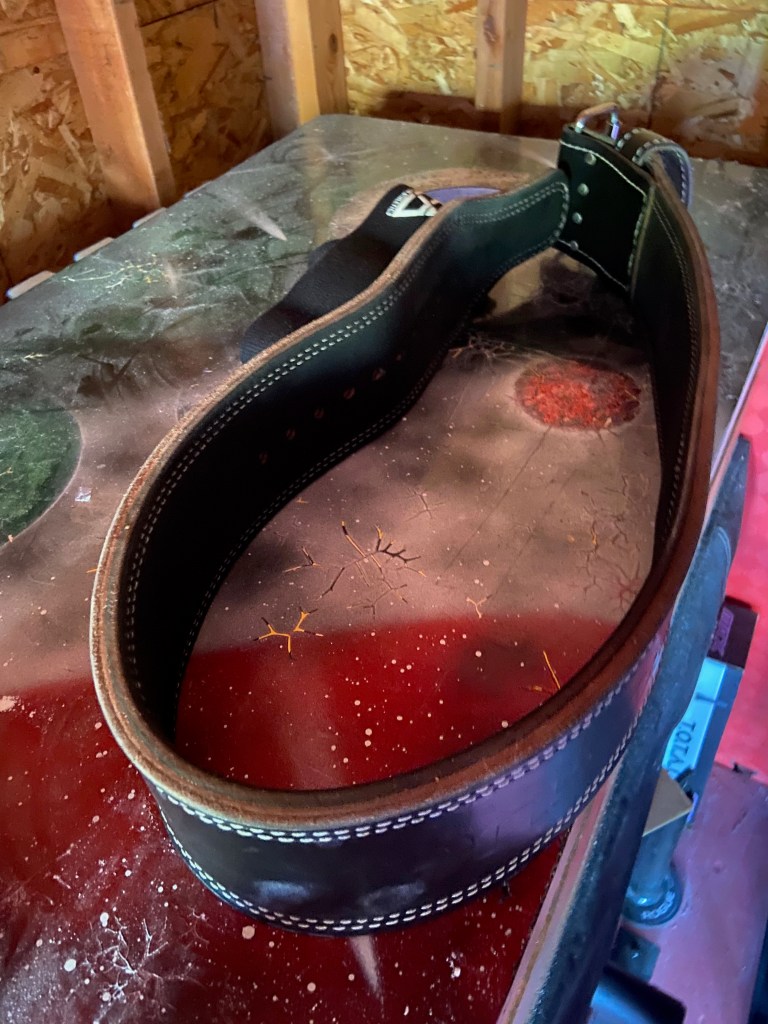
This leads to the review part of this entry. I ordered the Rogue Fitness 13mm Powerlifting Belt in July 2020. I did because I needed one to replace my previous hard belt that no longer fit. I hadn’t squatted in a year and half or so at that point so I needed a belt to squat 275 pounds or above. Rogue sells powerlifting belts at a variety of thicknesses. The one I bought is the thickest they sell. I believed it would give me the external support I was looking for. Its learning curve is inline with other hard belts I have used. Getting into position to deadlift was difficult at first. That was through the combination of it not being broken in and my leverage position being poor due to waist size. It took a couple months to break in. It’s very flexible now, but it started out about a stiff as a door. It does a very good job supporting my core during lifts I need it and has aided in protecting from further damage when I needed that. Getting into position when deadlifting from the floor with the belt on is still a small challenge. It was a good investment. I can see myself using it for a long time. It cost $123 but it has been well worth the money spent on it. The belt also tells me about changes in weight and other body changes I need to be aware of.
A lifting belt is a necessary piece of equipment for experienced lifters who want or need to push the boundaries of their possibilities. They will not save a lifter with sloppy technique or one who lifts too heavy from an injury. It can limit the damage done in that case, at best. Learning how to wear the belt when lifting will help increase the bodies ability to lift without one and help understand how to breath and brace properly. Strength training is about making the body able to function without external aid at its core. A lifter can get by without ever using a lifting belt.
 Life Through Lifting