More Lessons Experienced Over the Last 2 Years

Mark Brown
January 19, 2023
Lesson 3: Take inventory of the resources that can be thrown at the project before buying anything.
The word budget tends to call money to the mind, but it applies to everything that can be called a limited resource. It will determine almost everything that goes into the planned home gym and what kind of lifting gets done in that space. Money and space are the two limited resources that will probably be most on the mind of the person developing a home gym. They are the 2 biggest and most important limiting factors when it comes to equipment. There are a few specific lessons I have learned in helping put together the garage gym I do my lifting in regarding resource management.
First, the amount of space one has and what kind of space it is will determine what kind of equipment can fit in it. Larger and taller spaces will allow for more equipment to be put in it. The latter can be just as important as the former. A lot of power and squat racks are 90” inches in height and they are a challenge to put inside a house with typical room dimensions. Garage spaces are ideal for them. It just depends on if someone doesn’t mind parking outside for the entirety of the year or not. Many makers and sellers of high quality dedicated bench press and combo racks offer variations of them that include spotter arms, which makes them safer all around. Those will fit just about anywhere.
Floors are just as important as ceiling heights. Someone designing a home gym has to take into account if the floor will be table to take the strain from both the live weight and dead weight of a potential home gym set up. Dropping loaded barbells and dumbbells is largely the safest way to deal with loads that are too heavy, failed lifts or weightlifting. Proper lifting platforms are heavy duty pieces of equipment that are designed to survive weight dropped from at least 5 feet. I’d like to think the floors in homes could do the same but I’m not sure I’d like to find out in mine. Concrete with padding of some kind is as close to most home gym owners will get to having a proper lifting platform. Don’t assume concrete will hold though. It is one of those materials that can be brittle if not mixed properly. The floor of the commercial gym I have a membership at has had repeated damage over the last few years to the floor 4-5 feet in front of rack with the heaviest dumbbells. It’s not a coincidence.
Narrow rooms make for spaces best used for cardio work, bodyweight exercises and function strength work. Barbell work requires quite a bit of space to pull off comfortably. This situation is like when people put pool tables into rooms that are a bit too small. It’s definitely possible to get good at playing pool in that room, but it’s more of a case adapting to the environment than anything else. Yes, a lot of people have put power racks in small-ish rooms and made it work but it takes a high amount of organization to make everything needed for it to fit or not caring about anything else in it. Just make it easy.
Monetary limitations are probably a bigger impediment than space for a lot of people. Space is a bit a more adaptable than a lack of monetary resources. Working around limited space is easier to do when money doesn’t become a brick wall because the market for small space lifting equipment has exploded over the last couple years. It has been especially done so for people who are best described as “gen pop” lifters. That is short for “general population,” a distinction used for lifters whose primary goal is better health. That tends to mean a bigger emphasis on what Samuel Brown, formerly of the EliteFTS TableTalk podcast, called “looking better naked.” I have seen numerous companies come out with lifting products that are best described as computers with cable attachments. They offer subscription services like Peloton does. They are really expensive pieces of equipment but they do offer an alternative for someone with the money and a lack of space. There’s also never been more gadget type lifting devices or apparatuses that mimic traditional barbell work using resistance bands on the market than now. Once again, not my cup of tea but better than nothing. All of this works very well in small and/or narrow rooms.
When the space budget isn’t a big issue and a lifting plan has been established, money will be the deciding factor of what makes its way to the home gym. If someone is building a home gym in the vein of a commercial gym, they will be targeting barbells and standard 2 inch plates along with a lat pulldown machine and maybe some more specific equipment. Gym equipment is expensive. Don’t let anyone say otherwise. There are companies out there that sell standard straight barbells for lower prices, but it’s still a heavy up front investment for anything. It is especially so when shipping gets calculated into the overall price. Barbells come in varieties of finishes. They tend to bring the price of the bars up regardless of seller. Bare steel bars are cheaper but are more maintenance for the home gym owner. A good power bar will cost somewhere between $300 and $400 before the shipping cost comes into play. Specialty bars are often more expensive than that. The secondary market can be useful to find equipment but that’s far from guaranteed. Some local markets can be quite dry, especially in seller’s markets.
Lesson 4: Start with the basics before filling out the gym with accessories!
Social media is very good at promoting all kinds of gym equipment. It’s enough to to make someone go down a rabbit hole that just ends up creating a room full of stuff that never gets used after the initial phase of gym building. Some of it is gimmicky pieces of plastic that serve very, very isolated purposes. Some are alternative pieces of equipment designed to mimic the effect of isolation based machines that are the staples of commercial gyms. Still others are alternatives to very standard traditional gym equipment. They are meant to deliver a different yet similar effect for the lifter. It’s really easy to look at all of these alternatives to straight bars, benches, racks, dumbbells etc with a level of excitement but that feeling needs to be restrained in the beginning.
Straight barbells, regardless of being the power or olympic variety, are the primary means to push, squat or pull a load for lifters. They have been for a very long time. The only established strength sport that doesn’t really employ them is Strongman. That is a very large reason why it is growing in many strength athlete circles. The sheer amount of equipment possible to be used at a Strongman competition is limited merely by resources and imagination. Straight barbells are still used in Strongman training, but I haven’t seen a lot of standard straight barbells as events at competitions.
Not all straight bars are made for the same thing so choose wisely. Power bars have more aggressive knurling than olympic bars. The former are meant to be held very firmly in place. That’s why the grip pattern on the barbell digs in a bit more into the hands. Bench press and deadlifts are 2 lifts that really benefit from a hard grip on the barbell. The middle knurling helps anchor the bar to the body on a squat. Everything in a power bar is designed to keep the bar in place in the hands during a lift. Olympic bars feature less knurling because the primary lifts done with them (snatch, clean and jerk, half jerk) requires some movement of the bar in the hands. Aggressive knurling wouldn’t aid those lifts and would damage the palms in both the short and long terms. Combo bars are good for both styles of lifting and will help save hands in the long run. I’ve felt my hands remind me to start looking for either an olympic or combo bar many times after length pressing sessions. Aggressive knurling is no joke.
Bars don’t last forever. The bushings on the inside of the sleeves and knurling will wear out over time. Old power bars still remain useful as pressing and pulling bars, especially when using pins as aids. Metal pins can be quite damaging to bars. especially the knurling. Pete has had one forever. My first year lifting in his garage, 2020, one of the ends became loose when deadlifting. We got it put back on but I knew I would have to get a straight bar of my own at some point to ensure we had one should it fall apart and not come back together. Finding anyone with a stock of bars when I began looking for one in the fall of 2020 was very difficult. The bars started coming back in the fall of that year. It was definitely worth waiting to get the one I did end up buying, a stainless steel Ohio Power Bar from Rogue Fitness.
Lift specific straight bars are available but hardly necessary for beginners or even intermediate lifters. Squat, bench press and deadlift bar variants have been around a long time and feature differences that make them more useful to the specific lift they are designed to do. Deadlift bars have more whip than either bench press or squat bars because they are designed to help the lifter break the floor when pulling. It accomplishes this by releasing the plates added to the sleeves gradually instead of all of them at once. “Gradually” here means less than a second but that can be the difference between a good pull or a no rep. Also, the effect of the high whip won’t really be felt until someone is pulling a bar with 3 full plates on it. In my experience, 2 full plates come off the floor at the same time so a deadlift bar isn’t going to helpful until they can deadlift 315 pounds. They also lack middle knurling because the only reason to have it on a bar is so that is can be back squatted with. Squat and bench press bars are designed to resist as much deformation as possible because they are made with super heavy loads in mind, so they have very low whip. Only lifters training for competitions really need to even think about them. It definitely falls into the specialty bar category.
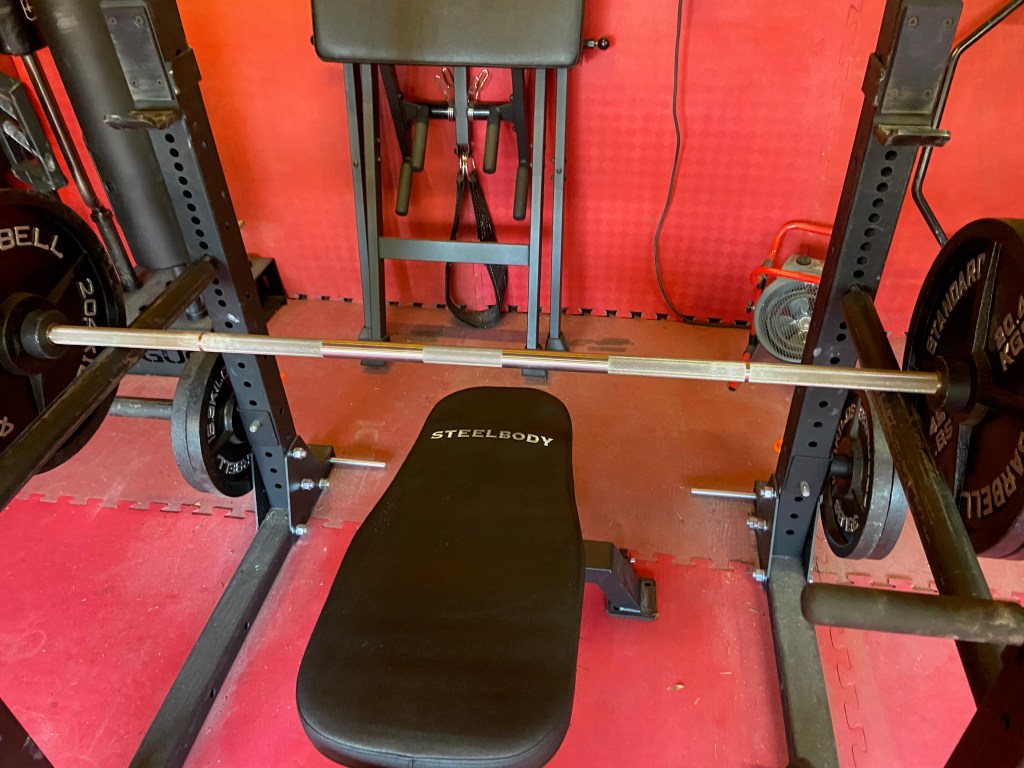
Having lifted only in a commercial gym and not really watching any fitness media on Youtube, I had no experience with power racks prior to 2020. The commercial gym I am a member of, Genesis Health Clubs, has lift specific racks at the location I primarily use. When it came time to look for a better solution to a rack that could pull triple duty for pulls, squats and bench press, I didn’t really know what I was looking for. Budget was also something I had to really think about. The initial squat rack I got from Rogue sufficed for a couple of months before I found I needed a bit more safety for the lifting I was doing. I converted the squat rack to a full on power rack and have never looked back. After having one for 2+ years, I don’t understand why commercial gyms don’t invest in power racks. They are incredibly versatile and provide a lot more safety than traditional bench press and squat racks. If someone is going to start a home gym, a power rack should be at the top of the list. It doesn’t need to be super premium or come with a lot of attachments and such. It just needs to be sturdy enough for the lifting being done in it. It will also likely be the most expensive singular piece of equipment in the gym unless machines are also on the plans.
The singular hardest piece of equipment to find outside of bars in 2020 was a good bench. When a lifter has a power rack, a bench that is independent of it is necessary. That kind of goes without saying. There are a lot of options out there, especially for those who shop on Amazon, and they aren’t particularly clear on how they will do when gotten. All benches have a maximum total weight it can handle but the dimensions of the bench can have a heavy influence on how a lift can be done. This is where my previous gym experience really helped when trying to aid Pete when he was looking. In my experience, Amazon and bigger online stores will have more of a variety brands to choose from but that choicer has a cost. Buying from Rogue Fitness, EliteFTS or one of the one premium brands will result in a bigger hit to the budget but their equipment is designed for frequent, heavy loads because they outfit public or commercial gyms and athletic facilities for universities and professional sports teams.
The first bench Pete got for the garage in 2020 was interesting. I didn’t know that there were higher, narrower independent benches out there. I’d only really experienced lower, broader benches prior to it. It was rated for about 600 pounds and both me and Pete were flirting with it so a new option had to be considered. Adjustable benches make the most sense to get for a home gym because it allows for greater variety of lifts can be done with 1 singular piece of equipment. The tradeoff is that that they tend to be more expensive than flat benches and the mechanism that is responsible for keeping the inclined bench in position may be less than great. An adjustable bench will only deliver more bang for the buck if it’s worthwhile using in the flat position. Most of my pressing I work is done in that position so it has to hold up there. It sounds a bit too obvious to point out but I have experienced using quite a few adjustable benches where the hinge on them were not in the right spot or awkward placed. Is it worth having both a flat and adjustable bench? I think so, but the latter is more important if can only afford one.
Plates being necessary goes without saying but the sheer variety of them does deserve a discussion. Iron plates are a great place to start. They generally are nice and round, which is helpful for deadlifting. They also get very cold in winter so be aware of that if training in cold weather. Cold steel saps dexterity in your fingers and causes major freezer burn on the palms. I felt that a couple weeks ago in the garage. I had insulated gloves from work with me so I was able to work through the sets. Fortunately it was a cambered bar squat. Pressing would have complicated matters. I really like iron plates. Rubber coated are nice because the freezer burn effect isn’t as pronounced. Some have handles worked into the place for easy of carry but tend to be more expensive than iron plates. Round plates beat ones that have straight edges, especially if a lot of deadlifting and other pulls are done. Bumper plates are very popular because they can function where iron plates would while allowing for proper Weightlifting lifts to be done. In that way, they can pull double duty. I got a pair of 45 pound plates and 25 pound plates in 2020 with the intention of getting more. I found that was enough to do the lifting I was doing in the garage. They are very bulky and take up a lot of space on the bar. For more pronounced strength improvement, lifters should shy away from bumpers. Skinnier plates allow more weight to be lifted ultimately. That said, any lifter just starting a home gym doesn’t need the calibrated plates used in powerlifting gyms and competitions unless training for it. They are very expensive. Most lifters in the United States also don’t need to be using plates in which the measurement of weight is kilograms unless prepping for competition.
A few more things are useful to know when going about getting plates. The most useless thing in most gyms are 35 pound plates. On the surface they don’t seem to be useless but they through the bar math off and causes a lot more shifting of plates around than anything else. That may not seem like much but there are certain days where every bit of energy needs to be focused on the lifting. Pulling plates off for every set just slows the lifting down and saps energy. Pete has some in his collection of plates. Their sole purpose is to provide counterweight for the power rack on the storage pins. They are just expensive paper weights and I don’t think I’m being harsh. When in the form of bumper plates, 35 pound plates carry some more value because plates are added to the bar more than they are taken off it. All the same, if I needed to do 105 pounds for something I’d probably just skip it unless that weight was a true 1RM or a heavy working set. The smallest plates, 2.5 pounds or micro plates, have far more use than 35 pound ones because progress at the top end heavy single, double or triple sets will be made in small jumps. This is especially true in weightlifting.
 Life Through Lifting