
Even MORE Lessons!

Mark Brown
January 25, 2022
Lesson 5: Specialty bars are luxuries.
The ultimate gym accessories are specialty bars. Yes, lat pulldown machines, t-bar rows and landmines are all very useful accessories but they don’t compare much to bars in the grand scheme of things. I use those 3 specific examples because they are all present in the garage gym at Pete’s house. They all see use, some more than others, but the speciality bars I bought over 2020/21 see far more of it. That is primarily because the various specialty bars give me a higher level of variance to my training than I can get anywhere else. This is especially true for pressing. Through no intention, Pete and I have built a gym that is made for making progress in pressing exercises. The 2 specialty squat bars I bought over the last 2 years have helped me make strides in that lift as well. Enough of them to allow me to firmly say that it is my best lift currently. The deadlift has benefited from a specialty bar as well. Being able to deadlift with both a stiff bar and more flexible deadlift bar has had a positive effect on me. My lack of progress at the top end isn’t because of the use or non-use of a deadlift bar.
What makes specialty bars particularly useful is how each individual bar impacts the movements that are done. That gives the lifter an opportunity to really work every part of the main lift that the bar is aiding as supplement. Some bars can do double duty. The cambered bar is both a good squat and pressing bar, for example. A benefit of variance is that it helps lifters mentally stay focused through doing something slightly different every few weeks. That concept doesn’t need specialty bars to be effective. I used it for most of the year using just the straight bar along with some other smaller accessories such as bands, chains and a shoulder saver pad. That makes specialty bars luxuries for any gym owner, public or private. The price range for most bars starts at about $300. Some specialty bars are close to that figure before shipping and some are closer to $500 when all is said and done. Very high end specialized bars can upwards of $700-800. This is no small chunk of change, especially when building a home gym is essentially a side project to everything else in life that needs paid for.
Getting specialty bars really does require a well thought out plan from both programming and financial angles. Even when the money is less of an issue, buying bars that need to be shipped to a house or gym isn’t like shopping for groceries. There is a lead time that needs to be understood when trying to implement them into a lifting plan. For me, that wasn’t much of an issue because I don’t compete. For others, it might be something to think about. Programming in specialty bars is something I have talked about in detail in other pieces, especially the equipment reviews I posted for each bar, so I will keep this part brief. They do take some time to learn. Shocking, I know. The thing that takes the longest to learn is how to use them in the program once the movements done on them are understood on a base level. What supplemental and accessory lifts go with them? Is more recovery required after using them over a straight bar? I could continue but those are just 2 of the questions someone wanting to bring in specialty bars needs to be prepared to have to come up with answers for after getting them. In that way, specialized bars force the lifter to learn how to program better so they can help it evolve in the most helpful way possible. I wouldn’t be where I am as a lifter without being forced to evolve as a result of buying so many specialized bars.
The cost of the bars means that they need to be used creatively once they are in the gym. This is the test of a home gym owner who strives to become better at programming. Ultimately, lifting programs come down to what equipment is available to use. High variance is still possible, as stated above, but there will be less of it when only using straight bars. Lifters, especially experienced ones, are fairly well known to the try figuring out everything that can be done given a particular piece of equipment. I’ve seen it at the gym many times. It has led to a lot of people looking like morons on Youtube or Facebook, but there are some things in the videos worth attempting. Barbells are best at multi-joint movements. As such, experiments with them that play off that will work best. Machines have specific movement patterns and ranges of motion so an experimentation will reflect that. That’s why the latter are so valuable for muscular development. Specialized bars have their own distinct movement patterns, effects and advantages.
Strongman presents the home gym owner with both an opportunity and a challenge. The sport itself has gained a bigger following, especially at the grassroots level, because it’s not as stringent as powerlifting is in some senses and is widely known to be creative with lifts done at competitions. Older World Strongest Man competitions were more varied than the ones of the last decade. They were very creative in the 1980s and 90s. The sport has seemed to settle on somewhat of a formula of events. The rule of equipment availability is more on display at a Strongman competition than anywhere else. Most competitions will have an overhead press with either an axel or log for reps or max. They will have a deadlift of some kind. There will be some conditioning medley possibly with a yoke and/or a farmer’s walk. There will also be some kind of atlas stone lift. Up to a pedestal, over a bar, up to the shoulder, or…something else. There could be a wildcard event like tire flipping, truck pulls, sandbag or keg tosses, etc. I have seen squats at competitions but that’s only relatively recently. These events focus lots of effort on different aspects of lifting. Farmer’s walks are a test of a lifter’s grip, first and foremost, as an example.
What this means for a home gym owner is that specific pieces of specialized bars/equipment are nigh mandatory to have. Yes, traditional lifting can be done to strengthen the body, but working with something close to what will be at the competitions will work best. Some of it is cheap, some of it isn’t. I can tell anyone from experience that logs are more expensive than nice powerlifting bars. Some pieces of equipment can be made if skilled enough at putting stuff together. Yokes can completed merely by welding pieces of pipe together. Farmer’s walk implements can be just about anything of heft with handles welded onto them. Atlas stones are made by pouring concrete into a mold and letting it harden. Concrete is a mixture that can go wrong for so many different reasons. My driveway at my house is proof of that. There is considerable skill in creating this nigh mandatory equipment. A home gym owner who decides to go into Strongman now is much better off than they were 10-15 years ago because logs, axels and such are much more commercially available. That doesn’t mean any of it is cheap. The big lesson here for Strongman focused home gyms is to prioritize equipment that will be at the vast majority of competitions. It still might be worth investing a membership at a Strongman focused gym as well.
Overall, the major takeaway I have had from the gym building experience over the last 2 years is that having a home gym is a luxury in general. Owning specialized bars is like the icing on top of the icing of the cake. They are useful to have around because they force mental development to speed up. They are necessary only in specific situations.
Lesson 6: Dumbbells are necessary but will probably be the most expensive item on the list all told.
Dumbbells are nigh universally useful in every kind of gym. Weightlifters would probably the only group of strength athletes that disagree with that statement for obvious reasons. However, there is also one undeniable truth about them: They are fucking expensive! Not freaking expensive. Not “Holy Jesus that’s a lot” expensive. Fucking expensive. The only other pieces of equipment in a home gym that rival a dumbbell set in price paid are power racks and machines with weight stacks. I’m going to go out on limb and say the vast majority of home gym owners don’t have a lot of the latter so buying a set of dumbbells is one of the 2 or 3 biggest commitments they will make. I remember buying hex shaped metal 35 pound dumbbells in somewhere around the middle of the 2010s very well. I bought it from Scheels and it cost me around $105 total. I believe they were about $1.29 per pound. That was my introduction into how expensive they can be. The bigger lesson came in the fall of 2020.
Dumbbells can be used in place of a barbell in any lift. The lifts change significantly because of the shapes of dumbbells when compared to barbells. They are valuable pieces of equipment for supplemental and accessory lifts. I benefited from Pete already having dumbbells from 25 up to 100 pounds, minus a pair of 90s. I added the few at the low end I had bought through the years to complete the set. Dumbbells were a major staple of my lifting routine before I started lifting in the garage with Pete. I did more with them than anything else. It is how I dealt with my lack of upper body strength from 2018 to early 2020. I’d have to change my entire thought process if he hadn’t put together his set. I can’t overstate how lucky I was to walk into this home gym situation.
Prior to the shutdowns in March and April of 2020, I was working up to the 125 pound dumbbells at Genesis for a set of 3-4 reps starting at about 95 pounds on pressing days regularly. Not lifting for 6 – 7 weeks is a long time. It doesn’t take much time off to lose those strength gains that have been made. When I first started back up in the garage, the 80 pounders were very heavy. I thought maybe it was the difference in the dumbbells themselves. Genesis has urethane Iron Grip dumbbells with thick handles up to 125 pounds in the location I use. Pete has mostly iron hex dumbbells. Some of the handles are thinner and have more rust or damaged knurling than others in the set. Turns out I was just weaker. It didn’t stop me looking into dumbbells above 100 pounds because I knew we would need them at some point.
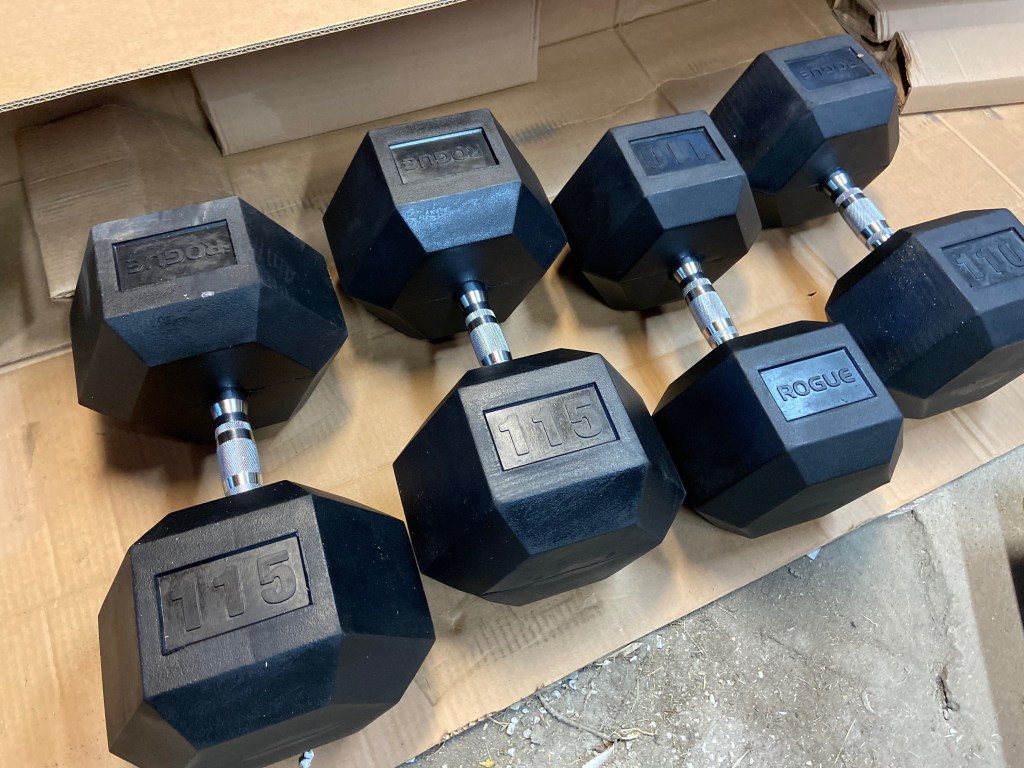
I thought I would get back to using the 100s or above by the fall of 2020 so I ordered a pair of 110 and 115 pound rubber dumbbells from Rogue Fitness. They are fantastic. The size of the latter looks a bit intimidating. The heads of the 115s are the size of a smallish teenagers head. I ate the largest shipping cost I’ve ever paid for anything only to find out that I was still far from being able to use them. All told it was about $660 cost to get those 2 pairs of dumbbells. Around $160 of it was shipping, probably because they could only get to me by freight. If that number is shocking, then consider the prices on the various secondary markets at the time were even dumber. I swear people thought their stuff was made out of gold in 2020. I knew it wasn’t going to be cheap to get and it was well worth the investment. Pete added a pair 120 pound dumbbells to really round out the set after that. The 120s have a thinner handle. They are much harder to lift than the Iron Grip ones at the gym are. It’s not even really that close. The gap at 105 pounds is more significant than the one at 90, but I don’t think I’ll have the chance to fill it anytime soon.
I am willing to detail the cost of the 110 and 115 pound dumbbells because I want people to really understand the financial commitment being made here. Prefab dumbbells are a great tool for lifting and making strength, power and muscular development but will probably be the most expensive and perhaps longest part of the gym building process. There are alternatives. I’ve seen ads for dozens of companies that offer up adjustable dumbbells. Some from 5-50. Others from 5-80. These are all viable solutions to building a full prefab set, especially for lifters who aren’t regularly pressing heavy. That could mean gen pop lifters as well as bodybuilders, who value volume over intensity. I have yet to see any ad for adjustable dumbbells up into the ranges that I dumbbell press (105-125). Doesn’t mean there aren’t any out there but they have less visibility. Therefore, there is an impediment to growth if a lifter only has adjustable dumbbells at their convenience. The thought of spending $660 on 2 pairs of heavy dumbbells might be sobering for some home gym builders but it is reality. Keep in mind the adjustable dumbbells will run anywhere from $400-700, regardless.
There are still other alternatives. Fatbells are a fairly unique piece of equipment. They are a mix of a dumbbell and a kettlebell. I have never used them personally. I’d love to try them but my resources these days are needed elsewhere in my life. The handle in the middle of a hollowed out kettlebell gives a different feeling for the lifter. I’ve seen some videos on Youtube with lifters using them, notably Brian Shaw. Note that these are also quite expensive and do not come as pairs, at least on Rogue Fitness’ website. Plate loadable dumbbells have always been an alternative. I’ve never been a big fan of them because the plates always get in the way. I’ve stated many times on other essays that the American cambered bar by EliteFTS feels like an offset dumbbell press. The offset feel makes it quite a different lift but the concept of pressing with the hands in a neutral or near position is really similar to a dumbbell press. Having lifted with the bar for near 2 years now, I can say very firmly that there is a big difference between holding the weight physically in the hands. That’s why I so firmly believe dumbbells need to be in every gym in some form.
The one lift where the American cambered bar is much better for strength development than dumbbells is seated overhead press. A lot of this comes from the ability to get the weight into position is much easier using the bar than dumbbells. I use the safety straps on the power rack to put the bar at shoulder height and essentially pin press with it. I find it incredibly hard to get 75 pound dumbbells to my shoulder, even doing that seated clean-cheater curl thing that looks ugly as hell. I can press that weight for 5-6 reps, but I find energy isn’t worth wasting merely getting it up to position at the base of the shoulder. It really does suck that much. Therefore, I use seated dumbbell press for hypertrophy and the American cambered bar for strength work. The American cambered bar isn’t the only multigrain bar on the marketplace, but it the one I have the most experience with.
I honestly don’t know what I would do if I hadn’t walked into my current home gym situation. Inevitably I’ll have to find out one day but I’m glad it isn’t now. One thing I do know is it will be ridiculously expensive. A bit of a side lesson steams involving dumbbells stems from looking around on Rogue Fitnesses’ website for other specific terminology on lessons I’ve written about. I found the rubber dumbbells I purchased in late September 2020 were now $400 and $420 for the 110 and 115s respectively. Throw in shipping cost and that’s $1,159.03. The lesson should be fairly obvious: Don’t wait to get what is needed for the gym in special cases, even if it can’t be used immediately.
 Life Through Lifting