The Last 3 Lessons!
Mark Brown

February 1, 2023
Lesson 7: Beware Secondary Markets! Buying from primary sellers is the only way to get exactly what you want in somewhat the timetable you want it.
This one can be a hard pill to swallow because we always think there’s a better deal out there than what the primary seller is offering. That fear of spending too much on something is always present until we just get over it. I’ve been over it for awhile. Stuff costs what it costs. What makes this lesson particularly interesting is how directly goes against the advice of the guy who posts videos on the Garage Gym Reviews Youtube channel. I remember watching his video that is essentially the equivalent of what this essay has been and nodding along, especially so when talking about being able to buy from secondary markets because they were cheaper. Then I found myself looking for stuff for the gym on Facebook marketplace and listening to Pete’s stories about trying to find stuff there. Disappointment. A lot of it.
Building a home gym in 2020 was good for some people and bad for others. The shutdowns created a major reason to create a home gym where there wasn’t one before. Demand for gym equipment skyrocketed and created a seller’s market for people selling their equipment on the secondary markets. The mix of people who thought their stuff was made out of gold and the people haggling for the lowest possible price was pretty mindboggling. Plates and dumbbells being priced at $2 a pound or more is just stupid. Hearing Pete talk to me about a guy haggling with him to get some dumbbells he was selling down to a $1 a pound when Pete had them priced at $1.50 a pound just made me shake my head. The secondary market did produce some finds for our garage gym but also no desire to participate in the games of buying and selling.
The biggest point with this lesson I want to bring up is that I learned how individual regional markets effect the buying and selling process on secondary markets. On Facebook marketplace, central Iowa is just a desert. It’s not really an active market for powerlifting or serious strength training equipment. I have also noticed that some of the equipment I would be interested in is 2-3 hour drive away. I don’t have much need for equipment now so I haven’t looked much lately. There might be a change in the market here. Pete has expressed being amused at the amount of equipment back on the marketplace when the gyms reopened.
One other thing I noticed was the lack of specialized equipment. If a safety squat bar or a multigrip pressing bar did end up on marketplace, it was taken off in hours. The lesson I learned from the lack of specialized equipment was that if I really wanted something specific, I needed to get it from a primary seller like Rogue Fitness, EliteFTS, etc. I’d be waiting forever if I had been relying on the marketplace to find a safety squat bar. Primary sellers, which includes Amazon, were out of equipment as well until the fall of 2020. The rush in spring and summer hit them hard and opened a gaping hole for sellers on secondary markets to charge ridiculous prices for the most basic of equipment.
Participating in buying and/or selling in secondary markets, especially on Facebook, means playing a part in a game of sorts. I’ve already mentioned the haggling. Neither Pete or I have the patience to play a part in it. When buying from a primary seller, they post a price and that’s what the product will cost. There is no haggling the cost down. There is just going out and finding a better price somewhere else. Yes, that can lead to spending more on a piece of equipment but I know that part is all done.
Lesson 8: Avoid Dr. Frankenstein’s Monster!
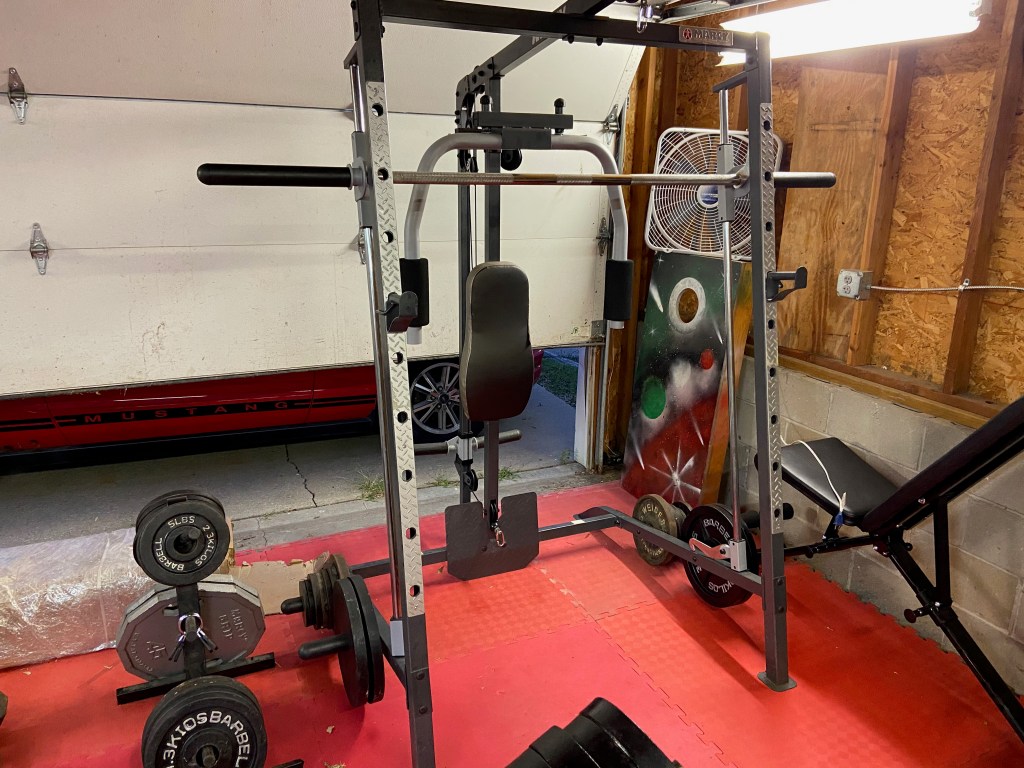
This lesson takes many shapes and sizes but revolves around 1 core concept: Trying to get too much done with one piece of equipment. I’ve seen some of this equipment in his garage when I first started lifting there in spring of 2020. There was a rack in the shape of an open cage that had j cups, smith machine, lat pulldown and a narrow pec deck. I will admit the last thing was nice to have around after we figured how to take advantage of it but the rest of it…garbage. Too light, cables too easy to pull off course, the smith machine non functional and a few other things that just didn’t work that should have. I don’t know how old thing was or the condition it was bought in, but it wasn’t what we needed for the lifting Pete and I were starting to do. I’d never seen that version of Frankenstein gym equipment before, nor do I ever want to see it again.
What I had seen before involved benches that had leg extensions/leg curl attachments on them. They are all over the place on Amazon and other sites that tailor more to home gyms than their commercial counterparts. The idea of being able to do those lifts at home is something worth looking into. The problem with these kinds of benches is that the attachment that makes them do legs gets in the way of positioning for the lifts that will be done using them the most, which will be presses and isolation tricep work. Pete’s initial bench when I started lifting in the garage was one of these and getting the feet positioned was a nightmare. Evidently these types of benches are popular on Amazon because they wouldn’t be all over the place if there wasn’t a market for them. They don’t even really deliver that well on the reason to buy them, either. Feet placement and being able to get into position on the bench freely without any awkwardness really does make a big difference when pressing.
One trend I have seen in the gym equipment market since I started looking 2 years ago has been to blend a power rack with cable based equipment. This particular brand of Frankenstein equipment is different from the open cage rack thing that I referenced above. The goal of this kind of rack/cable combination is to put a commercial gym in about a 12 square foot space. Instead of having just a lat pulldown/low row, there’s cables for crossovers and other chest movements. Cable based machines with weight stacks are some of the most used pieces of equipment in a commercial gym. Remember, most commercial gyms are aimed at people who put muscular development over strength. It makes sense why equipment makers would want to include it in with a good sturdy rack, especially if a lifter can squat inside it. The alternative is to just dedicate more space to a lat pulldown machine or one of the various cable pulley’s that are available. I am spoiled for space in Pete’s garage so I don’t particularly see the value of the cable/power rack combo for me. It just makes me ask “Why does this exist?”
The major issue with Frankenstein equipment is that it suffers from the same thing that multitasking does. By not focusing on doing one thing as well as it possibly can, it tends to make everything it does less effective. It’s not even a jack of all trades piece of equipment. It’s just not worth a damn. Design that openly favors one movement pattern will invariably be a detriment to another designed to be done on it or maybe outright ignore the best feature of it. The narrow pec deck on the already mentioned rack cage that no longer is in the gym is an example. The idea of having a pec deck in a home gym is really helpful because the movement really does help muscular development. Those standalone pec deck machines take up so much space because they are so wide. They are that way because the movement itself is designed to be done from the widest held position to the narrowest in an arc. This lift can be done with dumbbells, but the machine helps produce a consistent movement pattern. This is because the arc cannot exceed the limitations of the machine. There are limitations to how much the shoulder, elbow and even wrist joints can move when performing the lift but there is simply more room for imperfections in the arc of the movement.
What really makes the pec deck machine invaluable for any lifter is the ability to do the reverse movement, a rear deltoid fly. All lifters can get a benefit from this lift because the rear deltoids are one of the hardest muscles to actually isolate. That is for 2 major reasons. The location and size of the muscle makes it a very easy one to fail to isolate. The rear deltoid sits so close to the upper lats and traps, both much larger muscles, that failure to do a the lift perfectly means the lifter is doing more for the lat or trap than the intended muscle. It’s like how any elbow movement while doing a curl will bring the deltoid into the lift as well as put pressure on the joint and ligaments. Any lift that attempts to isolate the rear deltoid must be a precision movement to be effective. Dumbbells can perform this just like they can pec flies. The machine just helps really keep the arc backwards as perfect as possible. I bring this up because narrowness of the pec deck in the rack cage cut the range of motion by at least half and the didn’t even come close to allowing a rear deltoid fly. I got around this by doing super heavy pec flies and using dumbbells for rear deltoids. I did the best I could with what I had. Such a waste of potential all in the name of multitasking. Just like the monster Dr. Frankenstein created. One without a soul.
There is yet another trend that potentially involves Frankenstein. This one allows the lifter to build the monster themselves. A lot the power racks sold are marketed to potential home gym enthusiasts and commercial gym owners as the vehicle for being able to do every lift that involves a barbell without doing much moving. around That’s really enticing because the thing that commercial gyms are best at is derailing a lifting session. What makes the power rack attachment trend different from the rack cage is that the lifter is responsible for designing the potential monster. I have been tempted in the past to get attachments for the RML-390F I own but all desire to get beyond what I currently have evaporated awhile ago. The option is nice be able to keep the power rack as simple as possible or dial it up to 11 in an intelligent way. Don’t think this option isn’t expensive. I have about $1,600 invested in my RML-390F between the rack itself, safety straps, landmine, and spotter arms. There is a level beyond that with jammer arms, cable pulldown accessory, and dumbbell racks that I would love to have for it but none of it even remotely necessary now. I also know it’s at least $2,000 more. I don’t feel like becoming Dr. Frankenstein that much. I can see the attractiveness for someone who has the money but not the space. This isn’t the monster to avoid, but to be wary of creating.
Lesson 9: Mirrors are unnecessary.
Anyone with commercial gym experience should be able to get this one fairly easily. Since I went back to lifting at Genesis primarily a few weeks ago, I have seen so much posing in the mirrors. I mostly laugh at it. I do it every now and then and I shake my head at myself. There’s nothing to see! The vast majority of people in commercial gyms won’t see anything in the mirror. Lifters really need to have muscle stacked on top of muscle to see anything in it. What makes the posing even more ridiculous is that mirrors lie right to the face. I know when see my arms in the mirrors when I am doing curls that my arms anywhere near as big or getting isolated as they are showing me. I find them to be every bit as distracting for people in the gym as cell phones are.
The bigger reason for why mirrors are unnecessary is that they aren’t helpful to anyone lifting in the moment. Bodybuilders get a lot out of them because the body is the end product. For lifters focused on strength or power, the mirrors don’t help them with body position, squat depth or how forward they are before doing a deadlift. All of that is done by the lifter int he moment of lifting. For mirrors to be effective, they need to be directly in front of the lifter without distortion. That is a lot easier said than done. The mirrors at Genesis are all on the walls. The open racks in the CrossFit area line up perpendicularly from them. Therefore, any lift that employs the racks doesn’t get any benefits from them. Full plates block the view if I go to look for squat depth. I also know that that sideways head movement doesn’t help the movement at all. The same applies for the deadlift. Almost all lifts benefit the most from looking straight forward with a slight angle upward.
What is more effective than mirrors in a gym? Cell phones. They can take video that can be played back almost as soon as the lift is done, then analyzed on the spot for what can be done better on the next set or rep. Cell phones are distracting in general, but they do hold a very real specific use in a gym. Mirrors don’t, unless one is a bodybuilder. The only value they hold is in whatever vanity the gym owner seeks to have.
 Life Through Lifting