2022 Week 34 Training Log

August 22 – 28, 2022

Mark Brown

August 29, 2022

Monday
Scheduled Day Off – Recovery

Tuesday
Box Squats, Yoke Bar – 155 x 6, 245 x 6, 335 x 3, x 3; 345 x 3, x 3; 355 x 3, x 3
Block Pulls, 3 inches Off Ground – 365 x 3, x 3, x 3, x 3, x 3, x 3, x,3, x 3
Bent Over Barbell Rows – 225 x 3, x 3, x 3, x,3, x 3, x 3, x 3, x 3
Calf Raises, Yoke Bar – 335 x 20, x 20, x 20, x 20

Wednesday
Cambered Bar Press – 175 x 6, 225 x 3, x 3; 265 x 2, x 2, x 2, x 2, x 2, x 2, x 2; 285 x 2, x 1
Cambered Bar Hold, Flat – 265 x 1:30, x 1:30, x 1:30
Floor Press – 235 x 3, x 3, x 3, x 3; 245 x 3, x 3, x 3, x 3
Straight Arm Lat Pulldown – 70 x 10, x 8; 80 x 8, x 8

Thursday
Flat Tricep Press – 75 x 8, 75 with chains x 8, x 8; 85 with chain x 6, x 6, x 6
Standing Curls, EZ Curl Bar Wide Grip – 45 x 12, 65 x 12, 75 x 12, 85 x 12
Muscle Mace, Giant Set – 45 x 10(x 8)(x 8), x 8(x 8)(x 8); 50 x 8(x 8)(x 8), x 8(x 8)(x 8)
Preacher Curls, EZ Curl Bar Wide Grip – 85 x 12, x 12, x 12, x 12
Tricep Pushdowns, Prone Grip – 70 x 12, x 12, x 16
Preacher Curls, EZ Curl BAr Inner Grip – 85 x 12, x 12, x 12

Friday
Scheduled Day Off – Recovery

Saturday
Scheduled Day Off – Recovery

Sunday
Bench Press, Wide Grip to Chest – 135 x 6(wide grip), 135 x 6 (inside the line), 135 x 6 (narrow grip) giant set, 225 x 6, 245 x 6, 255 x 6, 265 x 5, 275 x 3, x 3; 285 x 1
Narrow Grip Incline Press – 185 x 6, 225 x 3, x 3, x, 3, x 3
Pin Press – 225 x 6, 225 x 3; 235 x 3, x 3
Viking Press – 160 x 12, 185 x 12, 185 + 30 pounds of chain completely off floor x 10, 185 + 60 lbs of chain off floor x 8
Tricep Pushdown, V shape – 55 x 12, x 15, x 12, x 10
Rack Push-ups – bodyweight x 12, x 12, x 12, x 12

Steps/Miles
Monday – 31,253 steps, 14.4 miles. Tuesday – 26,550 steps, 12.0 miles. 29,210 steps, 13.2 miles. Thursday – 26,448 steps, 12.0 miles. Friday – 26,726 steps, 12.2 miles. Saturday – 8,301 steps, 3.9 miles. Sunday – 6,718 steps, 3.2 miles. Total – 155,206 steps, 70.9 miles.
My House Sauce

Recipe Guideline and Background

Mark Brown

August 25, 2022

My formative years as a cook, from about 2008-13, were pretty exploratory. I learned a lot of techniques and focused on working with flavors I wasn’t familiar with. That led me to the sauce I am writing about today. At this point, it’s essentially my house sauce, so to speak. I’ve made it so many times with both the original ingredients and substitutes that I know what to expect from it just about every time. That’s ultimately the point of learning how to cook. I have other parts of my cooking repertoire that go along with is vein so there will be some essays about that in the future.

This sauce is a combination of a couple different sauces and ingredients: Hoisin sauce, Sambal Oleke, honey, black pepper, mustard, rice wine vinegar, and sesame oil. Each of those ingredients brings something necessary to the party. Sauces like this need to be balanced before they can be focused on a dominant flavor, which is the true reason why this sauce works for just about anything I make it with.

Hoisin is the salty part that helps brings out the other flavors. It is the true backbone of the sauce. It’s one of the 2 ingredients that cannot be substituted. As ethnically Asian sauces go, it’s unique. I don’t care for soy sauce because it’s like licking s block of salt with no flavor. Same for teriyaki sauces. They are just too sweet. I have heard hoisin sauce called “Chinese ketchup” and “Chinese barbecue sauce.” Pretty accurate, if my opinion matters. I have discovered that brands of hoisin sauce range from decently salty to full-on salt licks so understand that ahead of time. This will require experimentation with different brands to land on the flavor profile of choice.

Sambal Oleke is a particular brand of chili garlic sauce that are in regular grocery stores. It’s one of the more known ones, if I recall. Sriracha is the other brand that people associate this flavor with. I prefer Sambal to Sriracha mostly because I like the chunkier nature of the sauce. Sambal is very powerful on its own. It delivers a serious punch of flavor to this sauce. What makes it especially useful for the cook is that it barely takes any to get the intended effect. It’s that strong. In theory, any chili garlic branded sauce would work as a substitute. I don’t think garlic and chiles individually would work because there is something in Sambal Oleke and Sriracha that take the chile and garlic up a notch.

Honey obviously plays the part of sweet in this sauce. This sauce would be completely unbalanced without a serious element of sweetness. The salt of hoisin and the punch of Sambal Oleke would be completely overpowering. Honey’s flavor is unique among all the sweet ingredients that could be used here. It’s hard to describe the flavor of honey. It’s one of those flavors that one knows its in there when they taste it but fails to put actual words to. While I do prefer a clover honey, I’m not picky here because most of the time it’s not playing lead actor in this sauce. I have substituted molasses for it when I was out of honey and it performed admirably. Molasses presents a different flavor profile because it it derived from sugarcane. It’s less bright. That’s the best way I can put it. It offers a different kind of complexity and is a worthy sub. I’m sure there are other syrup-type sweeteners that would do well. I have used Agave Syrup for a habanero sauce so I wonder how it work…

Black pepper is another punch of flavor to this sauce. It cannot excluded or subbed out for a different spice. Black peppercorns offer a heat only available from it. In that way, it gives a different kind of heat that what the Sambal Oleke or Sriracha would be giving. Freshly ground pepper very coarsely would work best because the oils in the peppercorns themselves would be most present. However, anything black pepper coarse ground within a week or 2 of the sauce being made would be fine. There is a significant amount of it in the sauce. Even in this sea of flavor, I can still taste the black pepper. Pre-ground pepper from the grocery store has its place. That’s at the grocery store on the shelf.

Mustard is like every other ingredient here. It’s unique to itself. That said, there are thousands of mustard brands in hundreds of styles. Feel free to experiment with them. I will just say which ones I use more prevalently. I’m not a major fan of mustard on its own. In fact, I don’t use it as a condiment on anything. I keep it around as a complimentary flavor. The style that almost always goes into this when I make it is dijon mustard. Equally almost always is the brand I use, Grey Poupon. It’s a very, very sharp flavor that is completely different than American style yellow mustards, which I despise with every fiber of my soul. There is a fair bit of mustard in the sauce so it will be around, even if it isn’t playing many minutes, so to speak. Dried mustard or ground mustard seeds will also work here. The ingredient is playing a different role as well: Emulsifier. Sauces that combine oil with vinegar will separate unless the cook does something to help them stay together. Some of them are designed to be together for mere minutes at a time. Others to stay together to the end, even during a re-heat. This is the latter. Mustard does an extremely good job at making sauces stay together. That is the other reason it’s here.

Rice vinegar is the best choice of vinegar for this sauce because it is mild in taste and sharpness. The sauce already has standout flavors and doesn’t need the vinegar to compete. It just needs to regulate all of them so there’s not too much happening. The vinegar serves 2 purposes in the sauce. The first is what I just mentioned. The second is that the addition of vinegar takes the viscosity of the combined above ingredients from brown ketchup to a thickened but pourable liquid. Oil doesn’t blend well with thick ingredients. In theory, any liquid would accomplish this task but the vinegar is necessary for flavor reasons. There’s not a lot of substitutes here, though. White wine vinegar tends to be a heavier, sharper flavor than rice vinegar so it will throw its weight around a bit. Anything beyond white wine vinegar would be a bit out of place.

Sesame oil is a necessary component of my house sauce because it can stand up to the other bold flavors and gives a very pleasant aroma come eating time, especially after being heated in one of the various ways it would happen. It has a very strong flavor on its own. Sesame oil is used in a lot of Chinese dishes in part because it can stand up to insane amounts of heat before it goes bad. Woks typically cook so hot and fast because the burners typically used for that particular pan use a ton of natural gas as a heat source. Could I get away with blending some vegetable or canola oil if I ran out of sesame oil? Probably. The sauce would lack the aroma and flavor if it was just the former 2 oils.

The ratio of these ingredients is what makes this sauce special. It’s very adaptable to the desired flavor of the day. It has to work well together. Typically for a sauce to be truly balanced it has to have hot, sour, salty, and sweet. Umami is also said to be a fifth flavor, but that’s a different entry for another time. I can accent which of those 4 flavors I want by simply changing the ratio of that particular ingredient. That might seem facepalmingly self evident on the surface but there is more to putting an accent on food than just adding more of one thing. All of the ingredients have to be in harmony together, regardless of the dominantly accented flavor.

So here goes my best attempt to make a guideline for my house sauce:

More Hoisin Sauce than any other ingredient other than vinegar and oil.
Close to equal part of honey to Hoisin.
3-4 heavy pinches of coarse black pepper
1-2 actual tablespoons Sambal Oleke
1-2 actual tablespoons of mustard
Enough rice wine vinegar to turn the above into a pourable liquid.
Enough oil to ensure the sauce stays together.

Put the hoisin, honey, black pepper, mustard, and Sambal into a large enough bowl and whisk together just to combine them all into a thick sauce. Add the vinegar to the bowl and wish until the liquid could be poured if necessary. Add oil to the bowl and which until oil can’t be seen in the sauce. It shouldn’t take that long. Doing it in a mason jar would be easier. Put it all in and shake.

Typically I use about 4-5 tablespoons of hoisin sauce, about a 4-5 second squeeze of the honey bottle, and a 3-4 ounce pour of both vinegar and oil in the end. I know this is annoying imprecise, but that’s how this kind of recipe development works. It’s been with me for at least 12 years. I’ve made versions of this sauce heavy on the Sambal and heavy on honey. The former was quite intense with a lingering burn that was just right. I do that by going closer to the 2 then the 1 tablespoon I listed above. I don’t make this sauce a lot but it is fully learned now so I never have to think too hard about it. I like it best as a glaze for meat, especially when grilled, but it also makes a great marinade or stir fry sauce. One potential addition to my sauce when used as the latter is corn starch, ideally diluted with the vinegar. Stir fry sauces are usually thickened with corn starch anyways, so might as well mix it right in. However, remember that corn starch needs to be fully cooked out to get rid of its chalky flavor. Only do the corn starch addition for stir frying.

So there it is. My cooking secrets are starting to release all over the Internet. The ingredients I listed aren’t normally too expensive and usually last quite awhile unless they get used a lot. One thing to note is that while they can be found in most grocery stores, they are very rarely ever on sale. I know that might not be important to say for most people who will read this but it is worth mentioning. This sauce really is dynamic and is probably one of my most successful cooking ventures of my lifetime. Experiment with it and enjoy.

Research and Development, Part 4

Accessory Lifts

Mark Brown

August 23, 2022

Accessory lifts stay more stable in a program because they support the supplemental lifts and are just good gpp for any lifter. The important part to remember about them is that they support through developing the muscles that do the lifting. To do this, most accessory lifts are done to failure or well passed it. Main lifts and supplemental lifts aren’t typically taken to that level, even the ones done at max effort, because the joints would become far too damaged. The term “max effort” doesn’t hold singular meaning in strength training in terms of reps. Whatever effort is needed to get to a get to the strain threshold is what “max effort” means. A lifter finds out the specifics of it after a period of experimentation with all of the variables that encompass it: weight, reps, sets, equipment, time under tension, rest between sets, etc. Accessory lifts being more about the muscular development means that the weight part of the equation will be lower because a load that is too heavy will force technique that puts too much strain on the joints and ligaments. That is when the most gym injuries happen. However, the strain level has to be significant for growth to actually occur in recovery. It also has the effect of making fatigue harder to get to over time in both the gym and in the other places life is lived.

Experimentation of accessory lifts is generally safer than on major compound movements because of the sheer weights alone. When a lifter also considers how much movement is actually done in 1 rep of an accessory lift, it is also easy to see why too much weight is dangerous. Tendons and ligaments can take a beating but their stop sign usually is a tear or rupture. Part of the experiment is finding out how much weight can be used to stimulate growth without causing injury. There really is a fine line between them. Even when a lift is done well with the right calculated load, the tendon or ligament can go from wear and tear. Lifters get close to that ledge when intense muscular development is the name of the game. Most lifters in the gym will never do enough accessory lifts to get the muscular definition that is seen on movie screens, comic books, or competitive bodybuilding stages. They simply don’t put in the amount of effort and time to develop the shape and definition. That includes diet, water and potentially PEDs in addition to the thousands of reps a lifter would need to do to have bulging biceps and/or giant triceps. The lifters who spend their energy to develop well defined muscles do so at the cost of strength. Time makes itself very well known by essentially giving lifters the choice of greater strength or greater muscular development.

For lifters whose goal is strength or power, accessory lifts will always be about finding the exercises that aid the development of the parent lift with the least amount of time and energy put towards them. This usually leads to lifts that mimic, at least somewhat, the parent movement. It puts the muscles in the positions they would be in when doing that lift. For example, a flat tricep press, aka skull crushers, puts the triceps in the position they will be in during the bench press. The lift then serves 3 purposes: technical, strength and muscular development. The same goes for its upright cousin, the seated overhead tricep press, in regards to overhead presses. Lifts that don’t serve much in the way of technical development are lower on the priority list. These would include tricep pushdowns/pulldowns in all of their variations over different pieces of equipment. They are killer strength and muscular development lifts that really put bulk on the arms so they really should be part of any strength training program. Just understand what they bring to the program and what they don’t.

Biceps just don’t matter that much for traditional strength development. The way the pec tendons are attached to the arms means some bicep work is necessary to aid in bench pressing. To what extent? I’ve never felt much of issue from lack of bicep size/strength when pressing. I also don’t have a very high 1RM max on bench press, so take what I say accordingly. I lift a heavy amount of volume when I press and haven’t felt a lot of bicep tendonitis during my sets. I do know that the biceps and its tendon take the brunt of impact when I have too much weight out in front of me, either when deadlifting or doing curls, so be I am careful when focusing on biceps. I also feel a lot of stress on my left bicep and tendon when squatting with a straight bar. Strongman, as a sport, puts more emphasis on biceps than powerlifting does. I have seen a lot of events at Strongman competitions that are about holding or picking up weight out in front of the lifter. That is the most vulnerable position for the bicep to be put in. Here is where training biceps has the same level of value that a skullcrusher does for a bench press.

For bodybuilders or lifters focused on muscular development, accessories might well be where the bulk of a training session is spent. As a result, experimentation here will focus more on what piece of equipment will bring the most bang for the buck. It could take a long time to find that one magic piece of equipment that just feels right. The results of that experimentation won’t be seen for weeks and months. Time also rears its head in as an enemy because lifting past failure as much as has to be done to attain a high level of muscular growth, assuming no PEDs, eats into a lifter’s natural energy reserves like nothing else. The result is that muscles reach the finish line quickly causing sessions to be shorter, especially when one considers that rest times between sets of main/supplemental lifts and accessory lifts are much different. The latter are my shortest sessions by far. It’s not even close. Finding the pieces of equipment that deliver the best results is a never ending experiment that only concludes when a lifter wants to end it. I started out doing pushdowns primarily with the v-shaped cable attachment for years but I have used straight bar attachment more since 2020 because it’s closer to a bench press hand grip than the v-shaped one is. That’s just one example of small changes I have made to my lifting strategies.

The key to getting all of that muscular development is working past failure. That is by far the most important concept to understand when training accessories, regardless of what they are being used for. Lifting to failure is a fairly easy idea to understand and execute because it’s as simple as going till one can’t. Going further than that puts a lifter in a danger zone where the muscles have to go into into overdrive to do mere parts of a lift. That danger zone is where the most growth is made. It is also where the most danger from injury exists. There’s a certain mentality a lifter has to have to make lifting past failure a reality during a session. It’s quite easy to stop when a lifter can’t complete a rep fully. It’s much harder to remember keep going until they can’t complete half a rep. Sometimes it doesn’t even take that many half reps to get to the absolute failure point. Strength training isn’t a zero sum game. Reps add up over time. Lifters develop faster with more half reps at the end of sets. Simple as that. The same concept can be applied to failed reps during main and supplemental lifts.

Another part of time that is in this equation is how rest and time literally spent lifting figure into it. Time under tension is one of the ways to make the muscles work harder in any given lift. By extending the amount of time under which a muscle is under some strain, the lifter forces it to keep working. This is another way lifters can work past failure safely. Reps done for a long time tend to be done at lowest ranges of weight because of the effect of the constant strain on the muscle. This includes lifts that are slow in their completion but never stop as well ones that feature a pause and hold at the end of the eccentric or concentric phase before transitioning to the other.

Rest times play a large role in the length of lifting sessions and impact of the lift done on the body. Main and supplemental lifts require more time between sets because heavier loads cause more stress on the body. The length of rest time between sets is often times linked to how heavy the load of the previous set was. I decreased the rest time for sets of squat and deadlift twice a week during February of 2022 to 2 minutes between sets. The sets were being done in the 85% 1RM or up range and they initially felt good but my body couldn’t take the strain for more than 4 weeks. Experimenting with rest times like this will lead to learning a lot of information a lifter didn’t know. I’m glad I did it so I know how to do it better next time I do it. Accessory lift sets can be done with very short or no rest. Remember, the goal of an accessory lift is to support the main and supplemental lifts through increased muscular development. Lifting with less rest between these lighter sets will help a lifter hit that failure point sooner so they can push through it. The body will get stronger over time and push that failure point back further. This also makes getting through accessory lifts faster and sessions that feature them take less time.

Both lifts and sets that feature time under tension and decreased rest times are all about effort. These are max effort lifts that should be treated very seriously because muscles under this level of strain for the length of time they are become increasingly vulnerable. That’s why these lifts are done with the lowest weights in the range. Increasing the load would needlessly increase the chances of injury. Experimentation doing these lifts needs to be done safely so that a lifter doesn’t miss sessions for injuries that could have been avoided. Muscles may grow in the recovery phase, but the lifter has to be able to get to the gym to tear down down them down first. That doesn’t happen if a lifter misses sessions due to injuries.

Part of understanding how to train properly is to learn basic physiology. Figuring out what muscles do what and how goes a very long way to properly programming lifts for maximum results. Professional and high level amateur athletes do this to stay at that tier for as long as they can. Average gym lifters should apply the same thinking to their programs and plans. Lifts that fall into the accessory category tend to be on muscle groups that do a lot of work on a daily basis, inside and outside the gym. That’s why they are so hard to make visible progress on when PEDs aren’t part of the game plan. Shoulders, arm and legs do a lot of work during the day if one works on their feet, like I do. It explains why they need to be almost overtrained to see visible progress in the muscular development. Working past failure and training hard definitely helps a person fight fatigue better than a person who doesn’t do either. It’s part of the mission of this blog to help people understand how to train and why it is important to do so.

Doing the due diligence is part of every lifter’s responsibility to themselves and the people they train with. Research and development through both experimentation and from secondary resources are the primary ways that gets done. The benefit of each human being relatively unique is that not everything works for everybody the same way. Finding what works best for the individual requires a lifter to repeatedly experiment with all of the variables to find the exact combination of lifts to make progress. It’s a large part of what makes strength challenging and fun. Becoming stronger through eliminating weaknesses and making weaknesses is stronger over time is a satisfying feeling that can’t be understated. Know what’s better than that? Passing on that information to others so they can benefit from the research and development that has been done.

2022 Week 33 Training Log

Mark Brown

August 22, 2022

Monday
Scheduled Day Off – Recovery

Tuesday
Unscheduled Day Off – Recovery – Stiff Back, Didn’t Eat

Wednesday
Box Squats, Yoke Bar – 155 x 6, 245 x 6, 335 x 3, x 3; 355 x 3, x 3; 385 x 2, x 2
Assisted Box Squat, Yoke Bar – 405 x 3, x 3; 435 x 3, x 3
Block Pulls, 3 Inches Off Floor – 365 x 3, x 3; 385 x 3, x 3; 405 x 3, x 3; 415 x 3
Barbell Rows – 185 x 6, x 6, x 6, x 6
Calf Raises – 335 x 20, x 20, x 20 x 20

Thursday
Cambered Bar Press – 175 x 6, 225 x 3, x 3; 245 x 3, x 3; 265 x 3, x 3
Cambered Bar Hold – 265 x 1:30, x 1:30, x 1:30
Floor Press – 235 x 6, x 6; 245 x 3, x 3, x 3, x 3
Straight Arm Lat Pulldowns – 70 x 10, x 8; 80 x 8, x 8

Friday
Scheduled Day Off – Recovery, Didn’t Eat

Saturday
Unscheduled Day Off – Recovery

Sunday
Narrow Grip Bench Press – 135 x 6 (wide grip) 135 x 6 (inside the ring), x 6 (Narrow Grip), 225 x 6, 275 x 3, x 3, x 3, x 3, x 3; 285 x 2, x 2, 225 x 6
Incline Press, Normal Grip Paused 1 second – 185 x 6, 225 x 3, x 3, x 3, x 3
Seated Overhead Press – American Cambered Bar – 128 x 6, 138 x 6, 148 x 3, x 3; 158 x 3, x 3; 168 x 2, x 2
Flat Dumbbell Press – 100 x 12, 110 x 8, 115 x 6, 100 x 8
Tricep Pushdowns, V Shape – 45 x 10, x 10, x 10, x 10
Single Arm Tricep Pushdowns, R then L – 10 x 12 (x 12), 15 x 12(x 12), 20 x 12(x 12), 25 x 10(x 10), L only – 25 x 12, 20 x 10, x 15; 15 x 20
Rack Push-ups – Bodyweight x 12, x 12, x 12, x 12

Steps/Miles
Monday – 28,415 steps, 13.0 miles. Tuesday – 27,524 steps, 12.5 steps. Wednesday – 28,339 steps, 13.0 miles. Thursday – 27,237 steps, 12.4 miles. Friday – 31,368 steps, 14.2 miles. Saturday – 3,236 steps, 1.6 miles. 5,799 steps, 2.6 miles. Total – 151,918 steps, 69.3 miles.

Notes

This week was a hard one to get because work turned to utter garbage. There was only time to get stuff done so I didn’t get much eating done while at work. That’s what caused me to miss Tuesday. An already long day was going to turn into a longer one if I ate then lifted. I have learned that I really do need to eat if I am going to lift like I did Wednesday. The next few weeks look to be about the same so there will be a lot of miles and steps and hopefully enough eating to get to lift. The missed sessions annoy the living fuck out of me but the days weren’t lacking physical activity. I can live with that.

The combination of Yoke Bar squat and heavy block pulls is viciously hard when it comes to the amount of volume I do with them. This coming week is the last time doing block pulls for a bit. I believe I can pull more than 405 pounds from the floor, but I do far too much volume at the moment to fairly test that. I will move towards less volume in the near future to really push the power numbers. I missed the second leg day for recovery purposes. The Wednesday session was just that hard.

The combination of lifts I did on Thursday felt very effective. I knew the cambered bar really put extra stress on the lats during a bench press then hold but I learned how much after I did the straight arm lat pulls. This week I added the floor presses to the session. That effect on the lats definitely had an impact on the floor press. It definitely felt harder. That sequence will be brought back in future waves.

Recipe: Chicken in Tomato Sauce

Coo

Mark Brown

August 18, 2022

3 packages boneless skinless chicken thighs, About 5 pounds.
2 cans no salt added tomatoes
2 cans mild Rotel, or tomato with chiles
4 – 6 ounces water
2 tbsp homemade salt free taco seasoning
2-3 tbsp coarse kosher salt
3-4 tbsp coarse grind black pepper
3-4 tbsp vegetable oil

Cook time: About hour and 20 minutes.

This recipe is a new favorite. I’ve made it quite a bit lately. The dish is ridiculously easy to make but can take some time because the first part of the process is a little lengthy. In smaller portions, it would only take probably 25-30 minutes. Chicken and tomatoes go very well together. It’s also a very good way to getting in vitamin C and all the others that are in tomato and peppers. Chicken thighs are a very good vessel for this. I wouldn’t do this with chicken breasts because they don’t taste like much.

Season the boneless skinless chicken thighs with kosher salt and black pepper. Brown all the chicken in the pan and cook the chicken all the way through or just under that point. Be sure to cook the chicken in a hot enough pan to get a good sear on the chicken. Leaving it on the side in a hot oiled pan will brown and cook the chicken all the way through in just 5-6 minutes on each side. If it ends up being a bit dry, remember that the sauce will cover that up a bit. The pan has to be hot though. Do no overcrowd the pan. That will decrease the temperature of the steel the fond on the bottom of the pan will not develop over the searing time. Even with a 14 inch pan with straight sides, I can only fit 3 pieces of chicken per time in it. That’s why the cook time is so long here. Be careful about overheating the pan. This is medium-high temperature on the burner, not fully blasted high. The fond on the bottom of the pan is easy to burn. Once it burns, it becomes smoky and acrid. Completely unusable.

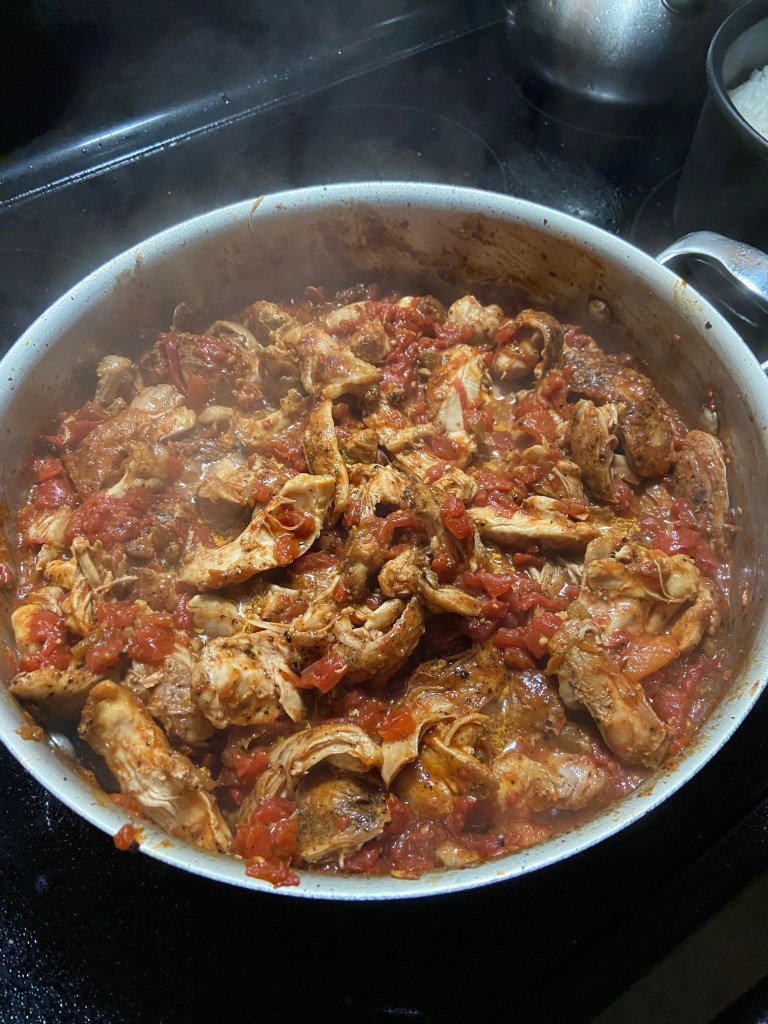
Once the final pieces of chicken are browned and set aside with the others, hopefully in a bowl to catch any liquid from them, pour in the 4 cans of tomato and Rotel. Add the taco seasoning to the tomatoes and chiles. Clean out the cans with water by pouring water into one can and transferring it to another and repeat that until all them are clean. The remaining tomato liquid and tomatoes should be in the water. Pour it in to the pan, then turn up the heat to let the tomato juice reduce till there’s almost just tomatoes and chiles in the pan. Pull the chicken in large pieces and put into the pan then stir into coat the chicken with the tomatoes and sauce. The amount of sauce that is left in the pan will tell the cook how much chicken to add to the pan. The picture has 11 boneless chicken thighs in it. I had 3 left over for the next night. Taste for seasoning, then adjust as necessary. It needed a few more good shakes of kosher salt before service.

There are some things that are important to note. First, I find buying canned tomatoes and beans without salt added to them is the best way to manage salt intake. The fond on the bottom of the pan is the saltiest part of the dish. It comes from the surface of the chicken as it cooks so salt somewhat aggressively. The tomato juice and water will dilute it before reduction begins. Second, this recipe is highly adaptable to how someone wants to make it. The 2 cans of Rotel could be swapped for 2 cans of tomatoes and different seasoning added. Italian seasoning or various curry powders would take this dish entirely different places. I like cooking food that is adaptable.

Research and Development, Part 3

Mark Brown

August 16, 2022

Supplemental lifts are what is the bulk of any training session that takes place are made up of. I do spend a lot quite a bit of time on the main lift because of the raw volume that is involved, but it is far from the majority of the time in a given session. The rotation of main lifts in 3 week waves carries with it the effect of rotating supplemental lifts as well, unless there’s one or 2 that are always done because they are that useful. My upper body training is a bit more varied in the garage than lower body training. The gym has a lot of isolation machines that make all of those movements like leg curls and leg extensions easier to get into the program. The amount of research and development a lifter does will show in this phase of the program more than in either the main lift or accessory work. Experimenting with equipment and lifts and becoming proficient at them will (repeat: WILL) be how a lifter gets stronger in both body and the main lift the supplemental lift is being used to help. Having a go to list of lifts to do for supplemental lifting is good and necessary, but that list needs to keep expanding so the right ones can be called upon to get the job done. I am all for doing the ones that work best but working these lifts in rotation has a rising tide effect.

The other thing to remember about supplemental lifts that forces them into being rotated is that they are done to directly support the main lift. That means technical proficiency has to be a major reason why any supplemental lift is done. Strength development could be the main reason for a specific lift being done in the cases of a muscle group being the weak link in the chain on a lift. Even the lifts that are done for bettering technical proficiency will provide a strength development component. Serious strength training is highly challenging because progress in it demands maximum mental focus. It’s not enough to lift hard and heavy. Putting effort into understanding how the lift is effecting the body allows a lifter to figure out which supplemental lifts will be best for particular variant main lifts. Even if the change in a lift is as small as a grip change on a bench press, it will determine the direction of the rest of the lifting session. For example, a narrow to mid-width dumbbell press will benefit a narrow grip bench press more than a wide grip bench press. The latter would be much better served by a wide lat pull. When specialty bars get added into the mix, the process of figuring out what supplemental lifts should be done becomes even more necessary. It’s yet another reason why a lifter should start simple at first. There’s too much to see the big picture right off the bat.

Specialty bars are very good ways of varying lifts that could get repetitive over the weeks to both mind and body. At the start, it’s a good idea to get the basics of the technique down before throwing variations at an inexperienced human body. Once the technique has been learned, development of weaknesses within the lift can begin. That’s when the variations I talked about in Part 2 will begin to come into the plan/program. This concept is applicable to every sport and skill out there. A specialty bar presents the lifter with the ability to hone in on specific weak parts of the competition lift or equivalent. In this way, the specialty bar variations that serves as a session main lift acts as a supplemental lift in the bigger picture. The full effect of what can come from specialized bars variations doesn’t begin to help until the technical parts of it have been learned. A lifter cannot place that specialized bar into the rotation in exchange for a lift that does what the new bar is supposed to do until proficiency has been achieved. Learning curves are pretty different from bar to bar, cable accessory to cable accessory. The lifter implementing these additions to the program needs to understand that extra time will be required to get through the initial learning stage. It’s really no different than trying to learn a secondary skill or sport. The extra time is necessary to learn the skill at first then more can be learned on the fly as elements within the skill set cement.

I can give some specific examples from the specialized equipment I own. The American Cambered Bar is a great piece of pressing equipment. I have read accounts of it becoming the main press bar for people whose shoulders are wrecked close to or beyond repair. However, it is not a replacement for bench pressing. That’s why I don’t refer to it as such in my weekly training log. Nor it is a replacement for dumbbell pressing. It fits somewhere in between. It is a massive ego killer for both bench press and dumbbell pressing. I highly recommend it strength and muscular development, especially if one isn’t going to bench press. However, it is bar much better served for people who do bench/chest press training twice a week. Let me repeat: It is not a replacement for a bench press. It currently fits into my program as the main lift on my mid-week press day and sees a lot of action on that day.

The Rogue Cambered Bar serves 2 purposes in my program. First, as a squat bar and, second, as a bench press bar. The 14 inch camber on the bar causes a distinct effect for the lifter to overcome. It is the swaying of the weight that requires the lifter to use more muscles and more effort within them to stabilize the body. For the squat, that is the lower back and abdominals. For the bench press, that is pecs, triceps, deltoids and lats. This is not a bar meant for new lifters. It is for experienced lifters who already have technique learned and want to strengthen the stabilizer muscles in addition to the main ones involved in the lifts it does. What I find interesting about the cambered bar as a bench press bar is that it comes with its own supplemental lifts then influences the accessories for the session. In that sense, it’s no different from a straight bar but it really tells the lifter what they need to do get the most out of it. It really places emphasis on the lats when doing the bench press movement. As a result, the lead supplemental I do for it is essentially a front hold. The difference is that since I am laying flat on the bench it is above me. When my arms are fully extended it forces me to focus my energy on flexing and activating my lats to merely hold the bar at that position for a set amount of time, which is 1:30 for me currently. Absolutely killer lift. It acts like a negative rep on the back side of the body. The bar produces a very lat heavy training session. I rotate it every 3 weeks or so with the American Cambered Bar during my mid-week pressing sessions. As a squatting bar, it acts like a straight bar except for the swaying weight at the hips. The weight being lower on the body has effect of the weight behind more in front of the body so it produces a forward leaning squat. Other than that, it doesn’t change the lifting session that much.

Those 2 bars have made it into the position they have in my program because I have become proficient enough at them that I can use them in place of what I had done before as main lifts on a non-bench press day. Dumbbell press has one of my lead supplemental lifts since I started lifting. Bench pressing is a skill lift that can be depressingly hard to make gains on at the beginning for new lifters. Dumbbell press gets around the problems of needing spotters for 85% and above 1RM work for almost every lift done with them. The American Cambered Bar has allowed me to feel more of an effect from dumbbell pressing on chest/shoulder days. It also has allowed me to do more reps at higher weights during those sessions. It did that by putting them as true supplemental lift on session days. Up until 2020, my bench press and dumbbell press severely limited what could be done depending on which of the 2 I did first. That’s no longer an issue. That is ideally what supplemental lifts do over time. The cambered effect is invaluable to me because it really helps me feel the weight better when I am much more connected to it. All that work on stabilizer muscles adds up over time and is the difference between making gains above 75% 1RM.

Time is the great adversary for anyone serious about getting better at anything. Mostly that’s because there are other things that need to be done that creates a time crunch. It becomes a major factor in what lifts become parts of rotations in certain lifting sessions in certain weeks. Some of the best examples of the lifts that time can get in the way of are main lift assistance lifts. These are the exercises that a lifter does to get better at specific parts of a lift. They are important to do for both lifters bound for competition and competency. It kinda depends on who a lifter is working with. I value pin press immensely but Pete and his son don’t do it quite yet so I let it pass to keep the session going. I have my list of lifts to do as assistance supplemental lifts. They are equipment specific as well: Straight bar bench press: pin press; deadlift: barbell rows; Yoke Bar Squat: Hatfield Squat; Cambered Bar press; Cambered Bar holds: Cambered Bar Squat: Cambered Bar good mornings. The best part of these lifts are that they are literally already set up with perhaps some removing of a few plates. They really shouldn’t take that much time to march through. They are also unlikely to be done at max bench press/deadlift/squat weight. That adds to the speed. If a lifter is taking the main lifts and movements seriously the lifts I mentioned really do need to in the program somewhere. If pin presses can’t be done because a lifter doesn’t have a full rack or spotter arms, a floor press is a good alternative. They are quite different in terms of how the lift effects the body, but doing floor press is better than not doing either one.

Another element of time that lifters must be aware of is how much stress the lifts are putting on the body. What I am referring to is a kind of biological clock. The human body only has so many reps in it in a certain amount of time. Bodybuilders get the physiques they acquire by working well past failure in reps, sets and sessions. Tolerance is built up over time to make the failure point harder to hit. Almost every skill that can be learned operates in this fashion. A golfer only has a set amount of full golf shots in them on a given day. Well trained golfers know this, so they get in better condition to be able hit more shots or exert more energy on the shots already needing to be hit. A golfer’s condition changes mostly because of weather and atmospheric conditions. Lifters, like me, who lift in a garage can be susceptible to the same issues. I love lifting in the heat, but there is a price paid for it. Sometimes the body gives out before some lifts are done. The main reason for bringing this up in this section of the essay is to really emphasize that going balls through the wall is only helpful if a lifter can recover from said session in time for the next scheduled session. Missing sessions is never helpful. Lifters must pay attention to the biological clock to ensure they get lifts done that were part of that session’s original intent. Sometimes that will change in the middle, it often doesn’t. Making adjustments during a session based on lift availability and body condition is a necessary skill to learn. That’s why I said the lifter’s diligence in doing the research and development in this phase will stand out. Supplemental lifts are the ones that will make the parent lifts better and stronger.

Shoulder press is an interesting subject for lifters. Strongman competitors and Weightlifters are judged by their ability to press and/or jerk overhead. Powerlifters aren’t so it often comes into programs as a supplemental. I used to do a lot more overhead pressing than I do now. I limit it a few heavy sets a week and some dumbbell work that more qualifies as accessory work than supplemental. I have found over the last 6-8 weeks that my overhead press has gotten easier and the lifts smoother with less overhead and more triceps work. Shoulders are very vulnerable to injury and extreme wear and tear over time. Lifts that have even the slightest bit of focus on the deltoids need to be taken very seriously. Most lifters get enough deltoid work done by bench or incline pressing. I still value overhead pressing as a measure of strength. I imagine that is because I haven’t suffered a shoulder injury. I’m including overhead pressing in this section to warn lifters from going too heavy on these movements and to make them as safe as possible when performing them.


2022 Week 32 Training Log

August 8 – 14, 2022

Mark Brown

August 15, 2022

Monday
Scheduled Day Off – Recovery

Tuesday
Free Box Squat, Yoke Bar – 155 x 6, 245 x 6, 315 x 3, x 3; 335 x 3, x 3; 345 x 3, x 3; 355 x 3, x 3; 365 x 3, x 3; 385 x 2, x 3; 405 x 2, x 2( complete fail at bottom of 2nd lift, finished last rep assisted)
Assisted Box Squat, Yoke Bar – 405 x 3, 425 x 3, x 3; 445 x 3, x 3
Block Pulls, 3 inches off Ground – 365 x 3, x 3; 385 x 3, x 3

Wednesday
Tricep Pushdown, V Shape – 45 x 10, x 10, x 10, x 10, x 10, x 10, x 10
Cambered Bar Press – 175 x 6, 225 x 3, x 3; 235 x 3, x 3; 245 x 3, x 3; 255 x 3, x 3; 265 x 3, x 3; 275 x 3, x 3; 285 x 1, x 1, x 1
Cambered Bar Holds, Top position – 265 x 1:30 x 3
Straight Arm Lat Pulldowns, Shoulder width – 70 x 8, 80 x 8, x 8, x 8
Tricep Press, Wavy Bar – 75 x 8, 75 w/chains x 8, 95 w/chain x 6, 75 w/chain x 8

Thursday
Tricep Pushdown, Pronated Grip – 45 x 15, 55 x 15, 65 x 15, 75 x 15, 85 x 10
Preacher Curls, Wide Grip EZ Curl Bar – 45 x 15, 65 x 12, 85 x 12, 95 x 12
Muscle Mace, Giant Set – 45 x 8(x 8)(x 8), x 8(x 8)(x 8); 50 x 8,(x 8)(x 8), x 8(x 8)(x 8)
Preacher Curls, Narrow Grip EZ Curl Bar – 95 x 12, 85 x 15, 65 x 15, 45 x 15

Friday
Scheduled Day off – Recovery

Saturday
Unscheduled Day Off – Recovery, Back

Sunday
Narrow Grip Bench Press – 135 x 6 (wide grip), x 6 (Just inside the ring), x 6 (narrow grip), 225 x 6, 275 x 3, x 3, x 3, x 3; 285 x 2, x 3
Tricep Pulldowns – 25 x 8, x 8; 38 x 8, x 8, x 8
Incline Bench Press, 1 second Pause – 185 x 6, 225 x 3, x 3; 235 x 3, x 3
Seated Overhead Press, American Cambered Bar – 128 x 6, 138 x 6, 148 x 6, 158 x 3, x 3; 168 x 3, x 3
Flat Dumbbell Press – 100 x 14, 110 x 8, 115 x 6, 120 x 4
Tricep Pushdowns – 55 x 10, 65 x 10, 75 x 8, x 8
Rack Push-ups – BW x 12, x 12, x 12, x 12 , x 12

Miles/Steps
Monday – 25,459 steps, 11.8 miles. Tuesday – 26,195 steps, 11.8 miles. Wednesday – 24,800 steps, 11.2 miles. Thursday – 25,176 steps, 11.5 miles. Friday – 26,614 steps, 12.3 miles. Saturday – 3,099 steps, 1.6 miles. Sunday – 8,669 steps, 3.9 miles. Total – 140,012 steps, 64.1 miles.

Research and Development, Part 2

Mark Brown

August 11, 2022

I haven’t bought a lot of equipment over the last 12 months so the rate of needing to learn how to use new equipment has evaporated quite a bit. Programming in new equipment is another thing all together. I have written before about how weaving 3 different squat bars into 1 program can be quite difficult to maintain the skill set with all of them. That is just one example of how owning multiple bars can lead to useful equipment not being employed regularly when it was bought for that reason, especially in the case of specialty bars and the like. Bars meant for pressing can have a similar effect on bench and chest press. Learning how to use the new equipment effectively allows the lifter to understand where it would fit into a program of rotating lifts to get the most benefit out of it. What makes new equipment challenging to bring into an existing lifting plan is that the march of time never ends. Existing equipment in the program gets faded out in exchange for the new stuff because time and the human body doesn’t allow for both to co-exist at the same time. This is the reason why the best programs are ones that rotate lifts and equipment in then out repeatedly throughout the year. That’s right. I said “year.” Short term goals, like meet prep, will be included at points during the year(s), but strength/skill/muscular development gain is a perpetual goal. That makes programming a constant experiment. Ideally, the off season is the best time to get down the best equipment, rotation and use of time for when prepping for a contest begins.

For those who lift in colder climates and maintain home gyms that experience outdoor conditions, there might come a time during the year that they need to take it indoors to a public gym or an indoor private gym. In both 2021 and 2022, I have done all of my lifting for at least 2 months at the the gym I am have a membership with. That has come with the challenge of adapting my program to a commercial gym setting. I handled it a lot better than I did in 2021. It got me more prepared to make the steady gains in the working sets that I have been making so far. The experiment I ran for the months of January and February of this year was how I got the most out of my time at the gym. Having all of the specialized bars, mats and other types of equipment that I have available to me in the garage makes for a unique program that is impossible to replicate in the gym setting, so I have to make sure I do one that translates well back to the garage. I experienced quite a bit of growth in the gym this past winter in squat and maintained both bench press and deadlift quite well. A big chunk of that is that I was already very familiar with the equipment. Having that knowledge of the equipment allowed me to seamlessly work into a technical and strength oriented gym program very quickly. Going from having a wide array of equipment to nigh 100% straight bars and dumbbells would have been much harder to do without the prior research and development. Furthermore, it allowed me to try new lifts so to bank more information for when garage work continued. I knew the lifts existed from social media and podcasts I listen to, but never had actually done them. In January and February, I was almost forced to give them a serious look at. Remember, it’s not enough to try new lifts out. A lifter has to make sure they are executing them properly to get the most out of them. Not executing the lifts correctly is tantamount to putting biased information into the variable portion of the scientific method.

Sharing some of my experiences with experimenting would help illustrate what I’ve written above. The amount of equipment I have bought over the last couple of years has forced me to learn how to use it, work it into a lifting program to get stronger and maintain the skill with it. That kind of experimentation has paid off quite well of late. I am familiar enough with almost of the equipment that I own or have access to in the garage to work it all into one coherent strength training program. The Fat EZ curl bar and Rogue Reverse Hyper Scout are the only 2 pieces I own that I am not currently where I should be in terms of learning curve. I started cycling lifts in and out every few weeks last fall. The transformation of my program around that concept fully happened when I returned to the garage in March 2022. Most of my lifting has focused on working in sets of 2-3 reps from 75% 1RM and up. The biggest result in general has been that all of my working sets are improving in numbers of reps and lift quality. My 1RM on bench press and deadlift hasn’t increased much. I suspect that is because I’m just so much more focused on building raw strength than getting a bigger gym total.

Using the method of doing a specific main movement for 3 weeks then switching to something else I learned from listing to Dave Tate on his podcast, Table Talk with Dave Tate. It has done exactly what he said it would do. I have bounced from regular bench press to a bench press with the shoulder saver pad, chains, bands and changing grips to emphasize different muscles during the lift. Throwing in the American Cambered Bar and the Rogue Cambered Bar on the other chest day has allowed me to really build the raw strength in my chest, triceps, shoulders and lats. I lift on Sundays with Pete and his son, so that pressing session is always a straight bar to keep things running smoothly. I am not lacking for varieties of ways to improve my straight bar bench press. The result of the wave training on my bench/chest press is that my 1RM, 2RM and 3RM are very close:

Bench Press – 1RM – 305, 2RM – 295, 3RM – 285
Narrow Grip Bench Press – 1RM – 285, 2RM and 3RM – 275
Bench Press with Shoulder Saver Pad – 1RM, 2RM and 3RM – 305
Bench Press with Chains, about 45 pounds adde – 1RM – 265, 2RM – 255, 3RM – 245
Bench Press with Bands – 1RM – N/A, 2RM and 3RM – 225 w/ 100 lb bands,
Cambered Bar Press – 1RM – 285, 2RM and 3RM – 275
American Cambered Bar Press, Outside Grip – 1RM, 2RM and 3RM – 248
Floor Press – 1RM – 265, 2RM and 3RM – 255
Wide Grip Press – Will be doing this soon!

What stands out to me is just how close these lifts are grouped together. There is no weak lift in that mix. It’s really nice knowing where my lifts are week to week because it allows me to plan more effectively.

The 3 week wave has also had a big impact on my working set lifting ranges on my squats and deadlifts. Moving between bars and accessories has really developed weaker lifts. The strategy used to emphasize strength and muscular development through different equipment has paid off in a way I haven’t totally expected:

Straight Bar Squat – 1RM – 435, 2RM – 415, 3RM – 405
Cambered Bar Free Squat – 1RM, 2RM – 405, 3RM – 385
Cambered Bar Box Squat – 1RM, 2RM – 415, 3RM – 405
Safety Squat Yoke Bar Free Squat – 1RM 355, 2RM, 3RM – 345
Safety Squat Yoke Bar Box Squat – 1RM, 2RM – 405, 3RM – 385

Deadlift – 1RM, 2RM, 3 RM – 405
Deadlift, Blocks 3 inches off Floor – 1RM, 2RM, 3RM – 415
Rack Pulls, Safety Straps – 1RM – 425, 2RM, 3RM – 415
Rack Pulls, with Bands – 1RM, 2RM, 3RM – Above 305 w/ 70 lb bands
Deadlifts, with Bands – 1RM – 265 w/ 70 lb bands, 2RM, 3RM – 255w/ 70 lb bands.
Sumo Deadlift – 1RM, 2RM – 355, 3RM – 345

There are a few numbers there that are positively ancient because I just haven’t done those lifts a lot. The yoke bar free squat and rack pull from safety straps are lifts I haven’t done since 2021. The former is a matter of strength. The yoke bar free squat is so, so much harder than a cambered bar or straight bar squat it’s not even funny. The yoke bar has a large learning curve. I’m only now starting to really understand it. The pressure the bar puts right down the middle of the back is a major hinderance for me. Getting the adjustable box in December 2021 changed just about everything about how I do my squatting from week to week and wave to wave. The box helps me maintain my squat depth from session to session. That has developed more hip and leg strength over the last few months as I have moved from the yoke bar to the cambered bar and back. The yoke bar box squat number is a new one as of August 9, 2022. It has been steadily increasing slowly over time but Tuesday was a big jump. Very surprising. I only occasionally squat with a straight bar because my upper back has seen a lot of development. There’s a high level of tension in my shoulder and bicep tendon when I do it. That’s why there is so much cambered bar squatting in my training logs. When I do straight bar squat it is pertly for the maintenance of the skill should I ever want to enter a competition.

On the deadlift side, the deadlift mats I got last year took the bare weight pulls out from the rack. The change has been significant and well worth it. Concentrating my heaviest pulls to being done on the mats, which are 3/4’ thick, made them more difficult than they were on the straps in the rack. First, it lowered the starting point. The lift moved from being a 15 -16” pull to being a 12” pull. That doesn’t sound like much to someone who doesn’t lift like this but it is night and day. I tried pulling 425 from the mats 6 weeks ago and couldn’t make it go at all. Second, the block pulls feel more like a deadlift because the way the deadlift bar moves. The banded pulls I’ve been doing ay back to 2020 but they left the rotation for awhile as I wasn’t as focused on the lockout part of the lift at the time. The most recent addition is the rotation has been the banded deadlifts. The 70 pound bands I have definitely have the intended effect. The bands really do add the constant tension throughout the lift. I’m flat-out not strong enough to use my 100 pound bands on deadlifts yet. The bands rip the bar out of my hands, even with straps. The number of reps I have done this year on squat and deadlift at or above 345 pounds is crazy. It’s gotta be getting close to 1,000 or above. I am very volume heavy, which some have noticed from my training logs when I have posted them, so it’s not unexpected. It will be very interesting when I decide to start focusing on pushing that gym total up.

Research and Development, Part 1

Figuring Out the Mess Through Experimentation

Photo by Steve Johnson on Pexels.com

Mark Brown

August 9, 2022

Strength training can be a mentally stimulating experience or one that bores the living hell out of someone. I tend to fall into the former more than the latter, but I know people whose relationship with it is vice versa to mine. Doing the same lifts week after week can definitely cause both the spirit and mind of the lifter to fall out of line with their goals. Lifting inside a program will provide the best results, but some organic experimentation is useful to both it and the lifter. Experimentation is the soul of research and development. It is what defines the initial stages of a lifter’s journey into strength training. One can read about how things should be and feel, but they have to do it in order to fully understand them. Every body is unique. What works is generally understood and has been written about in studies. However, it might take a lifter a long time to finally reach the point where that knowledge is useful. Experimentation helps the intermediate and expert lifters in some of the same ways as a beginner. The main difference would be that the beginner is going to see a different level of result than intermediate or expert because progress is just faster at first. Research and development is essential to every lifter of every experience level. Today’s essay will be about why that is, what ways it takes form, how to weave experimentation into an established program and perhaps some other related items.

Strength training is largely learned through experiencing and feeling the effect of movements on the human body. Yes, cell phones put the power of recording every lifting session in the palm of everyone’s hand, but no film will ever match the feeling of the lift. Maintaining a thirst for learning more will help a lifter better understand what they are feeling when they are doing lifts. That goes for the lift itself and the muscles that are being used to complete it. Research and development is the core of this learning and action cycle. The research part could easily come from personal experimentation or from outside sources. I have heard some of the most accomplished powerlifters talk about how much they read to learn more and advocate for doing that. The development part is more personal. It is up to the lifter to understand what was read or felt then turn that information into something actionable. Not every piece of information received is easily digested, especially studies. Reading scientific reports is extremely different than reading anything else. They are so, so demanding on the brain. It is legitimately a different skill from regular reading. When I went through Drake University in the middle 2000s, I barely got the hang of it and it wasn’t 100% of the time. One should never feel badly about themselves when they need someone to break it down for them. If someone is going to go to effort of looking up studies, they should still read them so they can get the reps of doing so before going to a secondary source to make it get into the mind quicker. Reading the reports as they are written will pay off in the long run if given enough of a chance.

Development requires goal setting, commitment, and good planning. None of those things are understood by any lifter in the initial phase. One can have an idea what they are and how others have interpreted what it means for them, but they are truly personally learned through experience and experimentation. When I started lifting at Genesis (then Aspen Athletic Clubs), I told one of the personal trainers I had a goal to bench press 250 pounds when asked about goals. I look back now and realize that I had no idea how to set goals. To be brutally honest, I’ve only understood that inside the last 12 months. I thought I was committed to strength training for the bulk of the last 10 years. The last 2 years have shown me that I was about 70% committed. Good planning? Ha! I was learning the entire time from 2013-20 but it feels I was a bit too narrow in focus. I wasn’t able to see the bigger picture. Now, the frame is bigger and wider. I am better able to understand what the outside sources of information are talking about and what my body is telling me when I lift. Research and development really is a messy process. The phrase that is often repeated when referring to it is “throwing shit at a wall and see what sticks.” It’s pretty damned accurate.

Beginning lifters will get the most benefit from experimenting and and gaining the information they need that way. It will help turn the development gears faster than reading any advice in essays or on podcasts. What makes research and development so daunting in the gym is that it takes years of information gathering through lifting to even get a low level understanding of the big picture. This stage can be hard for a lifter who is looking for hard and fast results in main lifts. Learning patience with results is one of the hardest lessons to let sink in. Instant gratification is a very powerful stimulant. Some elements of research and development are quite tedious. The most progress is made in the everyday work that is mentally and physically boring. There’s a very good reason why Youtube videos skip over those parts of the lifting sessions. They are exceedingly boring. Judging the pace of process can be a very tricky one for beginner lifters because the speed of it will never be faster. A problem that may arise is they might not be able to pick up on changes within the progression. A lifter can’t just move from 1 short program to a different one because it limits development potential. They have to feel the stimulus falling and adjust accordingly. That might be a small change in the program or a full move to a different one. The only way to to know for sure is to keep lifting. The mess never gets cleaner.

For intermediate and expert lifters, experimentation often cuts through the overly boring nature of day-to-day lifting sessions. A lifter in this stage has a better understanding of setting goals and what needs to be done to attain them. Normally this means they are on some long term session structure or program. Lifters in this stage of their strength training journey tend to have less growth potential, so they are always thinking of ways they can be doing something better. More sleep, better nutrition, more days in the gym, less days in the gym, different pieces of equipment, and so many other ideas pass through a lifter’s mind in regards to improvement. A lot of what I listed is related to either outside the gym or plan/program structure. The exception is the equipment. It’s a special form of experimentation for a lifter because it’s something that they can physically touch and do something with. It’s what a new pan or a new ingredient is for a chef. Lifters are notorious for doing idiotic lifts with machines made for unrelated isolated movements. Sensible lifters think about equipment experimentation in different ways, like different shaped lat pulldown bars and the various cable attachments for triceps work. Some of the experiments will stay in the rotation and others get rejected completely.

Gym experimentation will produce different results in both the development and the process depending on experience level. A lot of this is because an intermediate or expert has learned a lot more information than the beginner. This idea applies to just about everything; however, it shows much more clearly in the gym because the quickest anyone will see any useful results from any experiment will be a few months. Some of them will be closer to a year. The base of information learned prior to an experiment is helpful to the lifter because they have a better understanding of the control part of it, so they can better understand exactly what the new lift is doing or making them feel. In essence, an intermediate or expert lifter will get more out of the experiment than a beginner will if they are following the scientific process the way they should be. There are some pieces of information that are easily gathered in the short term that would cause the experiment to be cut short. A new lift that causes injury is at the top of the list. It is important to note that there are differences in health terms. “Sore,” “tight,” and “stiff ” are all words that describe how muscles can potentially feel after a lifting session but “pain” causes an instant reaction that shuts down activity both locally at the source and/or the entire body. A lift that causes pain should be stopped immediately so as to decrease the possibility of an injury or limiting the damage that has been done. The term “injured” to me means that an action cannot be physically done because the body won’t allow it. When performing a different lift it is important to note the differences in how the body feels in the moment and afterwards. The biggest thing that beginning lifters need to be aware of is that progress in the gym means lifting through soreness, tightness and stiffness. Those things can be the sign of possible points of injury, but that’s part of the price of getting stronger.

A major part of any gym experiment is a combination of the goal setting and good planning I mentioned above. In this context, the goal will act as a thesis. The nature of strength training is that the process is active and is a never-ending loop so the goal setting is a way to narrowly determine what is desired from the change. The planning phase follows by understanding what parts of the lifting plan structure or program stay the same and which ones become altered. Experienced lifters will do this every few weeks to force the body adapt to new stimuli repeatedly through out the year. It generally has the effect of pulling weaker lifts up so a lifter ends up having no objectively “weak” lifts. The active nature of strength training means the plan is constantly under evaluation. Some elements of lifting can make some gym experiments difficult to determine how effective a different lift is compared to others. Powerlifting competitors will always be focusing on the bench press, squat and deadlift because those are the lifts they are judged on, so every change made to a program has to aid them. These lifts are much more technical in nature than strength based, so gym experiments that focus on strength development may or may not show up in them the way they will in less technical lifts. That has to be accounted for in the evaluation phase of the experiment. Changes to programs might take even longer for bodybuilders, especially if they aren’t on performance enhancing drugs, because muscles don’t grow at the same speed as lifts. The focus on the muscular development means that gym experimentation might be less risky, as long as it doesn’t involve starting taking PEDs, because the weights and loads are generally lighter. This doesn’t mean a lifter won’t pop a bicep doing a set of curls that is well under max weight, but the probability of it is decreased.

Beginner lifters don’t have as much learned information to go off when setting the goal or thesis of the gym experiment. The significance of that will be that the results could be misread more easily. Something can be learned from every change made to a program. Understanding that information is more difficult for beginners and intermediate lifters than expert lifters because their catalog of knowledge is just less full. Where beginners have an advantage over more experienced lifters is that their results will come in a little bit faster, especially muscular development. Going from little or no lifting to fairly serious lifting will produce visible results quicker than going from fairly serious lifting to very serious lifting. A beginner lifter should use their first couple years in the gym to mess around safely and experiment with everything the gym has to offer to find out what will produce the best results for them. I call this time the “organic build phase.” Building a Rolodex of lifts is important for when the gym is packed and a lifter can’t get to the machine, bench or cable attachment they want. There are heavy odds that they will end up doing a lot of of what everyone else is using but the ratios or something else might be different. The organic build phase only lasts for so long. If a lifter is serious about getting stronger or more muscular, this is the time to really find what is most successful for them to get that. Once the visible results start to get harder to see, gauging on feel and load increases will become the dominant way to view results. I have found that the latter 2 are far harder to grasp than the former. Technical experiments can be worked on throughout a lifter’s entire life. They will need to be done because technique and leverages are all stem from the body that does the lifts. Additions or drops in body weight over time are a major factor when it comes to both technique and leverage. This also goes for golf.

Gaining knowledge through experience is especially important when life outside the gym begins to effect what happens inside the gym much more fundamentally. When related or unrelated events conspire to derail the current plan or objectives, something has to be done to keep it at least somewhat on track. In March of 2020, public spaces were closes to help prevent the spread of the Covid-19 virus. For those who had home gyms and only lifted in them, nothing much changed in regards to training. However, those of us who lifted in public gyms got a rude awakening. Six weeks without lifting is a long time away from strength training. It had a massively negative impact on my strength and muscular development. When I started lifting with Pete in his garage, experimentation was a part of almost every session. Since then, the experiments have been more focused to figuring out how to use equipment I have bought and lifting sessions done during the few months of winter that make the garage too cold to lift in. Those two different circumstances produce different experiments that involve the same elements. The issue is about resolving potential programming, equipment use and a gain or loss of the use of said equipment for an extended amount of time problems quickly.

Come back Thursday for Part 2!

2022 Week 31 Training Log

August 1 – 7, 2022

Mark Brown

August 8, 2022

Monday
Scheduled Rest Day – Recovery

Tuesday
Box Squat, Cambered Bar – 175 x 6, 265 x 3, x 3; 315 x 3, x 3; 225 x 3, x 3, 355 x 3, x 3
Sumo Deadlift – 315 x 3, x 3, x 3, x 3, x 3, x 3
Barbell Rows – 185 x 6, x 6; 205 x 6
Leg Extensions – 110 x 10, 130 x 10, 150 x 8
Calf Raises – 245 x 25, x 20, x 20, x 20

Wednesday
American Cambered Bar Press, Inner Grip – 138 x 6, 198 x 3, x 3; 218 x 3, 198 x 3, 178 x 6
ACB, Second Grip – 138 x 6, 198 x 3, x 3; 218 x 3, 198 x 3, 178 x 6
ACB, Third Grip – 138 x 6, 198 x 3, x 3; 218 x 3, x 3; 228 x 3, x 3; 238 x 3, x 3
ACB, Outer Grip – 138 x 6, 198 x 3, x 3; 218 x 3, x 3; 228 x 3 x 3; 238 x 3, x 3; 248 x 3 x 3
Flat Dumbbell Press – 100 x 10, 110 x 6, 115 x 4, 120 x 4
Seated Overhead Dumbbell Press – 55 x 12, 60 x 12, 65 x 9, 70 x 6
Bent Over Rear Delt Rows, Dumbbells – 10 x 20, 15 x 20, 20 x 20, 25 x 20

Thursday
Triceps Pushdowns – 45 x 12, 55 x 12, 65 x 15, 75 x 12, 85 x 8
Preacher Curls, EZ Curl Wide Grip – 45 x 20, 65 x 15, 85 x 12, 95 x 10
Muscle Mace Giant Set – 45 x 8(x 8)(x 8), x 8(x 8)(x 8); 50 x 8(x 8)(x 8), x 8(x 8)(x 8)
Preacher Curls, EZ Curl Inner Grip – 95 x 10, 85 x 12, 65 x 15, x 45 x 20
Seated Overhead Tricep Press, EZ Curl Inner grip – 45 x 12, 65 x 12, 75 x 12
Standing Curls, EZ Curl Bar – 45 x 10, 65 x 10, 75 x 10
Single Arm Pushdowns, R then L – 10 x 10(x 10), 15 x 10(x 10), 20 x 10(x 10), 25 x 10(x 10); L only – 20 x 10, 10 x 15

Friday
Scheduled Day Off – Recovery

Saturday
Single Leg Leg Curls – 35 x 8, 60 x 8, 70 x 8
Clean and Push Press – 135 x 3, 145 x 3, x 155 x 3, 165 x 3, 175 x 1 (3 fails)
Barbell Hip Thrusts – 225 x 10, x 10; 255 x 10, x 10; 305 x 8, x 10
Dumbbell Squats – 100 x 10, 105 x 8, 110 x 8, 115 x 8
Leg Press – 298 x 20, 388 x 20, 478 x 20, 568 x 20
Calf Raises, Leg Press – 298 x 40, 388 x 30, 478 x 25, 568 x 25
Isometric Back Rows, Per Hand – 90 x 8, 100 x 8, 110 x 8
Shrugs, Dumbbells – 65 x 15, 75 x 15, 85 x 15, 95 x 15

Sunday
Narrow Grip Bench Press – 135 x 8, 225 x 8, 255 x 6, 275 x 3, x 3; 285 x 2, 275 x 3
Incline Press, Ring Finger on the Ring 1 second pause – 185 x 6, 225 x 3, x 3, x 3, x 3
Seated Overhead Press, American Cambered Bar – 128 x 6, 138 x 6, 148 x 3, x 3; 158 x 3, x 3; 168 x 2
Floor Press – 235 x 6, 245 x 3, x 3, x 3, x 3; 255 x 3, x 3
Single Arm Tricep Extensions, Muscle Mace and Chains – 35ish x 8(x 8), x 8(X 8), x 8(x 8)

Steps/Miles
Monday – 25,444 steps, 11.6 miles. Tuesday – 24,195 steps, 10.9 miles. Wednesday – 26,425 steps, 12.0 miles. Thursday – 23,601 steps, 10.7 miles. Friday – 26,978 steps, 12.1 miles. Saturday – 7,441 steps, 3.5 miles. Sunday – 6,824 steps, 3.2 miles. Total – 140,908 steps, 64 miles.

Notes

The switch in grip on bench press and incline press is the start of a new 3 week wave. The goal is to work on tricep strength over the next 3 weeks for perhaps a wave of 1 rep bench press at 90% or above in 3 weeks. 285 is almost certainly my 1RM max for narrow grip press, even if I did get 2 Sunday. I doubt there was a rep high than that.

Tuesday I experienced a massive stomach/abdomen cramp after my last rep on my last set of leg extensions listed. It doubled me over and I couldn’t bend over to pick anything up for a few hours or put on my belt to the the calf raises. I’ve never experienced any abdominal cramp like that before. My guess is that it was a combination of the heat, dehydration, and I hadn’t eaten in 6 hours. I made the adjustment the following 2 days and haven’t felt any cramps since.

Wednesday’s press session was the best of day of the week. All of the lifts with American Cambered Bar felt good and strong, even with as many sets as I did. It would also account for my triceps feeling not great on Thursday.