Something That Needs to be Said

Mark Brown

July 16, 2022

So that’s there a first time for everything! First time I been to the Genesis all week and someone pulled the Anytime Fitness Light at me for dropping the barbell from 4 feet while doing clean and push press. I didn’t see the lady after that and one of managers talked to me about it (who was on my side and thanked me for doing as she asked to my detriment) so I guess I ruined someone’s workout. I don’t feel even remotely bad about it. I didn’t realize gyms were fucking libraries. So I say this to all of the people who are offended by loud bouncing noises: When you see someone doing clean and press, clean and jerk, or snatch and you ask them to pull it down because it’s too loud, you — repeat YOU — are being the rude one. Dropping the weight is far FAR safer for the lifter than bringing the weight back down to shoulders and down the body. “It’s too loud!” does not trump my safety, especially when I am lifting at near 100% intensity. Oh…and I finally got 175 clean and push press. Yessss!

The Hatfield Squat

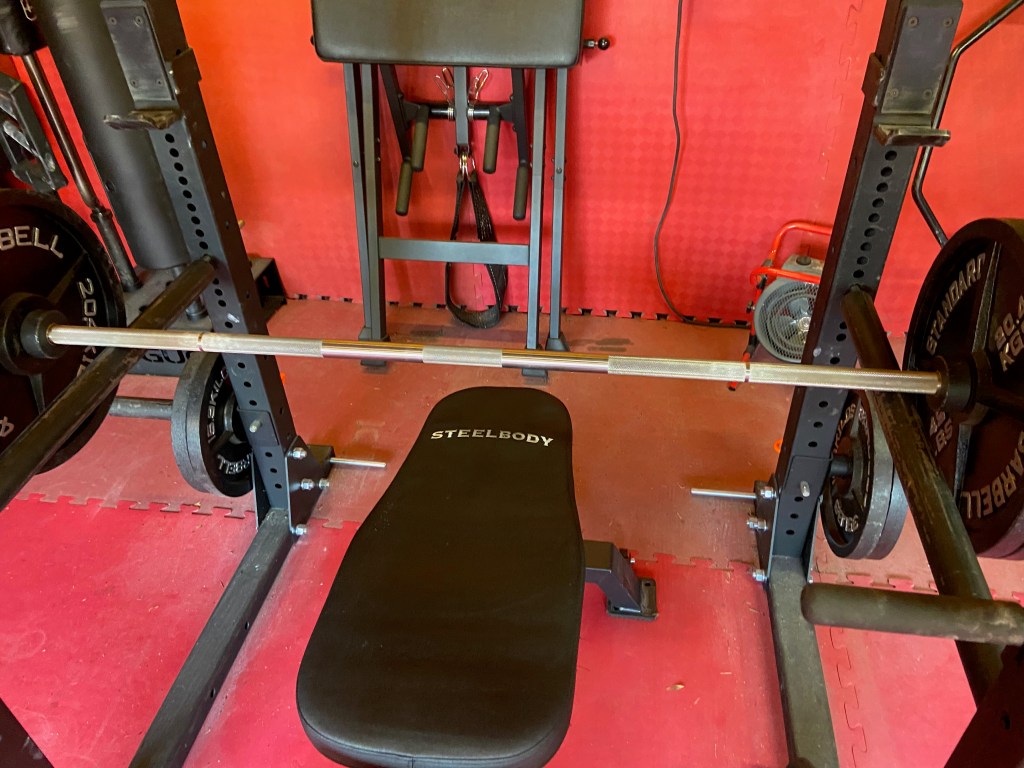
The set up for a Box Hatfield Squat before I bought a box.

A Squat for All

Mark Brown

July 14, 2022

The squat is one of the core lifts anyone strength training does. It can be done any number of weighted implements in tons of different movement patterns. It is also one of the human body’s natural movements so it is something worth improving over the years. Straight bar squats can be difficult for those with shoulder and bicep tendon issues to do because the placement of the bar on the upper back places tension on both of those areas of the body. Other bars get around that by changing the angle at which the the hands hold onto the bar. I own 2 such bars: An EliteFTS Safety Squat Yoke Bar, heretofore known as a Yoke Bar, and a Rogue Fitness Cambered Bar. The squat variant I am here for today is one that involves using the Yoke Bar and the use of either the vertical supports of a power rack or handles attached to a power rack. That doesn’t make is an advanced movement by any stretch of the imagination. Someone just needs access to them, which I concede might be difficult. I am writing this under the assumption that a lifter has it.

The Hatfield Squat is an effective variant of the standard bar and movement pattern for both experienced and beginner lifters. It’s only really doable with a safety squat bar, which is made differently depending on the company that makes or sells them. The Yoke version of the bar sold by EliteFTS is particularly good for Hatfield squats because the pad on the part of the bar that sits around the lifter’s neck is so thick that it allows the bar to sit on the their shoulders very stably without holding the handles. That is the most important aspect about this lift because the hands are used to externally stabilize the body. Most squats and their variants work stabilizer muscles as well as the quads, hamstrings, glutei and back because the lifts use internal stabilization to keep the body upright during the movement. By using the hands to stabilize the body externally using either the vertical supports of a power rack or handles that attach to it, the lifter is able to isolate the quadriceps better. The main effect of the external stabilization is that the lifter can load far more weight on the bar than they could on a free squat to maximize the potential of the isolation. That is why it is a main supplemental lift when I use my Yoke Bar for my main squat movement.

The movement itself isn’t that different from a free squat, but there are some notes of to discuss. For full effect a lifter should squat to parallel before moving back up out of the hole. First, the lifter grabs the handles or vertical supports firmly at close to where a parallel squat would be then unracks the Yoke Bar then begins the movement. The squat is most likely going to feel like a high bar squat because doing a low bar squat on a Yoke Bar requires holding the handles out in front. At the bottom of the squat, also referred to as “the hole”, the lifter squeezes the handles firmly to keep the upper body still without using their hands to pull themselves up while their feet push through the floor to move the weight on their shoulders back up to the lock out position. The lift will feel like a leg press or hack squat, which are machine based lifts. If done as a box squat, it will feel like the latter. If it’s done without a box, it will feel more like the former. A lifter should feel a greater concentration of activation in the quadriceps than anything else. A lifter could definitely see this as a weighted sissy squat.

The value in this lift comes entirely from the external stabilization that is the main point of difference in it from most squats. That impacts directly how it fits into a lifting program. This lift follows the overload principle. The external stabilization allows more weight to be lifted during the movement. That makes it firmly one of the first or second supplemental lifts done after the main lift has been done. I do it immediately following a box or free squat with the Yoke Bar as an extension of that set. Remember, the point of a supplemental lift is to directly help the main movement. Overloading this lift will put help add strength in the quadriceps and upper back because of the movement and natural effect of the bar, respectively. Any squat or pull will benefit from that. The Hatfield Squat might be a lift meant for a home/garage gym set up because public gyms, especially powerlifting focused ones, will likely have a leg press and/or a hack squat machine. Being able to get the effect of those machines in a home or garage gym setting is a major plus.

There are a few specific points to talk about that favor the experienced lifter over the new lifter regarding this lift. Proficient squatting skills are helpful but not necessary. I went over the specifics of what the Yoke Bar brings to a squat in the review of the Yoke Bar but it bears repeating here. It is heavier is in the middle where the “Yoke” part of the bar is. There is a very large concentration of downward force on the body that can be felt right down the middle of the back vertically when in use. The slight camber of 2 inches on the bar sleeves causes the weight to be slightly forward comparative to where it is on a straight bar. These 3 factors give the bar a steeper learning curve than a straight or cambered bar. They will throw any lifter off who is new to using the bar. One factor that is independent of the learning curve is that the bar gets more stable on the shoulders with increased weight. That’s what makes hands free squats not only possible but also even more so the heavier the lift gets.The added weight puts more stress on the neck area between the shoulders so there could definitely be some soreness in those regions.

Experienced lifters would use this lift for the same reason why an inexperienced one would. I’ve already said that one. However, there is a second reason why athe latter group would use it. A Hatfield squat is a good intermediate step from a bodyweight squat or perhaps a goblet squat to a barbell squat for a new lifter if they need it. It helps learn movement more fully without putting them at an increased risk of injury. Yes, the new lifter won’t get the stability work that is key to the squat but that can be worked in with either other lifts or in the next phase of training. Keep in mind this kind of training would probably be done in a home or garage gym where a buddy is helping another one learn how to lift. In this phase, it would treated as a main lift and may be only a few weeks length of time. The Yoke Bar’s features might not bother a new lifter as much because they may not have the reps under them to know how different it really is. I’m not sure how likely that is but it’s possible under the “you don’t know what you don’t know” premise.

The Hatfield squat is a valuable variant of the the parent lift to increase strength in the upper back and quadriceps. Yes, there is specific equipment needed to make it work but if a lifter has access to them, they should consider putting in their program when a SSB or Yoke Bar squat is also in it. Doing a Hatfield Squat after a Yoke Bar box/free squat is as logical to me as doing a barbell row immediately following a deadlift. As Dave Tate said about the latter, “it’s right there.” Even very well stocked home or garage gyms need barbells to do the job of machines. That makes this lift perfect for any home or garage gym lifting plan.

The Joy of Painti…Wait…What?

Making Bob Ross Proud in the Gym

Mark Brown

July 12, 2022

That’s right! That Bob Ross. A look into the paintings that the public television icon did for all those years and the man himself are worth taking a deep dive on into regards to the gym. The entire thing was amazing when it all hit me on the way to the garage to lift last week. First, his pet phrase “there are no mistakes, only happy accidents” is wonderfully complex statement about how to evaluate what is and has happened. Second, there is such an instinctive and organic quality to both the performance and the artwork that it is easy to forget there is a process to to be learned to create them. His ability to do the painting and explain to the viewer the processes involved in getting the exact image desired is powerful. This one is exceedingly important. It makes him organically authoritative on screen in a way that makes him receptive to the viewers. Third, the way the image comes into full view at the end is magical. It’s extremely fascinating how fast the paintings go from incomplete to complete. There are lessons from “The Joy of Painting” that that definitely translate to strength training. We can make Bob Ross proud beyond the canvas.

Bob Ross had a lot of behaviors and phrases that would fall into the “catchphrase” category. The one that sticks out the most the one I alluded to in the introduction. It’s a phrase that encompasses a positive mindset. The word “mistake” has a negative connotation because what was intended to happen didn’t occur. Bob’s phrase avoids the negative feeling associated with mistakes by continuing to work on it until success has been had. It definitely works for his style of painting and it makes him feel more organic as a presenter of information, which helps people buy him as a teacher. The way he goes out of his way add things to the paintings when they are seemingly closing in on being done has made more than just me cringe a bit. It always works out, of course. This behavior is done to show that action could be a mistake if left alone instead of becoming a fully integrated part of the painting. It highlights the long term over the short term and that risks have to be taken to improve.

It’s a lesson that translates to the gym quite well. I know I could get some push back on this from people who think form is king. That there is correct form and incorrect form with nothing in between. The latter is mistake, the other isn’t. I don’t take this position because it doesn’t account for human uniqueness. Proper form is about being as efficient as possible and avoiding positions that compromise long term health. Nothing else. It goes without saying that the learning process in the gym is done through experimentation, even if one has done extensive reading or watching prior to going. The body is really good at telling a lifter when to not do something, or at least not the way it is being done. The mistake would be to not address the issue, which could be a number of things depending on the lift in question. It’s in a lifter’s best interest to learn what not to do so the learning process is more complete. It’s also a lifter’s prerogative to try new lifts every now and again to see how they feel and if they can be of benefit in the program. Any lifter, especially new, isn’t doing themselves any favors if they aren’t doing this. Some lifts will join the rotation and others won’t. Each time a lifter learns what not to do via soreness, pain, etc or lifts that aren’t helpful to the goal and takes steps to correct them, they are following the intent of the happy accidents phrase.

When one watches The Joy of Painting they are seeing someone who has mastered his craft. Sometimes mastery is a hard thing to deal with from the teacher’s perspective because the process itself has become instinct. It has become as naturalized as possible. The teacher has be able to get back into the learner’s shoes, so to speak, and see all of the individual parts of the process they have already mastered. This sounds far easier than it is. It can be frustrating when what is being communicated to someone isn’t sinking in as intended. What Ross does exceedingly well is explain what those individual parts of the process are and how to make them happen. He just does it so effectively and efficiently that both inspiration and depression are inspired at the same time. Wanting to create a painting like the one Ross is executing right before the viewers eyes is a far cry from actually being able to do so. I have had an idea for a painting in my head for years now and even bought a 48” x 48” canvas frame to get it done but still haven’t acted on it because I know I couldn’t get it done as intended now. Perhaps one day. Watching Bob Ross in The Joy of Painting is watching what learned instinct looks like.

The gym is a good place to go to see people in the process of learning how to master their craft. It’s very easy to watch a lifter who is so efficient at a complex lift and be inspired and depressed by them. What’s most important to realize is that there’s a process involved in every lift, and each part of them needs to be mastered to become truly proficient at it. For example, a bench press has distinct points that need to be learned and strengthened. First, loading the pectoral muscles in the eccentric phase. Second, pushing up off the chest through the back. Third, transferring the load from the lats, pecs and deltoids to the triceps for the lock out. In many ways, its multiple lifts being mashed together to create one movement. Forgetting this fact is easy to do and it will hold a lifter back from mastering the lift. This concept goes for the any lift someone is trying to become truly proficient at. Finding a training partner is the easiest way a lifter can help themselves get better, especially if they are good at showing the finer details of the lifts.

Ross’s ability to show the execution all of the movements of the brushes and knife on the canvas, mixing the paint to get the thickness and color, and the total control of everything in the picture inspires confidence in him as the teacher. His level of mastery is such that he comes off as organically authoritative and authentic in his goal to help everyone watching succeed. This really does matter when trying to help someone understand how to do something. The message gets corrupted when a learner starts to feel as though the teacher is belittling them in a meaningful way. It is probably the reason why The Joy of Painting and the man have held up as well as they have since his passing. His show is masterclass in how to achieve organic authority. The method used to get it is the exact polar opposite chefs Robert Irvine and Gordon Ramsey, who use direct confrontation to inspire the same organic authority. The consequences of the difference in methodology means that the chefs will get more “screw you” responses than Ross will get because not everyone can mentally handle direct confrontation well. To be fair to Irvine and Ramsey, they live in high leverage situations on television or in world class fine-dining restaurant kitchens.

Transmitting the knowledge and information is the goal when teaching. Generally speaking, that is best done in a calm manner. It produces an environment in which the learner can accept the information and apply it. A lifter also needs to project a high level of confidence when helping a training partner with a lift. A lot of times this is done with non-verbal communication. Showing someone how to do specific parts of lifts and how the lifts can be improved upon after the first phase of learning has been completed requires significant buy-in to the teacher. This becomes increasingly more important as skill and strength is gained by a training partner. It’s hard to imagine someone telling Ross “screw you” but the attitude brought by Irvine and Ramsey is more useful for situations involving increased pressure. That normally means lifts at or near max intensity or effort. It helps people be more aware of potential dangers involving failure or of their abilities. Choosing Ross’s or Irvine/Ramsey’s method for organic authority will decide on the relationship the lifters have and how each one responds to a challenge. It’s easy to forget that Ross is challenging the viewer become a more instinctive and confident painter because of the tone of his voice and the his inherent positive mindset.

How Ross actually creates the painting in the show follows a certain logic and vision. It’s an example of how setting short term goals helps the long term goal succeed. In Ross’s case, mastering the paint mixing, brush stroke technique, knife technique, color mixing when working on the canvas, and creative bravery all create the final image on the canvas. If one keeps doing this, the process becomes more instinctive. The nature of liquid white, as he explains, allows for most of the work of the painting to be done on the canvas. That also means the painter has to function within a procedural framework. Almost all of Ross’s paintings in The Joy of Painting “move” from top to bottom and back to front. As a result, his paintings have a third dimension. This helps the image come into view more fully earlier than if it were more two dimensional. The speed with which the image comes into view then is completed is magical. It just happens. Then comes the creative bravery. That is the only term I can come up for the stuff that goes on the canvas when the image looks complete. This is when the “happy little trees,” rocks by streams, and other fine details come into the panting. It’s this last part of painting that really tells me that Ross has been challenging the viewer to expand their decision making process and confidence level the entire episode. Sometimes he actually tells the viewer the end of the painting is the “bravery test” because the painting looks done and and easy to walk away from. It’s also the part of the painting that really makes his positive mindset stand out.

A lot of what we can take from The Joy of Painting into strength training applies to programming more than the lifting itself. A program requires vision, logic and structure to be useful. The nature of the human body makes strength training also have a procedural framework. Responding to the bodies limitations on the daily basis becomes a skill the lifter must master over time to get the most of the body and the program. Each day has its own set of goals to accomplish so as to work towards a larger, longer term goal. The painting in this scenario is a lifting competition of some kind or specific strength goals. The smaller goals give programs the third dimension that Ross’s paintings have. Even in programs that are about strength and power development, there is always something in them to develop the muscles that perform the lifts. Once a lifter understands the goals of the program, they can use the daily work to pinpoint areas that need to be improved. That’s what will take the lifter’s recognition skill over the top. They can use it to help make themselves better or become a better lifting partner or coach. This also means being open to lifts that are not part of the program and seeing if they deserve a spot in it. The “bravery test” of a lifter is always looking for new ways to improve. A lot of times this will be done by simply reading or watching material then applying it at the gym in the form of better technique, attempting different lifts or adapting other principles into the current program. It’s very easy to just do the program that is written out without thinking about reasons why it is the way it is.

I know The Joy of Painting doesn’t sounds like a television program that would be helpful in the gym, but a lot of what can be seen in any episode of the long running public television series translates very well to the gym. The subject matter itself is a good analogy for gym work. A singular painting is a smaller scale version of a long term goal. Painting is a skill that requires constant practice to attain even small amounts of mastery. Bob Ross’s mastery shows what having a positive mindset makes one capable of accomplishing. The program also shows how important progress learning individual skills within the larger framework is. The way the picture comes together quickly demonstrates how effective the developing those skills is as an improvement strategy. Ross himself creates an organic authority figure on the subject of painting that allows him to guide the viewer in a way that makes them more accepting of the information. This is something that every lifter, regardless of experience level, can benefit from learning to do. His ability to focus on the goal and learned instinct in both how to do it and explain it to a mixed skill level group makes The Joy of Painting worth paying attention to for any athlete.

2022 Week 27 Training Log

July 4 – July 10, 2022

Mark Brown

July 11, 2022

Monday
Scheduled Day Off – Recovery
20 Minute Walk -1 Miles

Tuesday
Free Squat, Straight Bar – 135 x 10, 225 x 8, 315 x 6, 345 x 3, x 3; 365 x 3, x 3; 385 x 3, x 3; 405 x 2
Banded Pin Pull – 245 w/70 lb bands x 6, 265 w/70 x 6, 285 w/70 x 6, 225 w/100 lb bands x 4 (partials)
Leg Extensions – 110 x 12, 130 x 10, 150 x 10, 170 x 8
Single Leg Calf Raises – Bodyweight x 20, x 20, x 20, x 20, x 20

Wednesday
Cambered Bar Press, Inner Grip – 138 x 6, 148 x 6, 158 x 8, 168 x 6
Cambered Bar Press, Second Grip – 138 x 8, 198 x 3, x 3
Cambered Bar Press, Third Grip – 138 x 8, 198 x 3, x 3; 218 x 3, x 3
Cambered Bar Press, Outer Grip – 138 x 8, 198 x 3, x 3; 218 x 3, x 3; 228 x 3, x 3
Incline Press Press – 100 x 8, 110 x 5; 100 x 8, x 8; 110 x 5
Seated Overhead Dumbbell Press – 55 x 12, 60 x 10, 65 x 8, 70 x 8
Bent Over Read Deltoid Rows – 10 x 20, 15 x 20, 20 x 20, 25 x 20, 30 x 20

Thursday
Tricep Pushdowns, Pronated Grip 45 x 15, 55 x 15, 65 x 15, 75 x 15, 85 x 12
Preacher Curls, EZ Curl Wide Grip – 45 x 20, 65 x 20, 85 x 15, 95 x 10
Muscle Mace, Superset down to up – 45 x 10(x 10)(x 10), x 8(x 8)(x 8), 50 x 10(x 10)(x10), x 8(x 8)(x 8)
Preacher Curls, Narrow Grip EZ Curl Bar – 95 x 15, 85 x 15, 65 x 20, 45 x 20
Seated Overhead Tricep Press – 45 x 12, 65 x 12, 75 x 12, 85 x 10
Standing EZ Curl Bar Curls – 45 x 12, 65 x 12, 75 x 12, 85 x 10
Single Arm Tricep Pulldowns (R then L) – 10 x 12(x 12), 15 x 12(x 12), 20 x 12(x 12), 25 x 12(x 12), L only – 25 x 12, x 12, x 12

Friday
Straight Leg Deadlift – 115 x 5, 135 x 6, 155 x 5
Clean and Push Press – 115 x 5, 135 x 5, 155 x 5, 165 x 5
Barbell Hip Thrusts – 225 x 10, x 8; 245 x 8, x 8
Dumbbell Squats – 95 x 12, 100 x 8, 105 x 8, 110 x 8, 120 x 8
Single Arm Dumbbell Deadlifts, Boxed R then L – 100 x 3(x 3)x 3(x 3), 105 x 3(x 3)x 3(x 3), 110 x 3(x 3)x 3(x 3), 115 x 3(x 3)x 3(x 3)
Isometric Back Rows, Single Arm – 90 x 10, 100 x 8, 110 x 8, 115 x 8
Prone Leg Curls – 65 x 12, 80 x 12, 95 x 10, 110 x 10
Seated Calf Raises, Leg Press Machine – 100kg x 50, 120kg x 30, 140kg x 25 x 25

Saturday
Scheduled Day Off – Recovery
Mowed

Sunday
Banded Bench Press – 135 x 12, 135 w/70 lb bands x 8, 185 w/70 x 8, 205 w/70 x 8, 225 w/70 x 6, 185 w/100 lb bands x 6, 205 w/100 x 4
Narrow Grip Incline Press – 235 x 3, x 3, x 3, x 3; 245 x 2, x 2
Viking Press – 135 x 12, 160 x 10, 160 w/chain x 10, 160 w/ 2 chains x 8
JM Dumbbell Press – 30 x 10, 40 x 10, 50 x 8
Floor Press – 235 x 2, x 2, x 2; 245 x 3, x 3, x 3, x 3; 255 x 3, x 3, x 3

Steps/Miles
Monday 24,905 steps, 11.2 miles. Tuesday – 24,313 steps, 10.8 miles. Wednesday – 24,259 steps, 10.9 miles. Thursday – 22,076 steps, 9.9 miles. Friday – 26,554 steps, 11.8 miles. Saturday – 11,852 steps, 5.9 miles. Sunday – 7,034 steps, 3.2 miles. Total – 140,993 steps, 63.7 miles.

Notes

Right tricep was sore Wednesday morning upon waking up. I cannot tell if that is from body position in bed when sleeping, from the straight bar squat or a mix of the 2. Prior week’s squat didn’t result in triceps soreness but that doesn’t mean anything. It didn’t get loosened until Saturday morning.

American Cambered bar presses were done as supersets in various ways. The way I did them would have been mega confusing to read so I listed them as I did. They will be done for the next few weeks as the main on Wednesdays.

The banded press is interesting. The point is to work on explosive power off the chest. I don’t know if the current rep and set structure I have with them is what I need to develop that. I can feel significant slow down on bar movement at the top end so I know that’s not what I am looking for. Guess we’ll see when I press down the chest again.

Cleans are getting better, but I still can’t get 175 pounds. The second leg day being heavy on hip strength development has been helpful. Goblet squats are very useful front squat option.

Weighed myself Saturday: 288.6 pounds. That is 3ish pounds higher than the last time I weighed myself 4-5 weeks ago. Both thighs measured 27.5 inches. Forearms measured 14 inches. Upper arms measured 17.5 inches. I knew the forearms were close to that, but the other 2 measurements surprised me. I thought the upper arms were closer to 14.5-15. I can’t tell how big I am anymore.

New Lifts in the Plan

Mark Brown

July 7, 2022

The adjustment to my summer lifting plan has been in place for a weeks now. It’s gone fairly well. The addition of different lifts into the second back/legs and chest/shoulder day have made for a different feel and challenge to the session. Some of the lifts are here to stay for sure, while others will cycle through. Today’s entry is about some observations about the additions to the program.

I’ll write about the back/leg portion first because there’s far more variance of lifts than upper/front body. I have written glowingly about leg press before but I haven’t been in a mood lately to do them. Part of it has to do with how my feet feel after doing them and the other part has to do with the last time I did them I ended up with lower back pain. They will get back into the program for certain but I have moved away from them as a main or 1st supplemental lift.

The first lift that has moved into my program that wasn’t there 4-5 weeks ago is either cleans or clean and press. It’s a lift I am very familiar with but haven’t done them consistently before. I superset them with a light straight leg deadlift to get the legs stretched and going. As one can tell from my training logs from the last couple weeks, my cleans weight isn’t impressive. Objectively, the clean is my worst lift that I do. My front rack position is far too wide to be efficient with this movement. Some weeks I will do just a clean and others I will do a clean and push press or a clean and jerk. The latter is iffy. My jerk is terrible. I just don’t move fast enough. They are the main movement on either Friday or Saturday. I’ve felt some benefit from them. I’ve noticed faster, more explosive movement in log press and squat. I can really feel my glutei and hamstrings firing when I do cleans. The pull really is a light weight but movement from the pop off the hips to the catch in the front rack position is what really holds back a higher clean and push press back.

The second is hip thrusts. The addition of this lift is directly related to my removing 1 heavy deadlift and back squat a week from my program. When a lifter removes a deadlift from their session plan they have to replace it with various other lifts that hit all the areas the deadlift would have. Same goes for back squats. Removing a barbell deadlift from the plan isn’t as straight forward as it sounds. Hip thrusts are a major supplemental lift that can be done very heavy. The goal is to strengthen the glutei and hamstrings so they can move more explosively. It is very, very effective when done even partially. I position the bar in the rack about 2-3 inches above the level of a flat bench, rest my upper back on the bench, unrack the bar then stabilize it on my hips. Once the bar is only supported by my hips I lower my hips as much as I can without pain developing then thrust back up to starting position. I’ve seen the same people utilize the lift at the gym for the last couple years but never made it part of my regular plan. In the last few weeks, I have felt an increase in some explosive movements in clean, pulls and squats. I have noticed some bad back pain during a couple Saturday sessions involving hip thrusts but I think have isolated the problem so I don’t think deep hip thrusts are to blame.

The third is a goblet squat. On my training logs, it has been called a dumbbell squat because heavy dumbbells is what I have been using to do them. This lift’s effectiveness has surprised me the most of the new lifts in my program. The dominant reason for the addition of the goblet squat is to work in a squat exercise into my session without more heavy spinal loading. A lesser reason is that I can’t find a hand/body/bar position that is both effective and comfortable when front squatting with a barbell. As I stated above, my front rack position is far too wide to be effective and my wrist mobility is atrocious for performing front squats in either the CrossFit or Weightlifting fashion. What I have noticed the most when doing the movement is how much easier it is to hit parallel or below it, especially since I have heeled shoes on normally. My shins and back stay more vertical when I do them and how much stress is placed on all the front side muscles. The dumbbell is a fixed weight so this is more about muscular development than strength or power.

The last of the new additions to the leg/back sessions is a single arm dumbbell pull from the floor. I typically do this one after doing the goblet squat and from a box that starts my thighs parallel to the ground or close. I have thought about doing this lift in the past as an accessory or late supplemental but have never implemented it till now. The fact that I am using a dumbbell caps how difficult the lift can be from a weight perspective so this is more about training the lockout, grip and hip mobility. I feel full quad engagement at the lockout when I complete the pull. Like the goblet squat, this is more about muscular development. Without a barbell deadlift or back squat, hips have become the main muscle group targeted on the second leg/back day. So far the concentration on hips, which I wasn’t doing before, has been having a positive effect on my training. I have felt it on the first leg/back day when I do heavy squats and pulls.

There’s nothing really new coming into the chest/shoulder sessions that hasn’t been parts of them in the past. It’s more about cycling lifts through to keep them progressing at a good clip. Bands come back on the bench press to help increase explosive power on the movement so I can work past my current sticking point a couple inches above my chest. I haven’t used my Viking Press in about 6 months so that’s taken a bit to get used to. At the gym for the first chest/shoulder session of the week I have been using the isometric wide chest press machine as a supplemental lift. I go as heavy as I can for 3-6 reps, which is typically 90-135 pounds per hand. The goal for that day is to work on raw strength. The skill based movements are saved for the second chest/shoulder day Sunday. The only other consistent addition to midweek chest day has been working on the negative part of the press. The Genesis at Merle Hay has a selectorized seated chest press machine that is perfect for this exercise. I push the weight out to the “top” position of the press with my feet using max weight (285 pounds) then let it come back to the “bottom” position after at least 5 seconds has passed. I do usually do it for 4 sets of 6. The lift really tests the stabilizers in the triceps. I do much the same lift as a supplemental when pressing with my cambered bar. I have felt more stable the last couples weeks. Very helpful lift.

I’m sure there will be more lifts I will work through in the coming months to work on specific parts of lifts or muscular development. When I do, I will write about them when enough time has passed to vet them. The lifts I have shared today are ones that have had tangible positive effects on my main movements. Just 2 weeks after I started concentrating on hip development I did normal block pull routine of 345-365-385-405 for 2 sets of 3 at each weight without my powerlifting belt. They’ve given a benefit, there’s a chance it will benefit anyone reading this post.

Lessons From the Road

The Road to Discipline Addendum

Photo by Sergei A on Pexels.com

Mark Brown

July 5, 2022

The Road to Discipline is the most challenging written project I have ever done. The papers I wrote during my last semester at Drake in 2008 compare well based on the amount of research I had to do to complete them. I have had the blog up for nearly a year and I have both remembered writing lessons from the past and learned new ones during that time. I have made some realizations while writing the particular set of entries on the blog that are pertinent to the subject of The Road to Discipline, writing in general and even perhaps the future of the blog itself. Today’s entry will be about them. Other entries I make from this point could be about matters concerning discipline, but my drive to create a treatise about the subject has been sated for the time being.

The most fascinating part of the process to writing The Road to Discipline was how it ended up becoming what it was. The only idea called “The Road to Discipline” in my blog ideas notecard on my phone is the first one. It was indeed about what I wrote it about. I looked at my growing list of ideas and found that discipline was at the heart of them. Chapters 3-7 were ideas I had already stashed away for later. They’d been there for awhile and just needed to be ordered properly for best use in the grand scheme. The content of them was very thought out after the decision was made to make the original thought fit into the bigger picture. Chapters 8-11 were intentionally developed after I committed to finishing the accidental treatise. In many ways it resembles very precisely how my approach to strength training has evolved over the years.

Writing it helped me develop better writing discipline because it pointed my entries towards a specific direction. My blog has alway leaned towards strength training but has always been a scattershot of ideas that come to me. There is value in both the expected and unexpected from a content point of view. Releasing Road pieces on Tuesday allowed my brain to get my thoughts on discipline out on self imposed schedule while also developing other smaller ideas without a set schedule. It’s possible I could have written The Road to Discipline like how I wrote about deadlifts to the same effect but it had more power to me in my own mind that I was committing fully to concept.

The most important thing writing this series forced me to do was to tie different ideas together into one cohesive vision. My blog has entries that are split into multiple parts. Almost all of them were written as one piece but became 2 parts because they ended up being a bit too long to unleash as one entry. I learned last year that leaning towards shorter than longer is better for entries in a blog. That lesson was important because it informs me how I want to write a piece destined for the blog. If I am writing and I see it going above 4-5 pages in Pages, I will look for logical places in the piece to split it up. The other version of this is the 4 entries I’ve done on deadlifts. They all tackled individual aspects of deadlifts that I see need to be addressed in training, especially the last 2. They weren’t the same idea but the subject matter was related one central idea.

What The Road to Discipline did was take that concept and increased the volume and difficulty. In that way, it’s the concept of progressive overload being used organically to consciously improve my writing skill. If one only writes singular idea writing pieces, making two or more independent pieces connect well will be more difficult and be more time consuming. The subject matter helped me write the piece. Parts 3-7 being independent ideas already in my head forced me to come up with a the structure for Road fairly early on despite writing each individual piece week to week. The questions of why which individual ideas go before others needed to be only justified to me, the writer. One of the biggest takeaways for me is is that those questions would have to be answered to editors or other figures in other circumstances. It is something to be mindful of when writing.

Once the structure was set, connecting the independent essays together using discipline as the tether to bind them became harder to do as I thought of the ideas for the latter stages of Road. Parts 8-11 are probably the hardest writing challenges I’ve had in years. It’s not something I was capable of producing last year when I started the blog. Tying multiple independent essays together while marching towards a greater conclusion isn’t something I had planned to do on the blog. It just happened. Writing the essays and publishing them over the period of 10 weeks made me really think what my conclusion was. I can understand why some start with the conclusion and work backwards, but it was beneficial to me to constantly question what I writing about. The important part was that getting the structure stabilized in the middle allowed me to really concentrate on the bigger picture. That’s something that writing individual essays can’t help train.

The Road to Discipline also had the effect of clearing my growing list of ideas. A back log had developed that needed to worked through. My writing discipline has grown over the last couple months, especially since I self imposed a schedule of release dates on myself. That strategy has definitely improved how I write and how I structure my week. Making Tuesdays the day a Road chapter was released held my feet to the fire. It made me prioritize writing some essays over others. I developed the idea for equipment reviews during the writing of Road to be a piece for the blog that didn’t take as much mental energy to write, finish and post as scheduled. The reviews are some of the shorter essays I write because there’s just less meat on the bone to chew, so to speak.

I didn’t intend to write a treatise about anything on my blog. Bob Ross would be pleased, I’m sure. I’m happy I took the challenge that was literally sitting in front of my face and came out of it with something I am proud of. There will be more of these in the future. The lessons I have gotten from writing The Road to Discipline helped my writing discipline and understanding a bit more of the direction my blog is headed. I hope everyone sticks around.

2022 Week 26 Training Log

June 27 – July 3, 2022

Mark Brown

July 4, 2022

Monday
Scheduled Day off – Recovery
15 minute Walk

Tuesday
Free Squat, Straight Bar – 135 x 8, 225 x 6, 315 x 3, x 3; 365 x 3, x 3, x 3; 385 x 3, x 3; 405 x 2, x 2
Banded Pin Pulls, right below kneecap 1 70 lb band added to bar on each side for all sets – 225 x 6, 245 x 6, 265 x 6, 275 x 6, 285 x 6, 295 x 6, 305 x 3, x 3
Leg Extensions – 110 x 10, 130 x 10, 150 x 10, 170 x 10, 190 x 8
Calf Raises, Single Leg R then L – Bodyweight x 15(x 15), x 15(x 15), x 15(x 15), x 15(x 15), x 15(x 15)

Wednesday
Flat Dumbbell Press – 75 x 8, 105 x 12, 110 x 11, 115 x 9, 120 x 6, 125 x 4
Seated Overhead Dumbbell Press – 55 x 12, 60 x 12, 65 x 10, 70 x 10
Cable Crossover – 42.5 x 15, 50 x 12, 57.5 x 12, 65 x 10
Arnold Press – 50 x 8, x 8, x 8, x 8
Isometric Wide Chest Press, Machine, per hand – 90 x 8, x 8; 115 x 6, x 6; 140 x 6, x 6
Bent Over Rear Deltoid Rows – 10 x 20, 15 x 20. 20 x 20, 25 x 20
Machine Press, Negatives – 285 x 6, x 6, x 6, x 6

Thursday
Tricep Pushdowns, Pronated Grip – 45 x 15, 60 x 12, 70 x 12, 80 x 12, 90 x 8
Preacher Curls, EZ Curl Bar Wide Grip – 45 x 15, 65 x 15, 85 x 12, 95 x 12
Muscle Mace Giant Set – 45 x 10(x8)(x8), x 8(x 8)(x 8); 50 x 8(x 8)(x 8), x 8(x 8)(x 8)
Preacher Curls, EZ Curl Narrow Grip – 95 x 12, 85 x 12, 65 x 20, 45 x 20
Skullcrushers, Superset with Standing EZ Curl Bar Curls – 75 x 10(x 8), 85 x 8(x 8), 75 x 10(x 8), 75 x 10(x 8)
Single Arm Tricep Pushdowns, R then L – 10 x 12(x 12), 15 x 12(x 12), 20 x 12(x 12)

Friday
Straight Leg Deadlift – 95 x 5, 135 x 5, 145 x 6
Clean and Push Press, Singles – 95 x 5, 135 x 5, 145 x 5, 155 x 5, 165 x 4
Dumbbell Squats – 90 x 8, 95 x 8, 100 x 8, 105 x 8, 110 x 8, 115 x 8
Single Arm Dumbbell Box Deadlift, R then L – 100 x 3(x 3)x 3(x 3), 105 x 3(x 3)x 3(x 3), 110 x 3(x 3)x 3(x 3), 115 x 3(x 3)x 3( x 3)
Isometric Lat Pull, Per Hand – 90 x 10, 100 x 8, 105 x 8, 110 x 8
Prone Leg Curls – 80 x 12, 95 x 10, 110 x 10, 125 x 8
Calf Raises – 100 Kgs x 50, 120 kgs x 30, 140 kgs x 30, 160 kgs x 20

Saturday
Scheduled Day Off – Recovery

Sunday
Banded Press, To Chest Fast Press – 135 x 12, 225 x 12, 155 w/70 lb bands x 6, 185 w/70 bands x 6, 205 w/ 70 x 6, 225 w/70 x 6, 185 w/100 lb bands x 6, 225 w/100 bands x 2
Narrow Grip Incline Press – 225 x 6, x 6; 235 x 6, 245 x 3
JM Press, Dumbbells – 35 x 10, 40 x 10, 50 x 8
Viking Press, Clean and Strict Press – 135 x 12, 160 x 12, 180 x 10, 180 w/ 30lb chain x 8
Floor Press – 235 x 6, 245 x 3, x 3, x 3, x 3, 255 x 3, x 3
Rack Pushups – Bodyweight x 10, x 10, x 10, x 10, x 10

Steps/Miles
Monday – 27,779 steps, 12.8 miles. Tuesday – 24,017 steps, 11.2 miles Wednesday – 24,595 steps, 11.5. Thursday – 22,264 steps, 10.5 miles. Friday – 25,845 steps, 12.0 miles. Saturday – 4,958 steps, 2.6 miles. Sunday – 9,502 steps, 4.5 miles. Total – 138,960, 65.1 miles.

Equipment Review: Ohio Power Bar

Thoughts and Performance Review

Mark Brown

June 30, 2022

Ha! I bet you thought I only had EliteFTS Stuff. Reviewing a bar like this is harder to do than a specialized bar because the latter is designed to something very specific exceedingly well. That’s why they exist and are extremely valuable to have in a gym when the money allows it. A power bar has to be able to everything well because it used for a wider variety of lifts and exercises. That’s why this article has taken the time it has to get done.

First, the Rogue Fitness Ohio Power Bar has tons of different types of finishes for both the bar and the loadable sleeves. The one I have is a stainless steel finish on the bar and black cerakote on the sleeve. It’s very striking and has required no maintenance so far in a full year and half of ownership. The sleeves spin perfectly. It is a well constructed bar. The finish also made it about $100 ($400 total) more expensive than other finishes.The knurling on it is aggressive but it doesn’t take much to get used to. It’s definitely more present than on Olympic bars. That’s not shade on Oly bars because those bars are designed to do something else that doesn’t require heavy knurling. I’ve definitely felt more aggressive knurling on other bars, the Ohio Deadlift Bar and Texas Deadlift Bar specifically.

Now that the bar’s specs have dealt with, the harder part of the review for me begins. I got the bar in response to the only bar in Pete’s garage to lift with was his old power bar he’s had for 25 years. One of the sleeves came undone while deadlifting a couple times so that put me on the hunt for a power bar for use both there in the garage and if my stuff ever comes back to my house. This bar solved such issue I could have. The transition from the old power bar with little knurling left on it to the very knurled Ohio Power Bar took quite awhile. I could press all way up to 265-275 pounds with the Pete’s bar but could only do about 235-245 with the one I just bought. I suspect that’s because it is slightly longer and that threw off my hand placement. I have since learned a wider hand placement on the bar for pressing and my bench press has never been higher. Long pressing sessions have resulted in my hands getting overly chewed up so that is something to be aware of. It’s why I am considering investing in a combo bar.

Bars for squatting and deadlifting have been changing quite a bit lately. Deadlift bars are being developed with more whip in mind to help aid bigger deadlifts at competitions. Squat bars are being developed to fit a population of competitors that are bigger. Rogue Fitness’s Buffalo Bar is a Duffalo Bar on a few steroids. It was highlighted at their company’s Strongman Invitational. It got a lot of positive buzz because professional Strongmen are some of the largest athletes in the world and it worked well for them. Even with the effect of the bow in the bar, JF Caron made the bar look it wasn’t large enough. That’s how big some Strongman competitors are.

The reason I mention all of that is because straight bars can be difficult to squat with for because of the tension they put on the shoulders and both bicep tendons. This is especially true for individuals with larger upper backs. Getting the hands on the bar without feeling too much tension can be difficult. I myself own 2 different squat bars because of that reason. Straight squat bars are longer and thicker than power bars. The Rogue Squat Bar has knurling all the way down it and is 32 mm thick, as opposed to the 29.5 mm thick Ohio Power Bar. I have a squat with a straight bar in rotation with the Safety Squat Yoke Bar and the Cambered Bar to keep my skills on it fresh. A straight bar squat is and always will be one of the 3 main lifts at a powerlifting competition. The center knurling, as the squat is the only reason to have center knurling on a bar, is every bit as aggressive at the rest of it so make sure to wear a decently thick shirt when squatting with this bar. One will understand immediately if they made a mistake on shirt choice. I have my heaviest squats on this bar, in part because it is where my power rack is.

I haven’t deadlifted with this bar for a specific purpose. That reason is because I have a deadlift bar. The deadlift bar came in stock before the power bars did on Rogue’s site in the fall of 2020. If I ever wanted to do a powerlifting meet, then I probably would deadlift with Ohio Power Bar to work with a much stiffer barbell on that lift. However, I have done plenty of rack pulls off the safety straps and can firmly say that the difference in thickness from this bar to the Ohio Deadlift Bar, 29.5 mm to 27 mm respectively, matters. I know that doesn’t seem like much of a difference but in this sport the very fine points matter. I can’t get a hook grip on the deadlift bar as is because my hand size and finger length. I use straps and make it work. The difference between the thicknesses could matter to someone with a specific hand size.

The Ohio Power Bar is an excellent bar to invest in. As of the time of this post going up, the Bare Steel variety sits at $295 and the “lower” end finishes are in the low $300s. That’s a bit of a monetary investment but buying it could last multiple generations of lifters treated it right. I’m sure there are power bars out there with more aggressive knurling but this one’s knurling is good enough for me. It’s survived the pin presses I’ve done on it to date without damage. I expect that to stay the case. The bar does all 3 main lifts exceedingly well, especially for non-competitors like myself. I’m 6 foot tall and 285 +/- 5 pounds and a decently larger build. If you’re anywhere close to me and don’t have shoulder/bicep problems, you don’t need a Buffalo, Duffalo, Cambered or Safety Squat Bar to do squats. The thicker, stiffer bar will make deadlifts harder than using a deadlift bar for them, but that doesn’t make the latter necessary to do the lift. This bar will do all the lifts any gym needs it to do. Leave the Weightlifting to the Olympic bars though.

The Road to Discipline: Chapter 11

Photo by Shamia Casiano on Pexels.com

A Goal Only Interrupted By Death

Mark Brown

June 28, 2022

Long term goals can only be achieved by accomplishing numerous short term goals along the way. That requires working every day to get the the latter done to get to the next one. The real key to achieving the long term goals is to maintain past short term goals while going after new ones. It’s never wise for one to assume just because a goal was completed that it will stay that way. This means that improving every day is necessary. Discipline is what a person develops to make sure that happens. I have spent the last 10 weeks getting to the heart of what discipline is, what causes it to breakdown, and ways one can repair damage done to it over time because there’s one central truth to all of this: Discipline is a goal only interrupted by death. It’s the ultimate long term goal. I will explain why in this grand finale.

Long term goals are just like everything in life that choices are involved in. They have both positive and negative effects. They provide a general direction for all of the short term goals so they don’t get lost amidst the confusion of daily life. It’s very easy to make a goal with something specific in mind then make decisions that don’t help it in a meaningful way. I’ve referenced my early 2022 goal of increasing my deadlift only to end up programming more squat development numerous times already. I know it might get annoying to keep hearing about it but it really is one of the best personal examples I have of this happening. It’s a surprise that didn’t have any negative consequences in the moment only because I didn’t have a competition in March or April. It sounds like a smaller mistake than it actually is. If this kind of mistake happens to someone who runs a small business, survival could be threatened. It could also end up being a happy accident, as Bob Ross would say. Uncertainty stemming from procedural mistakes definitely forces someone to evaluate on the fly and learn to multitask.

A goal is much easier to pull off when the vision for it is clear from the start. It can make setting short term goals easier like what I just stated above. However, the net effect of a clear vision is seeing the growth process more thoroughly and understanding how to learn more effectively. That is felt more in programming and daily work than anything else. The process builds on itself like compound interest. A strength training program is a great example of this but it is hardly the only one. Anyone who wants to become better their craft needs to challenge themselves in stages to actually learn along the way. It doesn’t help to go right for the most difficult part of the process if one can’t learn quickly from what they are seeing. Burnout is a high probability for someone who isn’t all in with their soul. This process can be agonizingly slow but that lower speed is what will actually make later stage complexities easier to interpret. Decisions can be made faster and with better focus on how they will help the next few steps. Instinct is grown in this way and is the final stage to learning a craft. A sign of it is when someone has difficulty teaching a concept that they have fully learned without having to break down all of the processes involved for the learner.

One possible negative related to long term goals is emotional attachment. When someone goes all in with their soul on something, the highs will be very high and the lows will be very low. The latter will be either traumatic or very close to it. This can be a challenge to deal with on a daily basis because of the ways emotions effect decision making, especially when life’s other factors get thrown in there as well. I’ve described goals as being the thing that everything else we do is a slave to before. It’s important to this conversation because of the way goals compete with each other, even within one person. A lot of long term goals involve a level saving money over time consistently because a lot of them require a large monetary up front cost just to get feet in the door. Houses, vehicles, small businesses, equipment for home based small businesses, large scale equipment for larger businesses, etc are just a small portion of what I am referring to. This helps if someone needs to pivot off of a stated goal onto a different one. Pivoting to new goals without becoming emotionally traumatized is a tough task for anyone. Professional athletes talk about it quite a bit. Members of the mass media speculate on how professional athletes will handle the transition from retirement to normal life a lot. I just watched JJ Redick refer to retirement as a “second death” in his podcast with Stephen A. Smith. That might seem dramatic to someone as emotionally balanced as I am most of the time, but it’s perfectly in line with the level of emotional investment that discipline demands.

Through discipline, daily improvement is emphasized over everything else. The thoughts that are based around the tomorrow’s goals are nice but distracting, so they need to be washed from the mind. Consistency is the the most important concept to understand where discipline is concerned. It helps one maintain the momentum from yesterday’s work towards the greater goals through getting mentally, physically and intellectually better than they were last time, as Greg Doucette would say, and forces them to work under a greater load. Progressive overload isn’t just a term that is applicable to lifting. It’s how people get better in general. Breaking down complex movements or projects into their individual parts and using every day to improve at them is how someone is going to actually put significant progress together. That’s where learning how to learn from both experience and secondary sources comes into daily improvement. One has to pay attention to the world around them. Just doing something day after day isn’t enough. One has to actually take something from what they are doing one day and be able to apply it on command the next. Any long term goal is going to be dependent on consistent effort focused on daily improvement.

A focus on daily improvement has an effect than can’t really be planned for. Luck is something needs to be accounted for. Fortune plays a large role in everybody’s life in ways no one even comprehends. One of the phrases that sticks out from my reading of Napoleon Bonaparte is “managing luck.” It’s conceptually stupid but the man who said it is someone I regard as one of the most competent humans to ever exist so there has to be something to it. If one is focused on daily improvement, dealing with the bounces becomes an easier task. A small part of this is because one is getting better every day. A bigger part of it will come from opportunities that fall into one’s lap that they had no hand in. There’s more than enough success stories out there centering around people with divergent paths aligning to create something special. Sometimes this is business, others it’s personal. Improving daily requires one to keep their eyes open to see all the opportunities they have. One might go after something specific daily but find they like a particular part it more than others and pivot towards a goal that centers on that. If one isn’t working daily to improve, they never see it. One can help improve both their luck and how they handle it so when bigger, more lucrative goals become actually attainable, their increased competency aids faster growth. The same applies for when the larger goals have been achieved. Competition is fierce. Diligent daily improvement helps identify competitors and strategies to defeat them. This makes being consistent in effort crucial to survival of one’s goal.

Consistency isn’t exactly easy to successfully find when goals aren’t lurking somewhere. This can come from a lot of different sources. Most of them come from the beginning or end stages. People whose dreams have been defeated can be acutely effected, especially if their emotional attachment to it is great enough. Pivoting from from one goal to another can be traumatic, as seen from Reddick’s quote. It can create a rudderless boat effect, so to speak. Moving without a stated goal is difficult for those who are goal driven. Discipline functions as a goal in the absence of stated short or long term goals. The goal of daily improvement is enough to sate the mind in these cases so that interest can spark when one opens their eyes to the possibilities that lay before them. By maintaining that drive and momentum forward, one can accelerate the success of a goal they found faster than if they gained interest in it out of the blue. Sometimes one has become a slave a goal in order to do it. They do that by emotionally suppressing some needs while propping up others.

Daily improvement is a bit of a wandering target. It’s might not be the same every day. As we age, daily improvement changes in relation to what can be improved day-to-day. The peak of physical improvement tends to be from 25-40 years of age. From this perspective, the improvement one can make physically lowers, something drastically. Medical science is doing its best change that but the physical effects of aging are impossible to stop. Our ability to improve mentally and intellectually doesn’t peak unless there is a physical impairment that hinders it like a brain or nervous system injury of some kind. Between the 3, there are ways for daily improvement that shouldn’t be ignored. Some days there will be more of than others. That’s the way it is when we are any age. `Discipline is the force behind daily improvement and can be around our entire lives. It might not sound grand but is nothing short of the longest term that can be made. It is a goal only interrupted by death.

All goals require disciple to get accomplished. There is a lot less luck involved in getting the long term varieties done. It plays a substantial role in short term goals because of the way unrelated events effect the bigger picture. Doing the work that needs to be done every day helps minimize back luck and maximizes the potential of good luck. One can dream big but it is the daily work that actually creates the opportunities that make up the short term goals. No long term plan can be achieved without the first accomplishing those goals. They create positive energy from which someone can create forward momentum towards larger goals. Being able to take the fortunes of daily life in stride while managing to proceed towards stated goals is a challenge for anyone. The costs of staying on task can be quite high. They are varied and effect multiple people in one’s life. Constant movement forward isn’t necessary or even possible but not taking steps backwards is. One does that by putting in the work every day to improve. That consistency will pay off at some point. One just has to keep their eyes open to world around them and learn from it.

2022 Week 25 Training Log

June 20 – June 26, 2022

Mark Brown

June 27, 2022

Monday
Scheduled Off Day – Recovery
Evening walk, handful of short wind sprints

Tuesday
Free Box Squat, Yoke Bar – 155 x 6, 225 x 6. 335 x 3, x 3, x 3, x 3; 345 x 3, x 3, x 3, x 3
Hatfield Box Squat, Yoke Bar – 385 x 6, 405 x 3, x 3; 415 x 3, x 3; 425 x 3, x 3
Calf Raises – 335 x 25, x 15; 345 x 25, x 15
Banded Deadlift, weight + 70 lb Monster Band – 225 x 3, x 3, x, 3; 245 x 3, x 3, x 3; 265 x 3, x 3
Barbell Rows – 185 x 6, x 6, x 6, x 6

Wednesday
Flat Dumbbell Press – 75 x 8, 105 x 10, 110 x 10, 115 x 8, 120 x 5, 125 x 3
Seated Overhead Dumbbell Press – 55 x 12, 60 x 12, 65 x 8, 70 x 6
Isolatreral Wide Chest Machine, Weight in Each hand – 90 x 6, x 6; 115 x 6, x 6; 135 x 6, x 6
Arnold Press – 50 x 8, x 8, x 8; 55 x 8, x 8, x 8
Bent Over Rear Delt Flies – 10 x 20, 15 x 20, 25 x 20, x 20
Machine Press Negative Reps – 285 x 3, x 3, x 3, x 6, x 6, x 6

Thursday
Tricep Pushdowns – 45 x 12, 55 x 12, 65 x 12, 75x 12, 85 x 12
Preacher Curls, EZ Curl Bar Wide Grip Superset with above – 45 x 15, 65 x 12, 95 x 12, x 10
Chain Grenade Superset, Bottom then Top Ball – 45 x 12(10), x 12(x 10), 50 x 10(x 8), x 10(x 10)
Preach Curls, EZ Curl Bar Narrow Grip superset with above – 95 x 12, 85 x 12, 65 x 20, 45 x 20
Seated Overhead Tricep Press – 45 x 12, 55 x 12, 65 x 12, 75 x 12
Standing Curls, EZ Curl Bar Wide Grip Superset with above – 45 x 12, 55 x 12, 65 x 12, 75 x 12

Friday
Straight Leg Deadlift – 95 x 5, 135 x 5, 145 x 5, 155 x 5
Clean and Push Press, Superset with SLD, done as singles – 95 x 5, 135 x 5, 145 x 5, 155 x 5
Hipe Thrusts – 225 x 12, x 12; 275 x 12, x 8, x 8
Dumbbell Squats – 80 x 8, 85 x 8, 90 x 8, 95 x 8, 100 x 8, 105 x 8, 110 x 8
Single Arm Seated Dumbbell Deadlifts, R (then L) – 100 x 3(x 3)x3(x 3), 105 x 3(x 3)x3(x 3), 110 x 3(x 3)x 3(x 3)
Isolateral Lat Rows, Each Hand – 90 x 10, 100 x 8, 105 x 8, 110 x 8
Calf Raises, Seated Leg Press Machine – 100kg x 50, 120 kg x 30, 140kg x 30, 160kg x 25
Prone Leg Curls – 65 x 12, 80 x 10, 95 x 8

Saturday
Scheduled Off Day – Recovery
Golfed, Mowed

Sunday
Chain Press, To Chest, 45 lbs added at bottom 60 at the top – 135 x 12, 225 x 6, 245 x 6, 225 w/chain x 6, 235 w/chain, 245 x 3, x 3; 255 x 3, x 3
Narrow Grip Incline Press – 225 x 3, x 3, x 3, x 3; 235 x 3, x 3, x 3, x 3
Seated Overhead Press, ACB – 128 x 6, 138 x 6, 148 x 3, x 3; 158 x 3, x 3
Floor Press – 225 x 6, 235 x 6, 245 x 3, x 3; 255 x 3, x 3
Rack Pushups – Bodyweight x 10, x 10, x 10, x 10

Steps/Miles
25,543 steps, 12.6 miles. Tuesday – 23,745 steps11.0 miles. Wednesday – 23,699 steps, 10.9. Thursday – 20,980 steps, 9.7 miles. Friday – 24,284 steps, 11.2 miles. Saturday – 12,312 steps, 5.8 miles. Sunday – 6,291 steps, 2.8 miles. Total – 136,854 steps, 64 miles.

Notes

I can feel progress in upper body weekly now. Triceps feel more solid. Presses feel more even and quicker at the bottom. Going to start working on being more explosive and quicker at the bottom at higher end.

Didn’t feel a lot of pain in back while doing the second back and leg day this week, Hip thrusts still produced a bit of pain in the back but it didn’t linger. Dumbbell squats and single arm deadlifts are keeper lifts. I will use them in the future. It is much easier to keep the dumbbell in front of me than my barbell front rack position. It also introduces a high level of strain for the entire upper body without the spine loading.

I believe the Isometric chest machine and machine press negatives are doing the intended job. Chest is getting a lot of work for what feels like less work than before. I know there’s a lot of sets being done but the number of reps helps to keep me from getting overworked. I feel the slight change to overall plan is working so far.