The Road to Discipline, Chapter 7

Photo by fauxels on Pexels.com

Learning Strategies

Mark Brown

May 31, 2022

Any physical development needs to be paired with both mental and intelligence development to see the most growth. It is possible to get both individually but development of them will be slower because structure of discipline is less complete. I’ve seen evidence of it multiple times in my life. Learning how to accomplish tasks, both simple and complex, is at the core of what “good” discipline is about. I have talked about learning directly through experience and through supplemental resources in past chapters. There are a couple other learning strategies worth exploring. This chapter is dedicated to them and the what they bring to the table.

I believe I need to start this with a look at the physiological part of learning because I need to discuss how the body itself is effected. Learning how to perform tasks is amongst the most important things a person has to be able to do in general. This often gets overlooked because it is such an obvious statement to make it sounds stupid to say aloud. However, we know many things that get in the way of that: Learning or physical disabilities, upbringing, traumatic injury, etc. This opening stage of learning can be very frustrating because there are multiple layers of expectations at work regarding the rate of learning. The first involves one’s own ego and the second involves what others think of how fast one is picking it up. This can all come together into a storm that sets everyone back.

Getting better at athletic movements is particularly difficult because they can be only be learned by feeling the motions and seeing success from those actions. The difficulty is only added to by the fact that success in this situation could be send the wrong message. There are almost always multiple ways of performing tasks that will create successful outcomes. Each one has specific short term and long term consequences. Luck is always present and must be accounted for also. Determining what happened because of skill and what happened because of luck is extremely important and sometimes supremely difficult. This is what makes golf so damned hard. It is also why coaches, private trainers and training partners are in such high demand for athletes who seek to improve, especially when room for it decreases. Their ability to see what is happening from a third person point of view allows for the athlete to combine experience based learning with supplemental information to create a more complete breakdown of the technique was just used. This happens in an endless loop between the practices and games. Thus, the learning process never ends.

What I just described is why I favor prioritizing learning through experience over from supplemental resources. Learning how their actions feel allows one to funnel information about it from other sources more efficiently. That could be from watching directly as a spectator in person, from a video or from a magazine or blog. I often people watch at the gym to see how a movement I normally do is effecting another lifter’s body for this reason. It will also allow them how to better spot incorrect information within sources. Maintaining discipline is crucial to both physical and mental development because gathering information is always a good thing. “Paralysis by analysis” only happens when someone tries to accomplish too many things at once with the information given. If one knows their goal, has conviction, understands the consequences and the information backs up their feeling then the decision becomes easier to make.

Supplemental resources become more important the longer a lifter stays on the path because they will experience things that require some form of research to figure out what it is, how they could be doing it better, and what other things they can do achieve that effect. As I stated in last chapter, discipline’s structure allows knowledge that wasn’t learned through experience to filter in at a greater rate. The information becomes actionable much faster than if one isn’t actively building up their discipline. There are thousands of podcasts and videos about physical education on the internet so the supplemental learning is far easier to attain than ever before. The hard part is filtering through the information to distinguish what is really quite useless, helpful, game changing, and worth passing on. Information from these resources needs to be actionable first and foremost. It has to function the way a supplemental lift does. In the case of the information, it must aid the experience based learning. The best personal example I have is EliteFTS owner Dave Tate explaining how to plan sessions. Learning how to plan individual sessions has helped me learn programming much better. I can see my lifting before 2021 was planned but not structured. Seeing the differences between the two has elevated both my learning and my activity.

The metaphor I use for the path lifters take is that they start out on a flat, plain field then dip down into a deep, highly vegetated ravine and back up again onto another flat, more vegetated field. The first represents the initial organic phase of a lifting plan, which is more basic in nature. The ravine is what happens when a lifter starts to dig into supplemental information to enhance what they are doing. One could do this through experimentation alone but that would be a major commitment to do blind. Generally speaking, that doesn’t happen without significant research because of how expensive equipment in. The flat field on the other side of the ravine is what happens when someone puts a serious effort into the physical and intellectual part of lifting. The metaphor I used is what I feel my strength training journey has looked like. Most of the equipment I own is a result of living in the ravine for the last half of the 2010s. The tricky part is navigating the ravine. It’s easier to get lost than it is to find the path to the other side. Strength training really is a simple game when one finally understands it, which isn’t inevitable. It is entirely possible to never leave the ravine.

Learning is done in a multitude of ways. I’ve already talked about 2 of them at length through The Road to Disciple. There are a couple more learning strategies worth noting. Becoming proficient at assimilating information straight from a book, magazine, podcast or video is the most ideal way to pick up knowledge from supplemental resources. That isn’t as easy as it seems. It is a skill in and of itself that requires a lot of training to acquire. It is mostly done through reading, writing and listening. These are simple acts that require no physical activity to complete but one has to commit time to them actively and repeatedly. This grind is where the most intellectual growth is made. Do it consistently and one will become much more proficient at it. Naturally reading faster, listening closer and writing quicker are all the ways this will manifest itself in this setting. In the gym, moving with increased confidence, developing more strength and muscular growth and doing so more instinctively is how it will manifest itself there. When it comes to learning actions, thinking about the action will always slow one down and be less natural. There are moments where this is necessary, but it leads to more negative than positive outcomes, in my experience.

Another way learn is to bounce the information derived from both experience and other resources off other people and get their feedback. More than likely it will be a less efficient way to learning for most people because it is essentially a team effort to get everyone to learn it by the end. Looking at the information from multiple trains of thought can be just as effective as being able to get it right off the page, but it may take more time to get there. It illuminates the potential consequences that comes from decisions based on the information being shared. That can cause paralysis by analysis but it is better to know them than not. Some of the group will inevitably pick up the information faster. That is a good thing because it helps build respect in the room for peers rather than only respecting the teacher, professor, speaker or boss. Learning to learn from peers has effects that will last a lifetime. It builds relationships that put entire networks together. One never knows what will be the thing that stands out to someone in a conversation. This is the structure of learning that has been referenced many times about how Louie Simmons, the recently passed owner of Westside Barbell, strove for in his powerlifting gym.

The first thing learning this way does for someone is that it forces them to become better communicators, both in the verbal and non-verbal spectrums. This is something only learning from the source itself can’t give the learner. The source material can give only its take on the information given. The extra time invested in learning together is voided by the solo learner having to read or listen to more sources than the other group. This is what makes writing long term papers solo difficult. The time investment is through the roof and there’s usually a due date that’s relatively soon. It also explains why most of the important decisions one makes in their lives will be done as a group or team. Every decision has a consequence for each individual in the team effort. Even when the group succeeds as a whole, some individuals may get a sense of defeat or loss from the effort. Walter Payton being visibly and emotionally shaken in the locker room by not scoring one of the many touchdowns the Bears put on the New England Patriots in Super XX, played after the 1985 NFL season in January of 1986, in a 46-10 beatdown comes to mind immediately. He pulled personal betrayal over the joy of the team’s success.

The second thing it does is that it forces everyone in the group to do the work they promised, either overtly or tacitly, in the amount of time that was agreed upon to get the most learning done. People need to understand that if they fail to accomplish the work they were tasked to do that it has negative consequences for the group and themselves. The group is made weaker because that individual’s voice is either going to be missing or lessened by the fact they haven’t done the work. Individually, they will not be able to accurately and confidently put forward the consequences of any future decision will effect them to the group. Part of the psychology of group learning is putting as much pressure on the individual to put in the work as possible. Making and individual feel like they are impacting others negatively is a proven way to get the best results from them. There are exceptions to this, of course. Give people a reason to care about the person next to them and it will probably happen. This is not guilt tripping.

I have the best success with group learning, which is a bit of an ironic statement since I have lifted solo since the end of 2020 and seen a lot of improvement. I much preferred classroom settings while at Drake to online based courses. I just found no motivation to complete the work that was assigned, even though I knew the consequences of that inaction. Person to person interaction in person is best and most effective way of accomplishing the goal of group learning because of the ability to read non-verbal communication. Dave Tate has talked about this numerous times in his podcast regarding coaching lifters. The non-verbal communication is especially important when attempting to learn actions and action based processes. There’s simply no time to verbalize in the moment what is happening or being felt. With lifting it’s all the more impossible because controlling breath is one of the most important skills for a lifter to master. Lifting as a team also ensures that people are putting in the work that was agreed upon. The team bond becomes much more ingrained, natural and eventually instinctive when everyone is learning together. That is how you build team discipline inside an individual. If a coach or manager wants people to come together as a team, they need to push group learning to the members of the team. This can even be accomplished in sports or workplaces that are solo in nature.

I didn’t associate good grades or positive mindset with better physical health in high school. I always laughed when Keith Gurius, one of the PE teachers and the head football coach at North Polk when I was there, said that better physical health led to better grades. I came around to his side when he was proven right. The lesson was proven again when I went to Drake University because I let my physical health slip. I told myself I would be in the gym like I had been my senior year at North Polk but my discipline was dead by that point. I won’t retell the rest of this here but what I have learned from the experience of diving into the deep end of the strength training pool has helped me see the mistakes I made over the bulk of my 20s so I will not be making them again. They all stem from both a lack of confidence and discipline. I can firmly say that becoming physically stronger and understanding both why and how that has happened through supplemental information has made me a stronger, more disciplined learner in both solo and group learning. Even if I never become a master of my craft, I’m still better for trying to be.

Discipline requires a lot of things to maintain its strength. A continued drive to be an active learner is among the highest priorities on that list. It plays both primary and supplemental roles in whatever training someone does. Becoming better at one’s craft allows them to get into a position to help others with the same goals get better at theirs. The cycle of learning only stops when one puts up the stop sign. When that goes up, that’s one of the biggest signs that someone’s discipline is in danger. If killed, it can be replaced with a stronger, more durable discipline. One that uses group learning to help benefit everyone around. Using that shared learning experience helps build connections and networks. That starts to bind an individual’s discipline with other people’s to create a team discipline that is cohesive, even when individual goals differ.

2022 Week 21 Training Log

May 23 – May 29, 2021

Mark Brown

May 30, 2022

Monday
Scheduled Day Off – Recovery

Tuesday
Bench Press, Shoulder Saver – 135 x 6, 225 x 6, 255 x 6, 265 x 3, x 3; 275x 3, x 3; 285 x 3, x 2; 295 x 2, x 1
Pin Press, Two Inches Above Chest – 225 x 6, x 6; 235 x 3 x 3, x 3, x 3
Narrow Grip Incline Press – 225 x 3, x 3, x 3, x 3; 235 x 3, x 3, x 3, x 2
Flat Dumbbell Press – 100 x 10, 110 x 5, x 115 x 3
Seated Overhead Dumbbell Press – 55 x 12, 60 x 8, 65 x 8

Wednesday
Scheduled Day Off – Recovery

Thursday
Box Squat, Cambered Bar – 175 x 6, 265 x 6, 355 x 3, x 3, x 3, x 3; 375 x 3, x 3, x 3, x 3
Block Pulls, 3 Inches Off Floor – 345 x 3, x 3; 365 x 3, x 3; 385 x 3, x 3; 405 x 3, x 2
Barbell Rows – 185 x 6, x 6, x 6, x 6
Calf Raises, SSB Yoke Bar – 335 x 15, x 15, 30, x 15

Friday
Unscheduled Day Off – Rest
Hit Golf Balls at Range

Saturday
Unscheduled Day Off – Rest, Prep for New Lifting Wave
Golfed, Mowed

Sunday
Bench Press, to Chest – 135 x 10, 225 x 6, 255 x 3, x 3; 275 x 3, x 3; 285 x 2, 295 x 2, 305 x 1, 315 x 0 (Fail at chest)
Narrow Grip Incline Press – 225 x 6, 225 x 3, x 3; 235 x 3, x 3, x 3, x 3
Log Press, Strict – 141 x 5, x 3, x 3; 151 x 3, x 3, x 3
Flat Dumbbell Press – 100 x 11, 110 x 7, 115 x 4
Seated Overhead Dumbbell Press – 55 x 12, 60 x 10, 65 x 7
Rack Push-ups – Bodyweight x 10, x 10, x 10, x 10

Steps/Miles
Monday – 29,840, steps, 15.1 miles. Tuesday – 30,226 steps, 15.1 miles. Wednesday – 22,999 steps, 11.6. Thursday – 24,444 steps, 12.1. Friday – 26,655 steps, 13.4 miles. Saturday – 15,466 steps, 7.7 miles. Sunday – 7,787 steps, 3.9 miles. Total – 157,417 steps, 78.9 miles.

Notes

Successfully pressed 305 from the chest today. The Sunday Session was intended to be a bench press with my leg/back day because Pete and his son were lifting. I wanted to take advantage of Pete being s potter so I could see for sure what was up with my bench press. He suggested the issue could be triceps strength. I suspect he is correct because my lock out is fine and I can get the bar off my chest so the issue is somewhere in the middle. It ended up being just a press session based on my moving to a different plan for at least a few weeks. That is why I didn’t do my normal isolation session one Saturday.

The big change I eluded to is doing 1 heavy leg/back day per week to allow for some more recovery time on those areas while I develop more strength in the upper body. Those changes will be apparent in upcoming logs as well as a post documenting why it’s being made.

Training Logs

The Why and How

Photo by David Bares on Pexels.com

Mark Brown

May 26, 2022

Training logs are important for a variety of reasons and can be handled a variety of ways. The best way to do them is the way that works for each individual lifter. It’s all about finding what ways will help the lifter to remember to keep them. I didn’t log my training until I started this blog. For me, they are both content and ways to track my training from week to week. I want to help illuminate why they are important and what information to put on them. I honestly can’t believe it took me this long to get to this topic.

First why comes from the fact that the human memory is limited in the scope of things it remembers and often times fails to order events that happened correctly. Human memory has been proven to be unreliable at best. Tracking training makes it easier to understand the steps that have been taken by a lifter over the period of time that has been documented. It allows for audits to be made of the training to make sure one is doing what they intended on doing. It’s very easy for goals to get lost in moments under the bar. For those training for competition, that’s something that cannot be allowed. I can recall general things from years of session’s past but all of the details blend together, even the memories that stick out.

The second is that it futureproofs unexpected changes to the overall plan. Competing at meets for Strongman, Powerlifting, or Weightlifting isn’t always in the plans for a long time. While the decision to do so probably isn’t done by the seat of the pants, it might happen sooner than one has initially planned for. That means a few different things: Training becomes more sport specific, everything (and I mean EVERYTHING) becomes more dialed in and one becomes much more likely to hire a coach or personal trainer than before. Having complete, detailed logs of training prior to committing to competition will make it easier to plan and any competent coach will want to see the log to get a better understanding of the the lifter behind them. They will ask questions and the logs will show if one is being honest or not with the answers they are giving the coach.

The third is that it’s just a good practice to have. A log is primarily for the lifter who made it. Lifters hold themselves accountable with them. Eventually the log will become useful for when they start to work with others. In that way it’s not different from documenting changes done to one’s house over the years for when they decide to sell it. For those with blogs like mine, a training log shows readers how serious I am about this subject and helps build the author-reader relationship towards a positive outcome. Trust is earned and can be damaged faster than it can be repaired. The essay series The Road to Discipline or the single topic essays, like this one, are the most important things on this blog to me. The training logs help build that trust between the readers and the author. Without that trust, there’s no reason to take me seriously.

Now that the why’s have been covered, it’s time to work on the logs themselves. There are many methods to log training. I have personally witnessed lifters bring pencil and journal to the gym and write out what the did. I have heard of people using spreadsheets to put down that they did. I did that, myself, when I audited my early 2022 training, which I posted a couple months ago. I dislike spreadsheets for the task of training logs because they are restrictive. I don’t like bringing a paper journal or notebook with me into the gym so my methodology is what it is. There are a few basic rules I follow when doing training logs:

1: Be as detailed as possible in describing the lift that has been done. Dave Tate and Sam Samuel Brown joke about lifts being conjugate based on how many adjectives before the name of the lift in their videos and podcasts. While it is amusing how many adjectives are used sometimes, it helps the lifter by not having to remember what exactly they did on a given day a year ago. This becomes increasingly important as one gets deeper into strength training. Remember, this log is primarily for the lifter’s future self. Be as specific as possible.

2: Use weight x reps x sets to document how much was done. This is important because it is the most accurate way of documenting the information. It also makes future audits of the plan easier to calculate the workload. That term will become crucial when lifting capabilities increase. That’s why I prefer to use Pages to type out logs. There’s more space for all of this information. Take note of failed reps, also known as zero reps, especially. On my logs this is noted by “x 0.” Be sure to write where in the lift failure occurred and how.

3: Make notes about anything out of the norm. This doesn’t just mean writing about injuries or soreness, although those are probably the most important thing to take note of. A coach or private trainer would use this information in helping determine what a lifter’s injury history actually is. Answering questions about it is important but the logs will be the best place beyond official medical reports, which they won’t have access to unless the lifter gives it to them. Documenting the kind of progress made during a particular week will help plan future lifts by illuminating plateaus or when they were broken through, also.

4: Date the log. This seems obvious but it must be stated. First, if I didn’t say this I couldn’t take this essay seriously. Second, the date will give a decent clue to the weather conditions because the day and month on the sheet is generally associated with specific atmospheric conditions, especially if the location is also known. If one lifts outdoors or in outdoor type conditions, it’s really important information. Also note significant time changes to the lifting sessions if they occur. If one is normally an afternoon lifter and they do a morning session or vice versa, that is a significant change to the condition of the lifter prior to lifting. It needs to be noted for future reference.

5: Put anything else worth documenting on the log, no matter how small. Steps and miles is worth noting for me because I take a lot of them thanks to my job. It’s a major clue to my physical condition. Sudden shifts in this information has significant meaning for anyone looking at the logs for planning or programming. For others, steps and miles isn’t as important as it is to me, but other circumstances are. Each lifter is unique. As a result, information that is important to them is going to be equally so. Another one for me is if a lifting session was done at Genesis because I do most of my lifting in Pete’s garage. Anytime I see specific machines on the log I know it was done at the gym, not the garage because I don’t own many machines.

Logs are a key piece moving forward towards more strength, muscular and fitness development. Remember what they are there for and what are not there for. They aren’t any different from a loaded bar when it comes to losing sight of purpose. They can become a key piece of content for a blog or YouTube channel. Therefore, it is a doubly important that the information in them is accurate. Inaccurate logs damage credibility and that cuts the effectiveness of the message in the essay or video down significantly. As long as a lifter remembers that the log is primarily there for their future self, the temptation to lie on it should be completely negated.

If you take strength training seriously, you should have a log. This is especially true if there is even a scant thought in your head about competing. It will be the best tool the coach or private trainer hired to help prepare you for it has to make your past lifting sessions influence future ones or meet prep. Ultimately, it’s the best way to hold yourself accountable.

The Road to Discipline, Chapter 6

Photo by Min An on Pexels.com

Mark Brown

May 24, 2022

A well trained discipline expands and contacts when it needs to but has some rigidity to it to be able to bring some kind of consistency to the days, weeks and years. That kind of structure produces positive results in the gym or in whatever thing someone is serious about. It also creates dependencies. While it could be argued that the dependencies I’m talking about are the things that make up the consistency, I find dependencies to be largely negative. I’m not talking about physical addictions, which I am utterly unqualified to write about so I won’t. Dependencies are weaknesses to me. Strength training is all about hunting weaknesses and making them stronger. They represent some of the biggest tests of a person’s discipline. This chapter will be all about dealing with them and some strategies help defeat them.

Dependencies take all shapes and can be hard to distinguish from each other. In some cases, it’s something physical like a drug or supplement. In others, it’s a physiological or psychological cue. I will leave the scientific nature of addictions and the biological effects drugs use to those who are far better at it than me. The reason why I look at dependencies as weaknesses is because be potentially harmful to discipline if not addressed. A lifting session happening shouldn’t be tied to an energy/preworkout drink, headphones or music. It’s one thing for these act as aids but it’s different if they take any importance beyond that. It doesn’t take much for something that started out as a minor aid to being something that plays a major role in getting one mentally ready. It’s a sign that the mind-muscle connection isn’t strong enough. If something as small as forgetting earbuds at home can mess up the connection, I’d hate to imagine what something bigger would so.

The first thing one needs to do is take a good hard look at all the elements of what they do and then evaluate what makes them up. This step is important because it tests a person’s recognition, which is especially important for those who lift on their own. Anything that creates a physical or psychological need to do before any task qualifies as a dependency. Asking oneself “Can I do this without (blank)?” is the most basic and best way to start training recognition. If the answer is no, then one needs to really think about what goes into what they are doing. These answers will determine the direction of the overall plan, especially the budgeting of time, energy and money. The first two are important to a lifting session but the last one will create what the session looks like and what all can be added to it. This process is doable solo but bouncing ideas off other people, especially ones who are qualified, is always best.

The early stage of a lifter’s journey into strength training is filled with temptation from supplemental resources of information. They are bombarded with ads, sometimes disguised as entertaining Youtube videos, for energy drinks, preworkout drinks, supplements, equipment and countless other things they “need” for their fitness routine. I’m guilty of hyping some stuff up as well. The thing to remember all of “that” stuff is supplemental to what really matters. That is, and always will be, doing the work to get better technique, get physically stronger, get mentally stronger and get smarter. Psychosomatic dependency is the term given when a person gets it into their head that they need some kind of external aid to complete a task. It is the first step towards a physical addiction. When a psychosomatic dependency becomes entrenched every decision made flows through it. For example, smelling salts are a powerful way of tricking the body into producing more adrenalin for a minute or so. Lifters use them to help them lift loads in the 95-100% 1RM range or RPE 10+ range. What happens when they forget to buy more, bring it along or had enough for only 1 or 2 reps? If they have good discipline. they’ll just do the lift any ways and not care. If the lifter is dependent on them to produce the lift, something could go very wrong or they might not even do the lift.

Dependencies are often covered up, even after taking a hard look at the overall plan and budget for them. A lot of that is the use of psychology to to do mental gymnastics around issues in the biological effects of what is done to get ready that paint a different picture than desired. I look at energy drinks and preworkout supplements through this lens. I personally don’t understand why I need 200-400 milligrams of caffeine to do my normal 2.5 hour long sessions, much less the 1.5 hour long isolation lifting session. I do drink a pop on the way to the garage out of habit so there is some level of caffeine dependency there when I am completely honest with myself. Energy drinks, which most are described by Derek from MorePlatesMoreDates Youtube channel as under dosed vitamins, have never been more abundant because they promise the energy desired without the ill effects of sugar on the body. I’ve had enough conversations with people who say they drink them or pop because they taste good, not the effect of the caffeine. While this could be a true statement, it also very much ignores the effect that caffeine has. Drink enough of them and the caffeine gets harder to ignore, especially when one gets nearly half a gram in a single serving. I can barely feel the effect of caffeine. There is no jolt of energy anymore. Alan Thrall, owner of Untamed Strength in Sacramento and Youtube content creator, commented in a video that he started to feel caffeine’s effect only after removing it from his every day routine. There have been quite a few caffeine overdose medical emergencies, mostly heart attacks, in the fitness Youtube/Tiktok/Instagram community over the last few years. Caffeine is something to take very seriously.

Sometimes the things that get covered up are the things that are in the plainest of sights. Caffeine is not exactly hidden because of a broadening of education of what foods and drinks it’s in, but it is much more so than the equipment that is used to strength train. The equipment used can absolutely cause dependency issues for training. It’s big part of why I will never write a program for mass consumption based on my lifting in the garage. How I lift is entirely dependent on what equipment is available to me. That much became much clearer to me 2020 when I started lifting in Pete’s garage and added equipment to it after going 4-5 weeks without any equipment. A lifting program is just one piece of a larger fitness plan. Discipline can be drastically effected when what is available is suddenly lost. The mind-muscle connection is among the most important things to maintain for lifters. It can be lost quite quickly if one isn’t vigilant. I have a hard time getting up for bodyweight exercises. I’ve done a lot more bodyweight squats between sets over the last couple months and they are quite useful, but push-ups and the like are just….no. There’s just something about seeing the bars, racks, plates, benches and dumbbells that gets me psychologically ready to go. Whatever that “something” is, it isn’t present in bodyweight exercises. It would be a mistake for me to believe I am not 100% dependent on equipment. That includes compression shirts or shorts, elbow sleeves, wrist wraps, straps and lifting shoes.

Some dependencies are strictly biological in nature and are pretty non-negotiable. Sleep, for example, is one of those things. Sleep allows the body to rest and recover fully through hormonal balance. It is something bodybuilders and lifters on social media harp on a lot for a good reason. I am not the best authority on sleep because I short myself constantly. I know at some point I will be paying for that on the back end. I have passed out from exhaustion in bed far too many times. Proper rest lets the body’s full potential be used for tasks when awake. Part of the energy drink/preworkout boom is because people don’t feel they are awake enough to complete some task to the fullest potential. When that feeling is combined with a competitive spirit, a caffeine dependency is already well on its way. Eating and drinking are more examples. The human body is dependent on outside sources to nutrition to survive and make it the best it can be. There are tons of ways to get that done.

Figuring out what do to with the dependencies found in the recognition stage is not easy because the physiological effect of some of them have on the body. The first strategy used for overcoming them involves consciously choosing to not use something that acts like a dependency part of the time. Not having that caffeine shot before lifting, not using straps for the deadlift and committing to going to sleep earlier a couple nights a week are all ways this can be accomplished. This can be a lot easier said than done. When the body gets acclimated to some effect, it doesn’t always want to let go of that feeling or it stops doing what the person wants it to do. Choosing consciously to put aside the things that supplement the main thing being done is important to remind ourselves that they are supplemental, not primary. This will become key when something happens that cuts us off from those dependencies. The best personal example I can come up with is the 4-5 weeks I couldn’t train in March-April of 2020. Everything that kept me in balance physically and mentally was lost. My discipline was broken. It was only reforged when Pete asked me if I wanted to lift with him in his garage.

A second strategy is to use the biological dependencies as the guide for all of the others to follow. Getting enough rest puts a person in a much better position to be able to consciously understand if they need something or they can bypass it this time. This doesn’t require perfect sleep, but it does require enough of it. Eating enough of the right things throughout the day to keep hormones that effect mood in check. Better decisions are much more likely to be made by a body that doesn’t need as much outside assistance to get what it could from itself. Discipline will be much harder to break when the mind and body feels it can feels can overcome circumstances that start to break negatively in one’s favor. It’s so much easier to just do it when that’s what the body wants to do. Once discipline is instilled, get out of the way.

A third strategy is to go all in and educate themselves as fully as they can on what effect those dependencies will have physiologically and psychologically so they determine if they have the time, energy and monetary budget too accommodate them. I write often that to become great at something, they have to become a slave to it. This is that strategy. Employing it causes the one who uses it to go deeper down the hole to chase what they are after. As a result, the budget becomes a primary source of tension. When the various part of the budget get stretched, either more deposits will be needed to be made or withdrawals need to become smaller and better used. A secondary effect of this strategy is that it tends to isolate people in all the ways they can be isolated unless they go out of their way to not have that happen. Everything about this strategy says “This is what I am, this is what I do, and this is what I depend on to get it done” publicly.

I tend to lean towards the last one instinctively but I recognize it’s the most dangerous and least well rounded approach. I’m not bogged down by the details though. I’ve forgotten my knee or elbow sleeves on a few occasions going to Genesis, failed to bring my earbuds to work with me so I didn’t have them available for lifting after, lifted when I am dead ass tired and remembered that my powerlifting belt was still in the garage only after after parking my car in the Genesis lot. I have used the first strategy unintentionally so I know I am not a total slave to the equipment I wear. I am quite aware that there is a difference between intentionally doing it and doing through forgetfulness but the end result is the same. Eventually all 3 strategies come into play, but the ratio of which they get used changes dependent on the person employing them.

Managing what one is dependent on it is an extremely important thing to both understand fully and monitor so they don’t become full on addictions. When one attaches supplemental aids to the primary activity, they can feel as though they are one process. They are not as important as the primary activity. That needs to be understood so they don’t become limiting factors in the long run when circumstances work against someone. That is why dependencies are a major test of discipline. Being able to do the primary activity without the supplemental aids help discipline by not becoming dependent on them. It’s necessary to know that stuff can get accomplished without being dependent on one part of the process.

2022 Week 20 Training Log

May 16 – May 22, 2022

Mark Brown

May 23, 2022

Monday
Scheduled Day Off – Recovery

Tuesday
Bench Press, to Chest – 135 x 3, 225 x 3, 265 x 3, 275 x 2, 285 x 1, x 1; 295 x 1, x 1; 305 x 0, x 0
Narrow Grip Incline Press – 225 x 3, x 3, x 3, x 3; 235 x 3, x 3, x 3, x 3
Flat Dumbbell Press – 100 x 10, 110 x 8, 115 x 4
Seated Overhead Dumbbell Press – 55 x 12, 60 x 8, 65 x 6

Wednesday
Scheduled Day Off – Recovery

Thursday
Unscheduled Day Off – Rest

Friday
Unscheduled Day Off – Rest

Saturday
Tricep Pushdowns, Pronated Grip – 50 x 15, 57.5 x 15, 65 x 12, 72.5 x 12, 80 x 12, 87.5 x 12, 95 x 12
Cable Curls – 42.5 x 15, 50 x 12, 57.5 x 12, 65 x 12, 72.5 x 10
Lat Pulldown – 85 x 12, 100 x 12, 120 x 12, 140 x 12, 160 x 10
Seated Overhead Tricep Press, superset with Standing Curls – 45 x 20(x12), 55 x 20(x 12), 65 x 12(x 12), 75 x 15(x12)
Straight Arm Lat Pulldowns – 65 x 12, 72.5 x 12, 80 x 12, 87.5 x 10
Rolling Tricep Dumbbell Press, superset with Laying Tricep Extensions – 20 x 10(x10), 25 x 10(x10)
Preacher Curls, superset Wide Grip with Narrow Grip – 85 x 8(x 8), 95 x 8(x 8), 105 x 4(x 4)
Weighted Crunches, Machine – 110 x 12, 125 x 12, 140 x 12, 155 x 12

Sunday
Front Squats – 135 x 3, x 3, x 3, x 3; 185 x 3, x 3
Cleans, Singles – 135 x 5, 165 x 1
Clean and Press, Singles – 135 x 3, 155 x 3, 165 x 2, 175 x 0
Deadlift – 315 x 3, x 3, x 3; 345 x 3, x 3, x 3; 365 x 3, x 3
Barbell Rows – 185 x 6, x 6, x 6
Prone Leg Curls – 65 x 12, 80 x 12, 95 x 12, 110 x 10
Calf Raises – 100kg x 40, 120 kg x 20

Steps/Miles
Monday – 28,526 steps, 14.5 miles. Tuesday – 25,636 steps, 12.9 miles. Wednesday – 25,289 steps, 12.7 miles. Thursday – 27,559 steps, 13.8 miles. Friday – 27,054 steps, 13.7 miles. Saturday – 7,042 steps, 3.5 miles. Sunday – 7,474 steps, 3.7 miles. Total – 148,580 steps, 74.8 miles.

Notes

A de-load week in response to my achy right knee and my achier left knee. I think I bruised my knee hitting a forklift battery a couple weeks back. The muscles and tendons seem fine but the knee area itself is very sensitive still. I missed 3 sessions over the last two weeks: the Sunday prior to this week and Thursday’s leg session and Friday’s chest session. It was an active week though with other events. My oldest brother was up from Louisiana, so there were more family related things than normal this week.

I felt my left forearm getting tight and sore last Saturday, especially on preacher curls, but I felt it fine enough to do them again this past Saturday. It once again got tight, especially on the wide grip preacher curls. I’m guessing there is a small strain in my left forearm because I can feel it when I hold anything of weight with just my left hand. Perhaps a time to let preacher curls sit the bench for a bit. I’m kinda sad about that. I’m seeing quite a bit of bicep and tricep development now.

I tried to see if I could break past 295 on bench press down to the chest for the first time since the end of November. Both 285 and 295 pounds felt easier than in November but I failed to get 305 off my chest to the point where I could let the triceps take over. I can feel I’m right on the edge of succeeding at 305. Over the last 9 weeks I’ve pressed 310 in both chain and weight at the top of the press once, 300 with chain and weight multiple, and 295 easier with the shoulder saver than other times before. I know I’m right there. Just gotta work some more.

Equipment Review: Collars

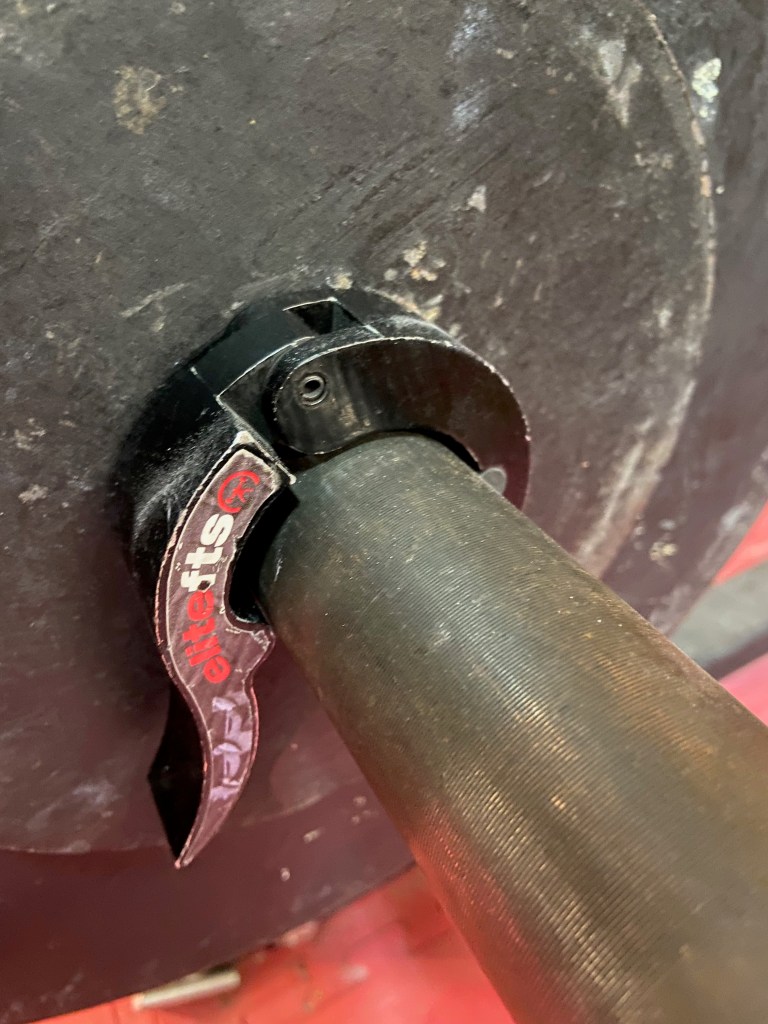
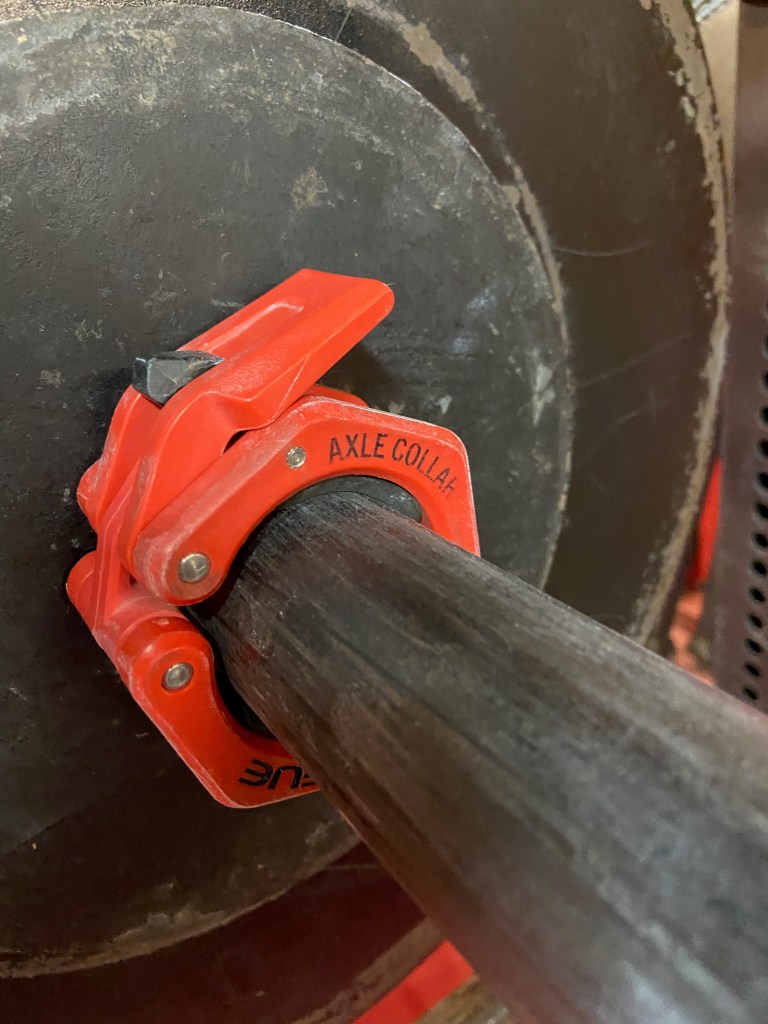
Rogue HG 2.0 Axel Collar and EliteFTS Shark Collar Black

Mark Brown

It’s time for another equipment review! This week I thought I would do a a review of one of the most important pieces of equipment anyone has in their gym. Barbell collars are used to keep plates held in place so if a shoulder dips during a bench press, it doesn’t take the plates with it. The Rogue HG 2.0 Axel and EliteFTS Shark Collar Black are the two collars I use in my gym. I will give a brief review of them.

I bought the pair of EliteFTS Shark Collar Black collars in 2020 when I bought their Yoke bar. They have performed exceedingly well in that time. They clamp down tight against the steel and keep the plates in place exactly as promised. This is especially true in lifts that are started from j cups on a power rack like the squat or bench press.

One of main features I like about them is that the design of them (see picture above) allows plates to be loaded onto the barbell then the lock pulled off and put back on. This seems like a small detail but it makes loading and unloading the sleeves quite efficient, and that process definitely isn’t always that. It’s especially useful for the viking press attachment EliteFTS sells. Being able to load to load the sleeve without taking the lock off is very, very convenient. Another positive is that the lock doesn’t require a lot of effort to pull it off, especially for how lock down as it is. That makes them very quick to put on and take off.

There is one major thing to understand about these collars. They only work on machined barbells. There must be something in the grooves in the steel machined barbells that allows the collars to work that isn’t present on smooth sided specialty bars. That is the main detractor here if a lifter can only afford one set of collars and has smooth sleeved barbells. At $54, they aren’t cheap. However, these locks are worth the price because they won’t need to be replaced anytime soon after purchase.

The Rogue HG 2.0 Axel Collar is a truly lock down barbell collar. Plates aren’t going anywhere when press between the sleeve inside and the collars. I use these on all my smooth sleeved specialty bars, which I have 4 of, and on my deadlift bar for deadlifts. They effect the specialty and machined barbells very differently but still gets the job done equally well.

When used on smooth sleeved barbells these collars slip on fairly easily and click into the locked position with barely any effort. They are made for specialty bars with a diameter of 1.5 inches. I got them after I found that Pete’s locks of a similar design were no longer capable of staying in place in 2021. The tab pulls back with just a hint of effort. They lock down and are easy to take on and off. That’s all anyone is asking for.

Rogue Fitness website states that “because of their smaller diameter, Rogue HG 2.0 Axel Collars CANNOT be used with standard 1.98” (50.4 mm) barbells.” I can understand why they would make this statement. They are definitely not designed for barbells. Putting these collars on and taking them off a standard barbell takes a lot of effort but is eminently doable. Part of the reason why is because standard barbell sleeves spin and it’s impossible to get enough leverage on the tab to pull it back while the sleeves are spinning. I have to place one hand on the sleeve to keep it still while pulling back on the locking tab to get it to unlock. It has no other issue with standard barbells.

If a lifter doesn’t mind that kind of effort put into taking a lock on an off for a deadlift, then this lock satisfies both barbells and 1.5” diameter specialty bars. I wouldn’t use this collar for standard bar for squats or bench press though. I would want something easier to put on and take off, like the Shark Collar Black. The price on Rogue Fitness’s site, $45, places it in line with other collars.

The Road to Discipline, Chapter 5

Structure and Procedures

Mark Brown

May 17, 2022

Discipline does not have a completely rigid structure. If it did, it would be nigh impossible for the vast majority of people on this planet to hold to a “relatively good” discipline. The gym ultimately just a small part of a lifter’s life. That’s shocking news, I know. However, the intensity more than makes up for the fact that it’s only a fraction of the day. The structure of discipline needs to adjust with all of the parts of one’s life. I will explain what exactly that means and some of the consequences that comes with the decisions that have to be made. Following procedures help to refine the ever changing nature of the structure discipline has. Understanding why decisions are made and in what order helps discipline grow harder to break in the face of changing circumstances.

Discipline functions the same way a power rack does for barbells. It provides the rigidity the heft of a barbells require to safely be used and is open enough to make a variety of lifts possible inside it. The chaos of life makes proper, good discipline tough to actually attain and retain over the years. Any structure that will actually stand in such an environment has to be able to deal with the ebbs and flows of everything around it. A strength training program is just a small part of any fitness plan. As such, it responds to all of the other part of the bigger plan that includes nutrition, rest, emotional and mental stress relief. For disciplined lifters the thing that will cause small adjustments to the program the most is their physical condition. It is widely held that muscles need about 48 hours to recover for the most part. That isn’t always the case. It is especially true when lifting in the 90-100% 1RM range. Some muscle groups are also prone to needing more recovery time than others. It doesn’t a lifter any good to hold to a lifting schedule when they aren’t in the proper condition to do what is called for on that day.

Let me give an example of what I mean. I started my current lifting program in mid-March. The intent was to lift 5 day a week on Mondays, Tuesdays, Wednesday, Fridays and Saturdays. Tuesday was to be for hypertrophy and isolation but the rest were to be power movement sessions. I followed that well for a few weeks before I needed an extra day to recover from a leg day. That meant a change the schedule of lifting that week and the following ones to get accommodating rest. That hasn’t just meant changing the days that I lifted but also what muscle groups got lifted when. Since December I have lifted isolation based exercises like tricep pushdowns, curls and lat pulls on their own day. I discovered in the months since then that doing that the day before a pressing session makes it harder for no good reason. I’d much rather my triceps be more beat after pushdowns then big presses. In the last few weeks I have taken Monday as a rest day and lifted both days of the weekend leading to one of two scenarios. First, Tuesday press, Wednesday rest, Thursday back/legs, Friday press, Saturday isolation, Sunday back/legs. Second, Tuesday press, Wednesday back/legs, Thursday isolation, Friday rest, Saturday press, Sunday back/legs. It took about 7 weeks to go from what I intended it to look like to becoming what it is now. All 3 scenarios I laid out still work because I still get 4 power days, 1 hypertrophy day and 2 rest days. It also allows me time to get drafts started, done or edited on the days prior to them going live on the blog. The writing is harder than the lifting. Honestly.

Short term goals like competitions can cause an adjustment in the program and overall plan. Training for the general “stronger” and a specific weight goal or tested lift are two entirely different things. A lifter can get to the former at their pace but the latter is an artificial time constraint that forces the lifter to adjust in its direction. Strongman competitors are much more acutely effected by this than powerlifters or Weightlifters because the events could be anything. There are staples for Strongman competitions but there are nigh endless variations of them without even touching the weight part of it. Training for these competitions, as well as the shows themselves, allows a lifter to strengthen the structure of their discipline by forcing them to work on an accelerated time table. That forces different decisions to be made than normal ones. It will become the building blocks of mental and intellectual development that every lifter needs to accomplish. It helps refine the structure itself and illuminates better procedures along the way. If done safely, it could spur a big jump in development when they return to “normal” strength training for a lifter by merely giving them a reason to really test their limits.

A good chunk of strength training is about viciously hunting down weaknesses and making them stronger. That can’t be done if a lifter only does lifts or muscles groups they are strong in already. Part of any good strength training program is an element of change. I have heard Dave Tate talk about working main lifts in 3 weeks waves for awhile now but only over the last 7 weeks have I put it into practice in my lifting. I have found that is does really help keep me mentally up to date and actively seeking to improve weak lifts and muscle groups. The supplemental and accessory lifts don’t necessarily need to change so long as they are benefitting the main lifts as they should be. What this means is that being willing to change then execute said change well while maintaining a solid base is essential to the structure of discipline in a powerlifting type program. The change to the program has to make sense and be done for reasons that aid progress, however. Changing lifts or programs that are successful in one’s overall success for the sake of boredom relief definitely falls outside the structure. It’s important to challenge oneself and bounce different things off the structure and see what happens. If a lifter doesn’t, they could become a prisoner of success. Moving to 3 week waves has had the effect of forcing me to get better at weak points and lifts. Seeing slight progress in those lifts has felt really good mentally and physically.

An element of a strength program that can really benefit a lifter is working with a training partner. I already have a post up about this so I won’t rehash it here but there’s some things that lifters should be aware of when they do decide to team up. The lifters might have different goals for weight lifted but the goal is still the same: Get Stronger. In the case of bodybuilders: Get more muscular development. Having 2 parties involves means twice the adjustments that need to be accounted for. It is a true team effort so when 1 of the lifters consistently misses sessions, the partner will be effected by it. That could mean a lot of different things. A lifter in this situation cannot let another’s slip in discipline, assuming it’s not for serious “real life” reasons, cause a dip in theirs. Both lifters need to be committed to the joint goal so they both have a stake in the success or failure of the joint venture. This falls under the “artificial time limit” part of training that is used by lifters to spur themselves into action. By agreeing to lift on certain days and/or times, they are putting that time aside to get that work done. In so doing, they are working on all the other non-gym work like family, work, etc so they can lift at that time. When a training partner starts missing those sessions or needing to change them increasingly often, the other lifter must choose to roll with it or find a new training partner. That, of course, is much easier said than done. I’m single. I golf with guys who have kids and wives most of the time. I defer to them on when we golf for that reason. Consistency is the biggest key to slow linear progress. The other option is to lift alone, but that also has consequences as well.

I’ve already alluded to one part of a lifting program that is an important part the structure of a fitness routine. It’s important to establish both specific and general goals first because that will indicate the nature of the discipline structure and overall plan. Developing the procedures to get to those goals is the second part. Procedures can refer to a lifting program solely, but that’s not necessarily always only the case. Preparation time outside the gym sleeping, eating, etc are all parts of the procedure. The order in which someone does what they do matters because it will change the end product. In this way, executing a lifting program isn’t that different from pouring a proper cup of hot tea. They both require steps to make the desired progress. Skip steps or mess a step up and an unsatisfactory result is all but assured. It’s up to the lifter or the drinker to start over or just be okay with the results of the day. A proper powerlifting type program, one geared more towards moving weight than muscular development, has the steps all but put before the lifter. If they make a concentrated effort while doing it, progress is almost inevitable. The character of that progress will be different person to person through. When a lifter gives the program a fair chance to succeed then sees success with it, the procedures of it become ingrained in them. Hence the phrase “training is about turning thought into instinct.”

Once the procedures start to become part of one’s instincts, learning can be done at an accelerated rate. The walls off structure build faster and seemingly on their own. I always think of baking when I write or talk about this. I’ve done enough cooking in my life to build a base set of knowledge, especially in barbecue, that allows me to do it in all situations. I’ve learned how to make yeast breads 8-10 years ago but have always been slave to a piece of paper with baking in general. That experience leaves me with a deep respect for instinctive bakers. It’s more than knowing what 2 cups of flour by weight or a teaspoon of baking powder look like, memorization of a piece of paper and baking time. It’s that they can just do it. It’s the essence of what I write the vast majority of my essays about. “Training is about turning thought into instinct.” When an instinctive baker is introduced to new sweeteners, they have a much better chance of understanding how they will effect a recipe than I do. The structure of discipline acts like a force multiplier for learning. People who learn something through experience are far more likely to get something out of supplemental learning materials than vice versa. Experience creates the structure of learning that new information can funnel into in. Understanding specific procedures fully is where this all starts.

I mentioned above that challenging the structure is important to avoid becoming a prisoner of success. People who challenge structure of their discipline are the ones who are able to get the most out of it. It makes them more situationally viable. Most of the circumstances one comes in contact with will fall under some established category but the minutiae of it is the difference in them situationally. This was famously on display by the New England Patriots under coach Bill Belichik and quarterback Tom Brady from 2001-19. The ability to game plan differently every week successfully for 2 full decades in a sport where a 3 year run is “good” is proof of concept. One can become very dogmatic if they don’t consciously attack their weak points. If they are not apparent to everyone at first, they will be. Colin Cowherd’s line about people telling you who they are all the time will become true at some point to people whose life is finding other people’s weaknesses. Being a prisoner of success will eventually lead to catastrophic failure. The dependencies involved with the dogma will be the root cause of them.

Forming a viable structure is essential to creating a discipline that won’t break. That structure is created by understanding the procedures of any given task to a degree that one can just do them without even thinking about it. It helps build a base through which supplemental learning can be done to further enhance the knowledge gained through experience. The trap of success if very real and can lead to catastrophic failure if the walls of the structure aren’t tested through change. One needs to work very hard to avoid becoming dependent on any one factor that makes up that success.

2022 Week 19 Training Log

May 9 – May 15, 2022

Mark Brown

May 16, 2022

Monday
Scheduled Day Off

Tuesday
Bench Press, Cambered Bar – 175 x 6, 225 x 3, x 3, x 3, x 3; 245 x 3, x 3, x 3, x 3; 255 x 3, x 3; 265 x 2, x 2
Cambered Bar Holds, To Top – 225 x 1:30 x 4
Narrow Grip Incline Press – 225 x 3, x 3, x 3, x 3, x 3, x 3, x 3, x 3, x 3
Log Press – 141 x 3, x 3, x 3, x 3; 151 x 3, x 3, x 3, x 3
Flat Dumbbell Press – 100 x 9, 110 x 6, 115 x 4

Wednesday
Unscheduled Day Off – Rest

Thursday
Box Squats, SSB – 155 x 6, 245 x 3, x 3; 295 x3. x 3; 315 x 3, x 3, x 3; 335 x 3, x 3; 345 x 3, x 3
Assisted Box Squats, SSB – 385 x 3, x 3; 405 x 3, x 3; 425 x 3, x 3
Banded Deadlift – 225 w/70 lb bands x 3, 225 w/70 x 3, 225 w/70 x 3, 225 w/70 x 3, 225 w/70 x 3, 225 w/70 x 3
Calf Raises – 335 x 15, x 15, x 15, x 15
Barbell Rows – 185 x 6, x 6, x 6, x 6

Friday
Chest Press, ACB super set middle-outer-narrow grip – 128 x 6(x 6)(x 6), 198 x 6 (x 6)(x 6), 218 x 3(x 3)(x 3), 218 x 3(x 3)(x 3), 218 x 3(x 3)(x 3), 218 x 3(x 3)(x 3), 228 x 2 (x 3), x 2(x 3)
Seated Overhead Press, ACB – 128 x 6, 138 x 3, x 3; 148 x 3, x 3
Floor Press – 235 x 3, x 3, x 3, x 3; 245 x 3, x 3, x 3, x 3

Saturday
Tricep Pushdowns, Pronated Grip – 50 x 12, 57.5 x 12, 65 x 12, 72.5 x 12, 80 x 12, 87.5 x 12, 95 x 10
Cable Curls – 42.5 x 15, 50 x 15, 57.5 x 15, 65 x 15
Lat Pulldown – 85 x 12, 100 x 12, 120 x 12, 140 x 12
Seated Overhead Tricep Press, EZ Curl Bar – 45 x 12, 55 x 12, 65 x 12, 75 x 12, 85 x 12
Standing EZ Curl Curls, Superset with Tricep Press – 45 x 12, 55 x 13, 65 x 12, 75 x 12, 85 x 8
Straight Arm Lat Pulldowns – 65 x 12, 72.5 x 12, 80 x 12, 87.5 x 10
Tricep Pulldown, Single Arm RL – 10 x 20(x 20), 15 x 15(x 20), 20 x 15(x 15)
Preacher Curls, Outside-Inside Grip Superset – 85 x 8(x 8), 95 x 8(x 8), 105 (x 4)

Sunday
Unscheduled Day Off – Recovery, Knee Pain

Miles/Steps
Monday – 30,314 steps, 15.3 miles. Tuesday – 26,013 steps, 13.1 miles. Wednesday – 28,842 steps, 14.6 miles. Thursday – 34,970, 17.7 miles. Friday – 26,592 steps, 13.3 miles. Saturday – 8,990 steps, 4.7 miles. Sunday – 14,879 steps, 7.4 miles Total – 170,600 steps, 86.1 miles.

Notes

I can feel my log press getting better by the week. The press itself stronger is stronger. I feel much more activation in the upper back and rear delt when I do the lift. It’s the same feeling when bench pressing. The reps on it are also getting more consistent. The clean is also improving. It’s more clean than exaggerated curl like it used to be. I could feel a bit of knee pain in my left knee so I didn’t push the clean that hard.

The cambered bar wave proved to be valuable and interesting. The passes were smoother this week than the two prior weeks. Also getting all the way up to 265 made me happy. Holding the bar out at arms length for a full minute and half is still a beast but I do feel more stable than before so they did something.

Felt the twinge of pain in my left knee increase a slight bit so I didn’t lift Sunday. I could really feel it Tuesday doing log press on the clean. I will evaluate ideas of how to proceed without knee stress for a a week or two till it recovers more. Both knees need rest.

What’s the Point?

Bench Press Edition

Mark Brown

May 12, 2022

Every decision in the gym needs to fulfill some specific purpose. Most of those decisions will involve sets or reps of some lift. The reason why is because the body has a limit to the energy it can put towards a lifting session. Don’t go hard enough the result will be less progress. Dip too much into the reserves and the result could be less progress because a lifter may not be recovered in time for the next scheduled lifting session. Everything has to have a point. Different goals will produce a different procedure and structure to each session. Today I want to go over something specific. The straight bar bench press is one of the lifters damned near everybody knows about. I’ve grown to learn a few things about it over the last couple years and feel like I can help answer this question. I started my review of the American Cambered Bar by EliteFTS by briefly explaining that a straight bar bench press is optional for lifters focused on muscular development. This is a topic that demands its own post.

I re-learned in 2020 that dumbbell press, cable crossovers, heavy iso-metric chest presses, and machine presses just don’t translate to straight bar bench press success, numbers and steady progress. I thought if I added the weight of dumbbells in my hands that I had a decent estimate of what a 1RM on my bench press would be. So, in 2020 I thought I could bench press around 270. I was wrong. Supplemental knowledge, largely from EliteFTS Youtube page and a few others, showed me why and helped me learn all of the things I need to craft a bench press dominant program. A straight bar bench press is a skill based movement that employs the entire body to do the lift with multiple parts to train. Furthermore, I have learned since I brought it back into the program that I have to keep bench pressing to make progress with it. It is a lift that dominates a program and demands all of one’s physical and mental energy in a session. A main press movement, regardless of what it is, is followed by supplemental ones that are designed to make the bench press either stronger or the technique improved. That is what I have learned over the last 2 years.

That’s where the American Cambered Bar comes in. I will condense what I said in the review. It’s a bar that does muscular development while developing more power exceedingly well. Yet I don’t consider it a bench press. Yes, it is a chest press done on a bench in mostly the same manner. I can’t mentally bring myself to call it a bench press because that term is so singular in my mind. I could be overthinking it, but I think part of the allure of the bench press is that it is a standard bearing marker of strength. It is one of the 3 lifts powerlifters are measured by, after all. In that sense, the bench press is almost by definition an ego lift unless one uses to increase pushing power like an NFL lineman or translate to a Strongman event. So, if a lifter states they are after muscular development I would question why the straight bar bench press is in the program. What’s the point? If it’s there to maintain the skill, then I could definitely understand. I did that for 10 weeks in January, February and March at the gym while using dumbbell press as a main power movement. I didn’t want to make the same mistake I did in 2021 during the same months. The strategy has worked very well. I can see that slow consistent progress I am after since March, regardless of how I bench press.

There are a couple of different factors for that. Some of it is related to forcing myself to rep ranges on the dumbbells for the lightest to 3-4 for the heaviest, which started at 105 and got up to 125 pounds. That promoted both strength and hypertrophy development. Doing that kind of lift first made bench press much harder. Some of the reps looked downright silly when I did them. Doing the skill based lift second allowed it done in a more fatigued state, which is one of the core tenets of powerbuilding. The other thing it did was make me think about my grip and how I got the most out of the lift itself. Bench pressing and other accompanying supplemental lifts, especially floor press, allowed me to practice a wider grip press over the weeks. The has had the effect of focusing more of the weight on the chest muscles and lats than triceps. It also trains my central nervous system for the increasing loads over time. The importance of that I cannot overstate.

A lifter’s energy is effected by sleep, diet, stress and a few other more individualized factors. That energy has to be pointed in the direction of the stated goals otherwise something else will end up happening. It could be good, like the case of the development of my squat over the winter 2022, or bad. The straight bar bench press is a great lift, but it is far from necessary. It can dominate a program if a lifter isn’t careful about how they employ it. Lifters should understand that there are better lifts, bars and machines to accomplish the goal of hypertrophy than a straight bar bench press. It is extremely important to be able to distinguish chest training from bench press training. They are definitely not the same.

The Road to Discipline, Chapter 4

Attacking Tomorrow Today

Mark Brown

May 10, 2022

Progress is the result of consistency. I shared in chapter 2 what happened when I lost 4-5 weeks of gym time to Covid-19 related public area shutdowns. Consistency is best evidence of someone’s discipline. It shows their commitment to both the goal and the process. This commitment when combined with progressive overload becomes the launching point of momentum forward. The key is to keep using that kinetic energy created by one’s own discipline to keep attacking day after day to keep growing and moving more momentum forward. That is where today’s chapter comes in. Doing what you need to do tomorrow through preparation today ensures that one can maximize the potential tomorrow has. This chapter will be about everything that entails and why it is important to attack tomorrow today.

The genesis of the phrase I am basing this chapter off of comes from work. I have stated in the past that my job is akin to a Strongman loading race. Most if is placing pallets on the floor then totes full, or not full, of products to be sent to the stores of the convenience store chain I work for. There are various other responsibilities. One of the primary ones is making sure that larger pieces like refrigerators, ovens, shelving, wire racks and such also get on said pallets along with the totes. The “service” parts for the next day come from a different warehouse and arrive shortly before I finish work. This presents me with a couple different options. In the past I have done the first option, which is to do it first thing in the morning. For the last couple months, I have taken care of “tomorrow’s” service stuff at the end the current day. It takes 10-20 minutes depending on volume. I have found that it is much better to take care of it that way because it allows me to get to what I need to be doing right away and gives me a heads up of stuff I need to be aware of tomorrow.

I thought about what I had been doing with the service parts and began to look at life and strength training through that lens. I found that quite a bit of the statements I hold true because of it and aids them. This biggest one is a phrase I have repeated multiple times: There is no honor in missing sessions because one went too hard the session before. What this means is that a lifter doesn’t get a pat on the back or a “Good job, bro!” for going so hard on leg day that they aren’t recovered by the next planned session. Missing sessions blocks the development of consistency and prevents the building of momentum forward. Moreover, if a lifter is part of a group of training partners, then they owe it to the others in it to be ready to go every time. Obviously, some life circumstances can get in the way of that. Not being recovered in time isn’t one of them. Being a dependable training partner can unlock doors that would otherwise stay closed. Relationships built on trust that stay trustworthy are ones that create opportunities for others to follow. Thus, discipline demands that a lifter not go full tilt every time in the gym. This is especially important for lifters, like me, who don’t use any performance enhancing drug or substance, banned or unbanned, to drastically increase the body’s recovery ability.

Missing sessions also has another effect. When a lifter misses one session, they become behind by at least 2 unless they just write it off as a missed day. This comes back to the “doing the program as laid out” phrase I also repeat. If a lifter decides to push the session missed back a day to make up for not doing on the day intended, then everything else gets pushed back a day. For lifters who lifter only 3-4 times a week, this might not have long lasting consequences. However, for those who lift 5-6 day a week this will complicate the program for weeks or it forces a change in the days lifted in the program. Based on personal experience, missing intended sessions has the habit of messing up weeks on end unless I decide to mitigate it. Moving my day 2 leg/back day to Sunday in correlation with my tiredness has had the effect of not being ready to go Wednesday while also pushing back my day 1 chest/shoulder to Tuesdays sometimes. This situation is where my splitting isolation day off on its own manipulates what days I do my power lifts. Sticking to a schedule is important because consistency demands the lifter be ready but not at the expense of recovery. That is why lifting in the RPE 7-8 range for the vast majority of sessions is ideal for making consistent momentum creating progress. Lifters who compete have be extremely aware of missing sessions because the number of sessions to a competition are finite. They also become more important as the date of the competition approaches.

Attacking tomorrow today means making physical and mental preparations to help it happen. Those who lift in the morning are more acutely effected by this concept more than those who lift in the afternoon or evening. I lifted before work 5-6 years ago when I was doing a different job in the warehouse and was working all the way to 6-7 pm instead of 3-4 pm like I am now. It requires a different mindset and is a different physical challenge. Lifting in the morning requires one to reach a physical and mental peak soon after waking up. The morning lifter, many of whom start at 4 or 5 am to get it done, has to take “yesterday” very seriously because of what I just stated. The day prior to lifting sessions, especially involving more power movements, have to be managed especially carefully. Eating and sleeping well are important for both morning and afternoon lifters, but the former will feel poor eating and sleeping more. Using the rest of the day to recover through proper nutrition and active rest while working is a very efficient use of one’s time and energy. It also means they have to somewhat ruthless with their sleep schedule to be able to peak almost immediately the next morning.

I have been an afternoon/evening lifter since around 2018 when my schedule at work had me starting at 5 or 6 am. I feel safe in saying that the physical and mental peak is more natural now and I feel my lifting progress has increased because of that. I regularly get 20,000 or so steps at work and get my upper back ready to go from the loading race. That preps me for the power movements that I do in my program, especially squats and deadlifts. I have found I am far less ready to lift without all of those steps, even with stretching. The biggest challenge for an afternoon or evening lifter is getting good nutrition in because the time scrunch makes for decisions to be made. I find that getting lifting, eating and sleeping in the right ratio is damned difficult. Adding the responsibility of writing the way I have chosen to do it hasn’t helped either. That is a large reason why PEDs or supplements are not even a consideration to me. Another effect for the afternoon or evening lifter involves people, unless a significant other lifts with them. Strength training is mostly a solo affair, unless a lifter goes out of their way to make a true team effort.

Attacking tomorrow today will help someone be more prepared for life’s chaos better. Aside from the fact that being more prepared is better than less prepared, regression can be avoided if sessions end up being missed for reasons other than lifting. What I have written so far says that a person with great discipline can always take steps forward. That’s a great goal to have but wholly unrealistic. I write like missed sessions are the worst thing imaginable but they are a reality so they have to be worked around and part of any plan. What’s important to remember is the best way to maintain forward momentum is to not taking steps backward. It’s perfectly okay if the next day doesn’t produce a full step forward, so to speak. The wall from chapter 3 will still be there ready to be knocked down and rebuilt. The 4-5 week layoff from the gym in 2020 was multiple steps backward and took a long time to recover from. It’s not a lesson I want to repeat learning again.

If a lifter had to take an extended amount of time off for non-injury reasons, there’s a lot scientific and anecdotal evidence that shows it can all come back over time. Muscle memory is a very real thing. I didn’t squat or deadlift from the middle of 2018 to the June of 2020. I surpassed my previous high squat from 2018 by August of 2020 by 40 pounds. Not the smoothest or best of reps at 405 on the day in August 2020 at the gym but it got up. I didn’t bench press much at all from the middle of 2018 to May of 2020. That lift is leagues above where I thought it would ever get. Muscle memory is an exceedingly important reality to accept because it gives a lifter something to believe in when breaks happen. By attacking tomorrow today someone can raise the floor of what can be accomplished and keep it there before momentum gets stopped.

One of the consequences of adopting such a lifestyle philosophy is that every day becomes regimented to a certain degree. This doesn’t always mean a rigid structure to the day. However, it does place a priority on certain activities above others and places them in certain time slots. Let me explain through a personal example. I’ve written before about the 60-70 hour weeks I worked in 2020 and 2021 so I won’t retell it in full. Not keeping up with my lifts would have been easy to do given the hours worked and time I left work. There were a lot of lifting sessions that finished up between 10 and 10:30 pm. Add 15-20 minutes of driving back home from Pete’s garage to a wake up time of 5 am and one sees a lot of tired mornings. I recognize now those lifting sessions were important a couple different reasons. First, I was reintroducing skill based lifts back into my normal lifting pattern. I would not be where I am at currently without them. Second, they became the backbone of my discipline by showing me the kind of effort I could put into lifting during less than ideal circumstances. If I could lift hard and make progress at that point, then I can do it when the circumstances are much more amenable.

Another of the consequences involves relationships with people in one’s life. When something is one’s soul to the degree I have been talking about, everyone else comes along for the ride. That means those people are part of the program and must be planned for. They can add a lot of different variables to the training or alter it completely. A major motivation for people who lift in the mornings before for work is to allow them to spend time with families in the evening. Family and friends can import some chaos to bring speed and a feeling of the need to accomplish something quickly. That’s the kind of energy people in one’s life who don’t lift but are present nonetheless help push momentum forward. I’ve made lifting such an integral part of my soul that any woman who I bring into my life or shows interest in being with it will have to deal with it. At this point, it’s me. I’ve written before that if one wants to be great at something, they become a slave to it. I am exactly that.

Hard work when used intelligently helps build momentum every day. Using the energy that comes with that to attack tomorrow today keeps building confidence and helps prepare for unknowns of every day life. The role of discipline is to maintain that need to push forward while actively forcing ourselves to demand more from everything we are. There’s no guarantee there will be steps forward, but the effort and the intent being there will be. Accomplishing tomorrow’s work today allows one’s discipline to create a positive patterns that push them forward. With time, the structure of discipline becomes more and more self-evident.