Monday 2 Board Press, using Shoulder Saver – 135 x 8, 225 x 6, 235 x 6 , 245 x 6, 255 x 6, 265 x 4, 275 x 3, 285 x 2, x 1 Narrow Grip Incline Bench Press – 165 x 8, 185 x 8, 205 x 6, 225 x 3, 195 x 5 Seated Overhead Press, American Cambered Bar – 128 x 8, 138 x 6, 148 x 4, 158 x 3, 168 x 1 Tricep Pushdowns, pronated grip – 45 x 12, 55 x 12, 65 x 12, 75 x 12 Flat Dumbbell Press, superset with Tricep Pushdowns- 100 x 8, 110 x 6, 115 x 4, 120 x 2, 95 x 8 Lat Pulldown – 90 x 10, 115 x 8, 125 x 8
Tuesday Safety Bar Squat – 155 x 8, 245 x 6, 295 x 6, 315 x 6 Calf Raise, Hatfield style – 245 x 15, 295 x 12, 315 x 10, 335 x 8 Romanian Deadlift – 315 x 6, 345 x 5, 365 x 4, 385 x 5 Hatfield Bench Squat – 335 x 8, 365 x 6, 385 x 6, 405 x 6, 425 x 5 SS Yoke Bar Good Morning – 65 x 6, 115 x 6, 135 x 6
Wednesday
Scheduled night off – Recovery
Thursday Multigrip Press, cluster set outer two grips – 138 x 8, 198 x 6, 218 x 5, 228 x 4, 238 x 3 (2 on outer) Multigrip Press, cluster set inner two grips – 138 x 8, 158 x 6, 168 x 5, 178 x 6 (outer only) Incline Dumbbell Press – 100 x 7, 110 x 4, 115 x 4, 95 x 6 Tricep Pushdown, Mace Grenade – 6 on each ball at 45, 55, 65, 75 Log Press, Strict Press – 111 x 6, 121 x 5, 131 x 5, 141 x 4 Viking Press – 115 x 12, 140 x 12, 165 x 10, 165 x 8
Friday High Bar Squat – 135 x 8, 225 x 6, 315 x 6, 345 x 5, 365 x 2 Leg Press – 478 x 12, 658 x 12, 848 x 10, 928 x 8 Dumbbell Deadlift – 100 x 5, 105 x 5, 110 x 5, 115 x 5 Standing Leg Curl, per leg – 35 x 10, 60 x 10, 70 x 80, 85 x 8 Calf Raises – 100 kg x 12, 120 kg x 15, 140 kg x 15, 160 kg x 12, 180 kg x 8 Leg Extension, held 3 seconds – 100 x 10, 130 x 10, 160 x 8, 190 x 8 Abduction – 295 x 240 Adduction – 295 x 60
Notes
It was an interesting week in training. The beginning of the week started out very well. Monday’s session was quite strong and felt like there is a lot of potential improvement going forward for chest.
I decided to table the cambered bar squat for the time being to start working back on the free standing safety bar squat. It is a very different movement from both a low bar straight bar squat and a cambered bar squat. I’ve done it before, but I forgot how to do it so I have do a bit of skill re-acquisition.
Last week I took Wednesday off because I was exhausted and the Thursday after was very good so I decided repeat it this week. The chest press went very well, but everything else felt labored. The motivation was to figure out how to get some more recovery during the week. I am unsure if I will do this again next week.
Monday 2 Board Press, using Shoulder Saver – 135 x 8, 225 x 8, 225 x 7 , 245 x 6, 255 x 6, 265 x 3, 275 x 3 Narrow Grip Incline Bench Press – 135 x 8, 185 x 8, 205 x 6, 225 x 3, 185 x 6 Seated Overhead Press, American Cambered Bar – 128 x 6, 138 x 4, 148 x 3, 128 x 5 Tricep Pushdowns, pronated grip – 45 x 12, 55 x 12 Flat Dumbbell Press, superset with Lat Pulldown – 100 x 8, 110 x 5, 115 x 3, 95 x 7 T Bar Row – 45 x 8, 70 x 6, 95 x 6 Flat Tricep Extension, EZ Curl Bar – 45 x 12, 65 x 12, 75 x 10
Tuesday Cambered Bar Squat – 175 x 8, 225 x 6, 275 x 6, 325 x 5, 345 x 4, 365 x 4 Calf Raise, Hatfield style – 245 x 15, 295 x 12, 315 x 10, 335 x 8 Romanian Deadlift – 315 x 6, 345 x 5, 365 x 4, 385 x 5, 405 x 3 Hatfield Bench Squat – 245 x 8, 335 x 8, 365 x 6, 385 x 6, 405 x 3 SS Yoke Bar Good Morning – 65 x 6, 115 x 6, 135 x 6
Wednesday Unscheduled night off – Recovery
Thursday Multigrip Press, cluster set outer two grips – 138 x 8, 178 x 8, 198 x 6, 218 x 5, 228 x 3 (outer grip only), 238 x 3 (outer Grip only Multigrip Press, cluster set inner two grips – 138 x 8, 178 x 6 (outer only), 158 x 6 Incline Dumbbell Press – 100 x 7, 110 x 5, 115 x 3, 95 x 7 Standing Lat Pulldown – 70 x 15, 80 x 8, 90 x 8, 100 x 6 Rolling Tricep Press – 15 x 12, 20 x 12, 25 x 12, 30 x 8 Tricep Pushdown, Pyramid style – 45 x 15, 55 x 15, 66 x 10, 77 x 12 Log Press, Strict Press – 101 x 8, 121 x 8, 131 x 6, 141 x 5, 151 x 3 (1 push press) Viking Press – 115 x 12, 140 x 12, 165 x 10, 165 w/chain x 8 Rack Push Ups – 4 sets of 10
Friday High Bar Squat – 135 x 7, 225 x 6, 275 x 6, 315 x 5 Leg Press – 478 x 12, 658 x 12, 848 x 10, 928 x 8 Dumbbell Deadlift – 100 x 5, 105 x 5, 110 x 5, 115 x 5, 120 x 3 Standing Leg Curl, per leg – 35 x 10, 60 x 10, 70 x 80, 85 x 8 Calf Raises – 100 kg x 12, 120 kg x 15, 140 kg x 15, 160 kg x 12, 180 kg x 8 Leg Extension, held 3 seconds – 100 x 10, 130 x 10, 160 x 8, 190 x 8 Abduction – 295 x 20 Adduction – 295 x 60
Notes
Thursday was the best day of lifting in a few weeks. I am really starting to feel the strength return fully in the upper body. It ended up being almost a 3 hour session and I didn’t realize that until it was mostly done. I’ve done the strongman event shoulder exercises on Thursdays before but I am considering changing the week to do it more.
I decided to pull the banded rack pull for at least this week. I felt my grip last week getting slightly lost on the higher sets. May use other lat pulls for the next couple weeks. Might have been too much on my middle and lower back over the last couple weeks.
We are accustomed to lying to ourselves, for better or for worse, and others by saying something without ultimately meaning it. “Doing whatever it takes” is a phrase much easier said than meant. It sounds good and can give the illusion of commitment but the words don’t mean anything if actions don’t back them up. Being great at something requires that one become a slave to the goal and process of the thing they are trying to do. To that end, everything else in life revolves around that thing. The kind of conversation one has to have with themselves revolves around the price that they are willing to pay for that greatness. The price is monetary, time, relationships, a mixture of those things or who knows. Understanding what one is willing to sacrifice and make others around them sacrifice is the key to actually make progress towards their goals.
Motivation is overstated. It is an incredibly easy thing to overcome. All it requires is finding something else that one wants more. That makes discipline much harder to attain and much more ingrained once it is. All of the focus in the world isn’t going to help unless the question of what one actually wants is answered. Defining goals is the first step in the process. The second is a cost analysis of those goals. The depth of the analysis depends on how specific the goals are. This conversation one has with themselves or a coach is the thing that will define them. The major thing here is to not lie to oneself or the coach during said conversations because that will end up distorting the vision or cause the goals potentially irreparable damage from the start. Every facet of life should be addressed: How much time to work out does one have? How much sleep is one getting? How long are the work days? How stressful is work? How stressful is one’s home life? Etc. Brutal honesty is required in this step. When one has truly figured out what they want, those costs become easier to see and understand. It is a far muddier conversation if that direction hasn’t been set because actions made will trigger consequences that damage one goal while helping another.
Last year, 2020, made me more aware of what I wanted and the costs associated with it. The closings of public privately owned facilities left me in a tough spot because a big part of my mental well being was kicking my own ass hard in the gym after work. I was an atrocious human being for those 6 weeks. I had never bought into the “home gym” thing because the public gym had everything I needed and I figured I knew the monetary costs of gym equipment. I learned exactly what those costs were when I, like many, looked into equipment during the summer. The monetary cost was daunting but not as bad I expected it to be. The availability of gym equipment in general up until about November 2020 was unbelievably frustrating. All I did was hit refresh button on the web browser because I was constantly on Rogue’s or EliteFTS’s web site because I wanted to see if what I wanted was in stock finally. It’s comical now thinking about how much money I spent last year hitting the refresh button that one last time at 11 pm. I don’t regret any of it now because I have a very well stocked gym at my disposal.
What I learned last year was that my desire to get stronger and better was the thing that enslaved everything else in my life. I knew that desire was powerful but it became very apparent it was the only thing that mattered when I started to buy gym equipment instead of just waiting out the closings and going back regularly when they reopened. I stopped buying anything that wasn’t food or gym related and began to understand the limitations of the commercial gym I am a member of. I poured all of my energy into lifting in Pete’s garage and became a different lifter. I was more committed to lifting in part because I wasn’t just lifting by myself. As I have written before, Pete let me control how we were going to lift despite me being 12-13 years his junior. That act really helped me emphasize lifting in my life even more because I consumed more fitness media than I ever had in my life. The “book learning” began to combine with what I had learned through gym experience and lifting became a full fledged obsession. Learning about the effects of various performance enhancing drugs was particularly fascinating because I found that it really is not the path to go down unless competing is in one’s future. I was aware of wrist wraps, straps and belts but learning how much those pieces of equipment effect lifting through both experience and watching videos on Youtube was instrumental in my understanding of how to watch major feats of strength. It doesn’t take long to learn that lifting like people using PEDs and deadlift suits doesn’t make sense when one isn’t doing either of those.
The time cost with this turn towards obsession was very easy to see when work days began to routinely hit 12-14 hour shifts 5 days a week and half day on Saturdays almost all of last year. There were many nights I didn’t start lifting till 7:30-8:30 pm only to finish after 11 multiple nights a week. My level of focus and willpower became unbreakable. The more Casey’s pushed absurd hours my way, the more I poured into lifting to combat the stupidity. The result of long shifts and the completion of lifting sessions meant a complete loss of time for other things. Down time was planned for complete rest and I was constantly tired because sleep got cut into because those sessions were starting at 8 pm instead of 6. Eating in the evening became pretty blatantly impossible. I ate far, far too much food from convenience stores. Everything that wasn’t lifting paid the price for my obsession with getting stronger. Even now that hours have returned to relative normality, eating in the evening requires extreme thoughtfulness. It’s part of why I laugh at Blue Apron commercials. The other part I will expand on in future entries. What helped me maintain the discipline to keep going was the results I was seeing and feeling.
I have to discuss sleep a little bit more in depth here because it is very important. It is truly the only time the body is at rest. The only thing I would push back on is that the only way to get stronger is to put effort into lifting. That could be barbells, concrete, bags of dirt or whatever else. There’s even a sport built around that exact thing: Strongman. Skipping lifting sessions to ensure the same number of hours of sleep a night will not help one get stronger. Workouts can be manipulated and changed to help get more regulated sleep but they cannot be skipped. Unless one makes money without working a lot of hours, something is going to give. Sleep is probably going to be the thing that does. There’s only so much time in a day and there is much to accomplish. My body requires more than 5-6 hours of sleep to be really effective. Once I start getting below that, I know I will be paying for it later in the week. Any more than that and I feel it’s wasteful.
Relationships are part of the cost analysis because they are like results in strength training. They are built up over time. I don’t need to defend my use of time lifting for long sessions 5 times a week after work because I don’t have a significant other. That has been part of the choice I made when I decided to go down this path. I can understand why people have a hard time committing to strength training when there are people kind of standing in the way of it. Almost every minute of my days from Monday through Friday are spoken for. It’s not an impossible task to find someone to have that kind of consistent relationship but it would be a lie to tell them they would be the primary part of my life. It is the hardest part of this cost analysis because it can’t be quantified in any way. What Dave Tate, former powerlifter and owner of EliteFTS, said in a recent podcast regarding relationships and sacrifice rang true to me partly because it was a growing feeling in me but it was also in line with what a lot of professional athletes have said. He said that the sacrificing is being done by the other people in the relationship, not the one going after the goal. “You are the one who is doing what you want to do,” he said. This relationship part of the costs analysis is where one determines the scope the goals more specifically. The bigger the goal, the bigger the effect on those around someone. Becoming emotionally aloof to those around is going to be part of the public consequences of going down this path because some will never understand the desire to be the best at something in their life. Actions have consequences that cannot be controlled or spun. It’s best if one makes people around them aware of why the choices are being made and making sure the actions back up the words.
What I have laid out applies to everything in life. If being great at something is the goal, then the process of goal setting and cost analysis has to be there from the start. Once the analysis is made then the brutal honesty must follow with oneself and those around them, those helping and those effected by the goal. Sure, life is going to get in the way sometimes but that’s where adaptation and problem solving skills that have been learned along the way become more instinctive. That is the point of training, after all. Understanding the cost of one’s goals is how discipline overcomes motivation.
Monday 2 Board Press, using Shoulder Saver – 135 x 8, 225 x 8, 235 x 7 , 245 x 6, 255 x 5, 265 x 4, 275 x 1 Narrow Grip Incline Bench Press – 135 x 8, 185 x 8, 205 x 6, 225 x 3, 185 x 8 Seated Overhead Press, American Cambered Bar – 98 x 8, 118 x 8, 128 x 8, 138 x 6, 148 x 4 Tricep Pushdowns, pronated grip – 45 x 12 Flat Dumbbell Press, superset with Lat Pulldown – 100 x 8, 110 x 5, 115 x 4, 120 x 2, 95 x 7 Lat Pulldown – 90 x 12, 115 x 12, 125 x 10, 140 x 8 Flat Tricep Extension, EZ Curl Bar Strip Set – 75 x 12, 65 x 15, 55 x 12, 45 x 15, 25 x 20
Tuesday Cambered Bar Squat – 175 x 8, 225 x 8, 275 x 5, 325 x 5, 345 x 5, 355 x 4, 365 x 4, 375 x 2 Calf Raise, Hatfield style – 245 x 15, 295 x 12, 315 x 10, 335 x 8 Romanian Deadlift – 315 x 6, 345 x 5, 365 x 5, 385 x 4, 405 x 2 Hatfield Bench Squat – 245 x 8, 335 x 8, 365 x 6, 385 x 6, 405 x 6 SS Yoke Bar Good Morning – 115 x 6, 135 x 6
Wednesday Log Press, Strict Press – 101 x 8, 121 x 6, 131 x 6, 141 x 5 Viking Press – 115 x 12, 140 x 12, 165 x 8, 165 w/chain x 8 Seated Overhead Dumbbell Press – 45 x 8, 55 x 8, 65 x 8, 75 x 4, 80 x 2 Bent Over Rear Deltoid Fly, Dumbbells – 20 x 10, 25 x 10, 30 x 10 Side Lateral Raises – 10 x 10, 15 x 10 Ez Curl Bar Preacher Curl, superset outer and inner grip – 45 x 12 (8) , 55 x 12 (8), 65 x 12(8), 75 x 12(8) Rack Push Ups – 4 sets of 10
Thursday Multigrip Press, cluster set outer two grips – 138 x 8, 178 x 8, 198 x 6, 218 x 4, 228 x 3 (outer grip only) Multigrip Press, cluster set inner two grips – 138 x 8, 158 x 6, 168 x 6, Banded Rack Pulls – 185 w/70 lb bands x 8, 205 w/70 lb and chain x 8, 225 w/70 lb and chain x 8, 225 w/100 lb and chain x 6, 245 w/100 lb and chain x 5 Incline Dumbbell Press – 100 x 8, 110 x 5, 115 x 2, 95 x 7 Standing Lat Pulldown – 70 x 15, 80 x 8, 90 x 8, 100 x 6 Rolling Tricep Press – 15 x 12, 20 x 12, 25 x 12 Tricep Pushdown, Pyramid style – 45 x 15, 55 x 15, 66 x 10, 77 x 12
Friday High Bar Squat – 135 x 7, 225 x 6, 275 x 6, 315 x 5 Leg Press – 478 x 12, 658 x 12, 848 x 10, 1018 x 6 Dumbbell Deadlift – 100 x 5, 105 x 5, 110 x 5, 115 x 5, 120 x 4 Standing Leg Curl, per leg – 35 x 10, 60 x 10, 70 x 80, 85 x 8 Calf Raises – 230 x 20, 270 x 15, 310 x 15, 250 x 12, 400 x 8 Leg Extension, held 5 seconds – 100 x 10, 130 x 12 Abduction – 295 x 20 Adduction – 295 x 20 for 4 sets
Notes
Whatever is happening in my left shoulder is starting to feel better. It’s not hindering any chest or shoulder training currently.
This week’s training felt like it’s on the uptick. Everything I did for upper body felt stronger and more mobile in the movements. The press with the American Cambered Bar is really progressing. Moving towards a two board press with the shoulder saver is a lift I will be keeping in for a bit longer.
I have felt incline press, both with dumbbells and the straight bar, become easier and stronger than the flat dumbbell press. I guess the easiest explanation is that my shoulders are getting stronger but it feels weird for that to be the case. It’s not exactly the first time hearing of something like this.
Strongman is my favorite strength sport. The mix of both straight ahead powerlifting and seemingly absurd lifting or power movements makes it something I can latch onto. There’s not a lot that can say that for me much anymore. It’s also impacted which athletes I follow more closely, how they train, what they train with, and how I can train better. Strongman has been around for over 40 years but has gotten more mainstream over the last 12-15 years as modern technology has evolved to make everybody more connected. My relationship with it is very new but I feel connected with it the way I was 20 years ago to the mainstream American sports.
To start, it’s best if I help illuminate the strength sport scene to those who might not be familiar with it. Each strength sport values various elements of strength over another as a main source of differentiation. A mainstream audience is familiar with Bodybuilding because it was Arnold Schwarzenegger’s path to stardom in the late 1970s and early 1980s. It’s probably the most mainstream strength sport because it values the body over the lifts themselves. Powerlifting, as a sport, is less known publicly but everybody knows the lifts. It requires a level of discipline that most people who train can’t or don’t want to have. An even smaller niche within the sport is Equipped Powerlifting, which uses suits and shirts to push the limits of what can be done. Weightlifting has been around for much longer than either of those two sports but gets nowhere near the publicity because it’s one of “those” Olympic sports that gets coverage for a week every 4 years then disappears. It has no media partner to keep it in mainstream. The name even causes some confusion because the lifts, the clean and jerk and the snatch, goes by another because of its attachment to the games: Olympic lifting. Its inclusion in the Olympics going forward is even in doubt due to corruption within the sports main governing body, the International Weightlifting Federation. CrossFit is the youngest of the strength sports, but has gained a lot of steam over the last decade because it’s appeal to a time crunched public. Combining Weightlifting and conditioning is a way to get a serious workout in over a short amount of time. Strongman, like CrossFit, uses both lifting and conditioning as the core of their sport. The difference is the weights lifted and a serious emphasis on finding out the maximum of what can be lifted. The thing that really differentiates Strongman from Equipped Powerlifting, which it definitely shares qualities with, is that anything heavy could be part of a competition. It’s that last sentence that really speaks to me.
I was a major consumer of a couple different shows on the History Channel from about 2017-2020 and I saw promos for a show called “The Strongest Man in History” starring Brian Shaw, Eddie Hall, Robert Oberst, and Nick Best in 2019. It was about 4 professional Strongman competitors seeing if they could repeat strength feats of legend and lore. When the ludicrous is combined with people who can make it happen, I’m in. I watched it without knowing really who the guys were or what Strongman was. In Winter of 2019-20, I fell into a rabbit hole on Youtube and before long I had watched all World Strongest Man competitions from about 2001 through 2015 or so. This was my introduction to the sport. I saw overhead presses with logs, deadlifts using cars as weights, garbage trucks and planes being pulled by a rope, 400 pound round balls of concrete called Atlas Stones placed on pedestals and other ridiculous things happen. I could keep this list going on for a very long time. I saw all these things being done by guys who were mountains of muscle. I’m having difficulty telling if it’s the lifts or the lifters that really drives it for me. I can’t mentally separate the two from each other. Whatever the case is, it works for me.
The individual feats of strength put me in a sense of awe. It’s not always the big record setting lifts that do that to me, either. I haven’t experienced that watching baseball, football or basketball in a long time. Heavy deadlifts and log presses are especially impressive to me because I understand a little bit how hard they are to do. Eddie Hall’s 500 Kg deadlift at the World Deadlifting Championships in 2016 is mind boggling to me. It’s genuinely inspiring. Hafþór Júlíus Björnsson’s 501 kg deadlift in 2020 was also inspiring but it didn’t feel the same because of how I feel about Björnsson, aka Thor. The way the deadlift record went up over this past decade was crazy. What stood out watching those WSM contests, especially after 2009, was the way Zydrunas Savickas owned the log press and it was so effortless it seemed at times for lifts above 200 kg. Bobbi Thompson strict pressing a 370 pound log at the 2021 Shaw Classic made me laugh because of how absurd the concept was in my head. The WSM contests between 2009 and 2014 are especially fun to watch because both Savickas and Brian Shaw going back and forth at every event both of those years.
I haven’t watched as much fitness content on Youtube in 2021 as I did in 2020. I find a lot of dumb content involving the subject and I don’t want it sitting in my head. What stuck is certain content creators. My prior viewer relationship with Brian Shaw helped me follow him. His level of commitment to training and the sport is very inspirational. I can easily leave aside the fact that I’m nowhere near as strong as him and see what he does and why. He started running a Strongman contest last year called the Shaw Classic, and I’m all the way in. Eddie Hall, 2017 WSM winner, has a Youtube channel that is entertaining because his personality is so large and goes all in. He is an extremely powerful lifter, especially at static power lifts. His recent bicep tear pushed his boxing match with Thor down the road a bit. Oberst’s channel is mostly about training but his personality is so big it shines through. I can see why the people who run the History Channel chose the guys they did for their show. Alan Thrall, a powerlifting and strongman gym owner in Sacramento, California, has a channel that is both highly entertaining and educational. I have learned a lot from it.
Where Strongman interacts with me personally is training. While the base of my programming is powerlifting, I have elements of hypertrophy and Strongman in it. Powerlifting doesn’t care much about overhead pressing, but it is a major part of Strongman competitions. Shoulders are a major part of the bench press because of the way the human body is arranged, so shoulders must be addressed in training. This is where Strongman comes in. The sport specializes in overhead press movements. A lot of those movements are done with neutral or almost neutral hand positioning as opposed to pronated or supinated grips on barbells. Once I got the American Cambered Bar, I felt the difference in how my shoulders felt when overhead pressing. Seated overhead press with that bar is part of my regular routine. Standing overhead press is a physical issue because the length of my forearms makes it difficult for me to get an easy front rack position with a straight barbell. That has an effect on a number of different lifts but this is the one does so the most. The logs Strongman uses in competitions allows for a very easy to maintain front rack position. That changes the nature of the clean to it as well. To me, its much safer than cleaning a barbell because the pressure is lifted from all of the joints on the arm. I got an 8 inch log from Rogue when I saw them back in inventory in fall of 2020 after deciding to start working on clean and press. It helped immediately. In addition to strengthening my shoulders, I showed more muscular development in the front and side deltoids.
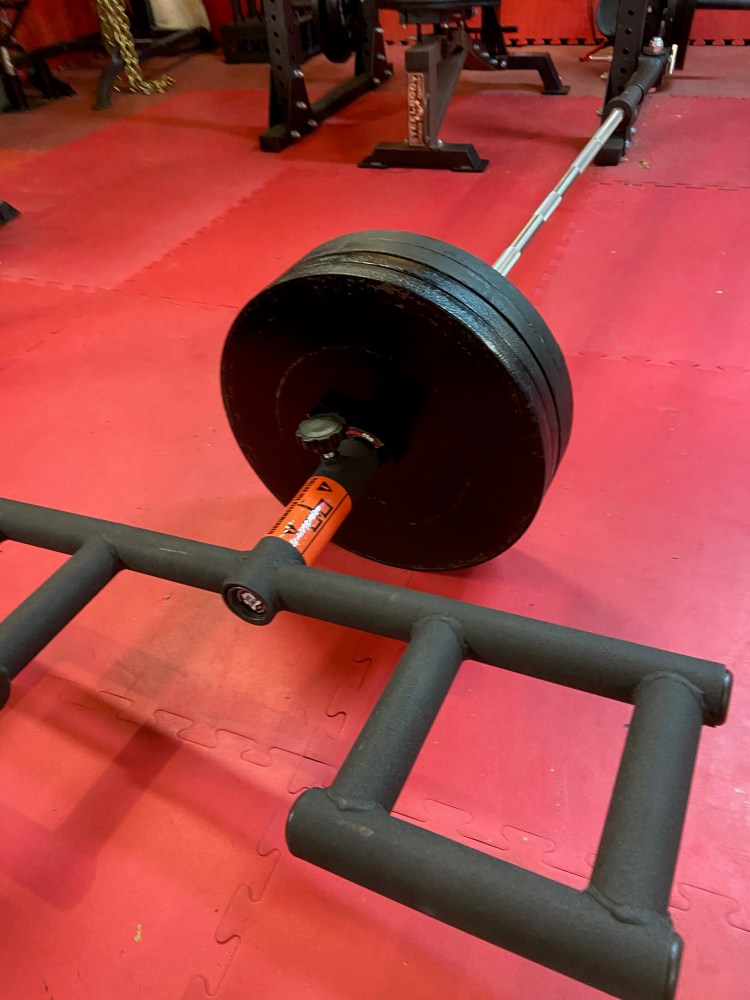
Another Strongman event seen in competitions is the Viking Press. It’s typically it’s own machine where each hand presses a weight up overhead. Its purpose in competition is to determine whose shoulder strength is stronger. Almost all of the times I have seen it done is for reps, not max. That machine is neither cost effective not space efficient for a home gym owner. EliteFTS came up with a solution for us home gym enthusiasts. It is a piece with two handles that attaches to one end of the barbell while the other end of the barbell is in a Landmine, if one owns a Rogue power rack. It is a quintessential Strongman piece of equipment. The ethos of being able to lift any thing of any shape as part of training or competition is embodied in this piece because it requires a deadlift and a continental clean just to get it into position to press it overhead. It is also one of the most effective shoulder and upper back exercises I have found. It is my primary rear deltoid lift. The reason is that it feels like it both an overhead press and a lat pull. That makes it a very unique lift, and one I can overload unlike the log press.
Moving events in Strongman involve moving something heavy from place to another. By “something heavy” I mean it could be anything. Most of what I have seen is sandbags, kegs or anvils. That’s what makes the sport so accessible for people. Other moving events are more defined by their equipment, like the Yoke Walk and Tire Flip. I own a tractor tire and will flip it occasionally. I would love to get a yoke. I am very seriously thinking of getting a rubber Atlas Stone. These moving events is my kind of conditioning. I don’t like running or jogging. It just do anything for me mentally. Making it more physically demanding makes me perk up. I love pushing a weighted sled as part of leg training sessions. I don’t own one but I do it when I do go to the public gym. Farmers Walks are very easily done. They train grip strength and conditioning. All one needs is a set of dumbbells heavy enough to be a challenge to walk with. That’s not a hard thing to find in my friend’s garage.
I don’t see myself doing Strongman competitions anytime soon, but I do find a lot of value in the ideology and practicality of Strongman. It is a sport designed to get the most out of anything we have around, the heavier the better. At this point in my life, it is one of the sports I follow the most because I feel an involvement in it. It’s a niche sport at the moment but modern communication technology is helping spread the word of Strongman. I hope to see it gain steam and see more gyms based around it. I will be keeping an eye on it.
Monday 2 Board Press, using Shoulder Saver – 135 x 8, 225 x 6, 235 x 6 , 245 x 5, 255 x 4, 265 x 3, 275 x 2 Narrow Grip Incline Bench Press – 135 x 8, 185 x 8, 205 x 6, 225 x 3, 185 x 6 Seated Overhead Press, American Cambered Bar – 128 x 6, 138 x 5, 148 x 2, 128 x 6 Tricep Pushdowns, pronated grip – 45 x 15, 55 x 12 Flat Dumbbell Press – 100 x 7, 110 x 5, 115 x 4, 95 x 7 Lat Pulldown – 90 x 12, 115 x 12, 125 x 10, 140 x 8 Flat Tricep Extension, EZ Curl Bar – 55 x 12, 75 x 10, 85 x 10
Tuesday Cambered Bar Squat – 175 x 8, 225 x 8, 275 x 5, 325 x 5, 345 x 5, 355 x 4, 365 x 4 Calf Raise, Hatfield style – 245 x 15, 295 x 12, 315 x 10, 335 x 8, 355 x 8 Romanian Deadlift – 315 x 6, 345 x 5, 365 x 5, 385 x 4, 405 x 3, 415 x 2 Hatfield Bench Squat – 245 x 8, 335 x 8, 365 x 6, 385 x 6 SS Yoke Bar Good Morning – 65 x 6, 115 x 6, 135 x 6, 155 x 6 Barbell Row – 135 x 6, 185 x 4
Wednesday Log Press, Strict Press – 101 x 8, 111 x 8, 121 x 6, 131 x 5, 141 x 5, 151 x 2 Viking Press – 115 x 12, 140 x 12, 165 x 8, 165 w/chain x 8, 165 w/2 chains x 8 Seated Overhead Dumbbell Press – 45 x 8, 55 x 7, 65 x 6, 75 x 3 Bent Over Rear Deltoid Fly, Dumbbells – 15 x 12, 20 x 10, 25 x 10, 30 x 10 Side Lateral Raises – 10 x 10, 15 x 10, 20 x 6 Outer Grip Ez Curl Bar Preacher Curl – 45 x 10, 55 x 10, 65 x 10, 75 x 8, 85 x 8 Rack Push Ups – 5 sets of 10
Thursday Multigrip Press, cluster set outer two grips – 138 x 8, 178 x 8, 198 x 6, 218 x 4, 228 x 3 (outer grip only) Multigrip Press, cluster set inner two grips – 138 x 8, 158 x 6, 168 x 6, Banded Rack Pulls – 185 w/70 lb bands x 8, 205 w/70 lb and chain x 8, 225 w/70 lb and chain x 8, 225 w/100 lb and chain x 6, 235, w/100 lb and chain x 6, 245 w/100 lb and chain x 4, 255 w/100 lb and chain x 5 Incline Dumbbell Press – 100 x 8, 110 x 5, 115 x 2, 95 x 7 Standing Lat Pulldown – 70 x 15, 80 x 12, 90 x 10, 100 x 6 Rolling Tricep Press – 10 x 15, 15 x 12, 20 x 10, 25 x 10 Tricep Pushdown, Pyramid style Drop Sets – 90 x 6, 80 x 6, 70 x 10, 45 x 12
Friday High Bar Squat – 135 x 7, 225 x 6, 275 x 6, 325 x 6, 345 x 2 Leg Press – 478 x 12, 658 x 12, 848 x 10 Deficit Deadlift – 225 x 6, 275 x 6, 325 x 3, 345 x 4 (normal) Standing Leg Curl, per leg – 35 x 10, 60 x 10, 85 x 6, 95 x 5 Machine Row – 90 x 8, 100 x 8, 115 x 8, 130 x 8 Calf Raises – 242 x 12, 264 x 12, 286 x 12, 308 x 12, Leg Extension, held 5 seconds – 100 x 10, 115 x 10, 130 x 10, 140 x 8 Abduction and Adduction, both – 295 x 20
The barbell deadlift is my best lift among the 3 mains that powerlifters are measured by. My squat 1 rep max is equal to my deadlift but my form isn’t as clean at higher weight. My bench press is improving but still very much a work in progress, especially at max weights. The deadlift is an exercise that is both respected and feared, as it should be, because injury is always one rep away. Yes, that could be said about every lift but danger is far closer in the deadlift and squat than others. My evolution with this particular lift isn’t just a story about my progress doing it at the gym but it is also about how it has changed how I view strength sports in general.
I didn’t know deadlifts were a thing until I became a gym member in 2013. Even then I didn’t really understand them until a few years later. Deadlifts were not done in our high school. The main power lifts we did we squat and hang cleans. I didn’t understand for a long time a clean involves a deadlift at the start. When I started doing them in 2015-16 my back strength was quite poor and my form was pretty terrible. That math leads to a deadlift that ends up in injury so it was a lift I didn’t keep in the rotation all the time. It is a lift that requires the body to move in proper order to do it well and safely. I have heard it described as being lifted by the legs and finished with the back. That is largely accurate. Training is required to deal with the points where the load is moved up the chain to the, hopefully, inevitable lockout position. Pulling from the floor helps train the central nervous system to respond to the full range of motion but partial range of motion movements help train specific muscle groups for the load that is going to be on them. The lift is the goal and the process simultaneously.
As my back strength improved in 2017-18, I was more dedicated to leg and back strength than upper body. I believe very firmly that if one takes care of those two muscle groups the rest fall into place for strength training. That’s not the case with bodybuilding. By the time I stopped putting active effort into legs and lower back in late summer of 2018, I had worked up to a 1 rep max of 335. It was such a grind every week that was wearing me down mentally and physically. In my experience, squats and deadlifts are far more exhausting than upper body work. A lot of that is the the muscle groups involved and how much they can be loaded compared to the front upper body can be. Two factors are at play here. First, legs do more than arms do for the vast majority of humans so they require more loaded weight to be effective. My job has me on my feet for anywhere from 8-11 hours a day with light to medium sized loads so it is an effective warm up for heavy leg work. Those who don’t have that level of workload in regular day to day life will find that heavier weight is just that much more taxing on the muscles and the central nervous system. Second, the shoulder joints are less loadable than the hips. I have never really experienced hip problems but I have had shoulder pain at various times. I have never really looked into what exactly was causing the pain but it has never been enough to pause training. It’s just a pain in the ass joint to deal with. The tricep being the main support for any shoulder movement is another driving point in this factor. For comparison sake, my current 1 rep max at deadlift/squat is 405 pounds and my max overhead strict press is 161 and my 1 rep max bench press is 285. Another factor in my deadlift being my best lift is that my height and frame help me quite a bit, I believe. I am 6 foot and 270-285 pounds on any given day currently with an all around medium sized build. It allows me hold the bar then pull it up my legs right from my shin so I have the best possible leverage point available to me. The length of my legs is also the right length for me to really get my quads and hamstrings into the lift from the start.
Strength training is very slow process and shifts in goals have consequences. I don’t know where my deadlift and squat would be right now if I had stayed with them as I hit upper body a bit harder to gain strength and mass. When I started lifting in buddy’s garage in April-May 2020, deadlifts came back into the regular rotation after I decided barbell rows weren’t working for me. My experience of having lifted only in a commercial gym made me have to think how I could attack lower back training. A barbell can work every muscle group in the body but it does compound movements best. The deadlifts started around 185 pounds and topped out around 245. I didn’t fit in my lifting belt anymore so I was limited in what I felt comfortable lifting without it so the loaded weight stayed down. I ordered a 13 mm lifting belt from Rogue Fitness and it came around July. That allowed me to really start training legs and back much harder. My squat was improving at a higher rate than my deadlift. It is important to note that I was doing more hypertrophy training than strength training during the summer and early fall in 2020. That shifted a bit after my belt arrived. I knew from my lifts of 245 that there was much more in the tank, but I just wanted to be safe about it.
Muscle memory started to kick back in from 2015-2018 and I started to make strides in my weekly deadlifts as summer 2020 lead into fall. I accomplished a 405 pound 1 rep max in squat in late August last year. Equipment has also played a big role in deadlift development. I bought a Rogue Deadlift Bar in early September and started to deadlift only with that when I did it at the garage. It helped development by forcing me to adapt to it. A deadlift bar is thinner and far less stiff than a normal power bar so it has more bend in it. The effect that has is that there is less weight in the hands at the very beginning of the lift. That can be the difference between a successful rep and a failed one. I also discovered how round plates helped in the lift during this time. The commercial gym that I am a member of has 8 sided rubberized plates that don’t roll so easily. I found one of the ways to help the movement was to bring the barbell into position by rolling it to my shins before I started the lift. Round iron plates are much easier to roll than 8 sides plates. Deadlifts are also one of the greatest tests of grip strength. Poor grip strength like mine, relatively speaking, can mitigated a number of ways. I use all the tricks necessary to do so. The aggressive knurling on deadlift bars helps the bar stay in hand, chalk makes hands instantly dry, and straps looped around my wrist and the bar allow me to hold the bar using a pronated grip for longer and at heavier weights. When I am not using straps, weight is easier held with a mixed pronated-supinated grip. Many lifters use what is called a hook grip for deadlifting without straps. That is executed by gripping the barbell and holding the thumb down on the pointer finger. I cannot do that because my fingers aren’t long enough.
I mentioned that deadlifts are feared by lifters, especially new ones, because the threat of injury is increased due to the movement involved. I have suffered some minor tweaks on a 3 different occasions involving pulls. One was December 2016 while doing straight leg deadlifts, a variation where legs are kept as close to straight as possible to isolate hamstrings when pulling from the floor. That kept me out of the gym for about 2-3 weeks. In August 2020, I tweaked my back again on a traditional form deadlift. I felt the twinge right below my belt on the 4th rep doing a set of 315 pounds. However, I believe I put myself there in the lead up to it. I was at a point in my progress where I didn’t need the belt for 275 pounds anymore, and was getting close to not needing it for 295. I decided to see if that was the case so I did a set without the belt at 295 and it went fine. I’m not entirely sure what caused the tweak to happen. I didn’t even stop the lifting session. Probably should have but just shows where my mind was at. Early December is the last time I felt my back go after performing this lift. I did it doing a deficit trap bar dead lift. A trap bar, or hex bar, deadlift feels like a front squat to me so I just amped it up by setting two iron plates under my feet inside the trap bar. At this point, my deadlift max was 375 pounds with the straight bar. The neutral grip trap bar allowed me to lift slightly more without a belt. I worked all the way to my top weight of 340 and did the lift without the belt. There was no tweak to indicate injury but just an overwhelming feeling of stiffness in my back that told me I had gone a little too far. I did 8 reps at that weight and distinctly remember pausing to decide if I wanted to do that last rep or not before doing it. This one kept me out of the garage for about a week or so. Before the end of the year I was back to deadlifting my normal planned weight.
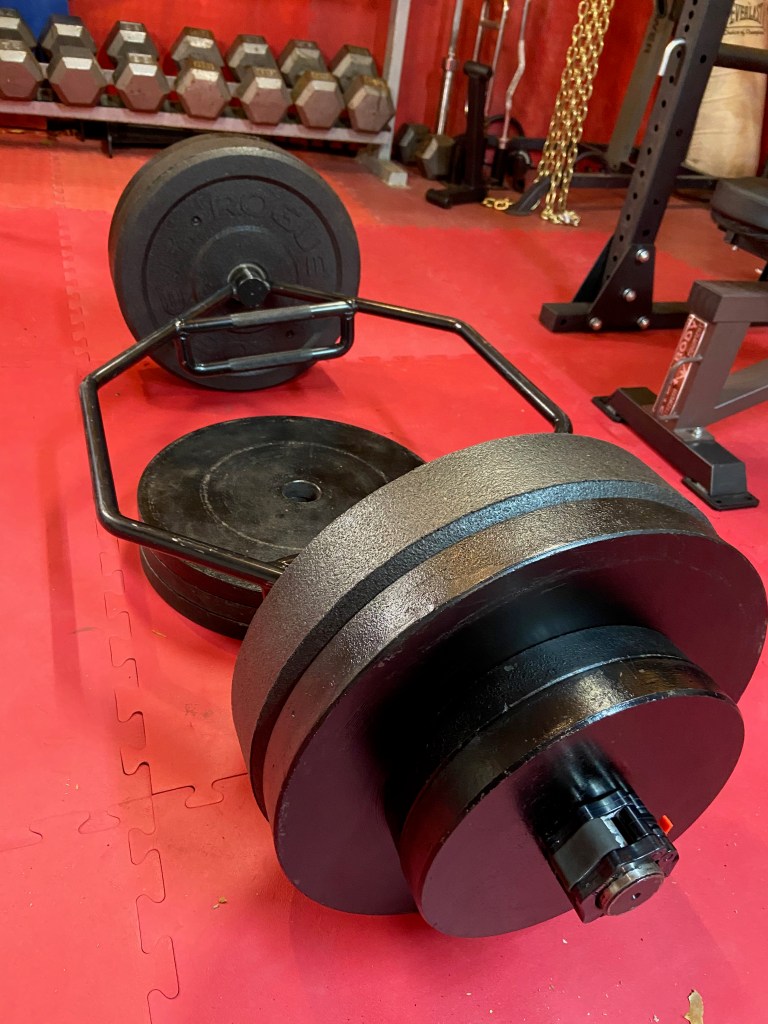
Deficit Trap Bar Deadlift
The deadlift is a major part of my program, which as I discovered through watching various videos from people I trust on Youtube that my programming was a powerbuilding one. It has not always occupied the same space in said programming. In 2020, I put the lift at the end of a hard leg session because I wanted to work hard into fatigue and force myself to use everything I had. Now I realize that kind of programing is best for competition prep. In the past I have split up squats and deadlifts but was unsure how to get the best out of both so I condensed them into one day. I typically squat first then deadlift second because I feel the squat primes my legs and lower back for the movement. I view deadlifting as my main back power movement so I use it both for strength gain and muscular development so I tend to be higher volume in the lower weight range and low volume in the higher weight range. Currently that means 315 – 365 pounds for 5-6 and anything above that for 1 to 3 reps. I could do more at the low range of the former but I know that has a price at the top end. One only has so many deadlifts in them in given session.
I also do more partial range of motion work than before. It is done to work more on the back portion of the lift and the lockout. First came rack pulls. I discovered the lift having watched it on Youtube and doing it when my spotter arms for my squat rack arrived. It was a lift I could load heavier than pulls from the floor because the lift started at my knees plus or minus a few inches. I started with bare weight to start but I added band tension in mid-September. I got 70 pound and 100 pound bands arrived from Rogue and found immediately the value in banded rack pulls. The added tension made lockouts hard to achieve unless max effort was given and proper form was kept up. It is one of my favorite lifts because I feel it all the way up into my lats. I recognize now where they belong in the week’s layout of lifts. I now employ them when I do chest, as that is when I do lat work. They are probably the dominant reason why I feel a lot stability in my upper back. When I turned my squat rack into a power rack in mid-October, I used safety straps I bought at the same time I got the equipment to turn the former into the latter. Those safety straps allowed me to really pull a lot of weight without damaging the safety pins that came with my power rack. Second, July 2021 saw the arrival of deadlift mats from EliteFTS. They were 3/4 inch thick rubberized mats that allow me to perform block pulls. I probably will be getting more in the future, because they make doing heavy hamstring work easier. I use 4 on each side to raise the barbell off of the floor an extra 3 inches from the normal 9, the distance from the bar to the floor when loaded with 45 pound plates. The difference between the rack pulls I was doing from the straps and the block pulls from the pads was immediate. The starting position difference of the bar was about 3-4 inches lower than the rack pull. That made it a harder lift and involved my legs a lot more. Rack pulls have their place, especially when banded, but they are not even remotely the same lift.
I would be remiss if I didn’t tell about how seeing strong deadlifts has effected me. Alexander Bromley, a powerlifter and strongman, called squats the “king of lifts” in a video I watched about leg training programming and I think he is right but the deadlift is bigger in popular culture. A lot of that is derived from the feud dating back to the 2017 World Strongest Man contest involving Eddie Hall and Hafþór Júlíus Björnsson, aka Thor. The Strongman deadlift record over the decade of the 2010s surged to astronomical heights. Brian Shaw and Laurence Shahlaei set the standard at 430 kilograms (948.98 pounds) then Zydrūnas Savickas deadlifted 440 kgs (970 lbs) at the 2011 WSM cap a year a major growth for the record. Hall took it all the way to 500 kgs (1102.31 lbs) in 2016 at the World Deadlifting Championships using a suit and straps. The difference between Strongman and Powerlifting is that the latter has more rules about how a lift must be completed than the latter. The two main differences in the deadlift is strongman allows grip enhancement through straps and allows lifters to hitch the bar up to lock out position after momentum has been lost and Powerlifting doesn’t allow either. Strongman is essentially Equipped Powerlifting on wild amounts of steroids. The feud sparked a lot of animosity between Hall and Björnsson, the latter having felt cheated out of victory at the contest, and it simmered for years. Many powerful lifters tried to best Hall’s 2016 lift but all failed until Björnsson successfully lifted 501 kg (1104.52 lbs) in 2020 as part of Rogue Fitness’s Feats of Strength initiative during the pandemic. Björnsson’s role as The Mountain in Game of Thrones definitely had something to do with the popularity of the pursuit of it. There have been many attempts to deadlift 505 kgs (1113.13 lbs) but none have yet succeeded. Strongman, as a sport, has come a long way over the last 10 years and has brought the deadlift with it.
Other deadlifts have inspired me to awe and continue my training. Benedikt Magnusson’s 460.4 kilogram (1015 pounds) raw deadlift in 2011 is mind-blowing because of how easy it looked. The Hummer Tire Deadlift is always fun to watch. It was a lift I originally saw that the Arnold Strongman Classic and Brian Shaw has used it at his event he started last year, The Brian Shaw Classic. It is a partial range of motion deadlift but the weights involved are still mind blowing. I watched JF Caron shatter Savickas’s lift of 1155 pounds at the 2014 Arnold Strongman Classic. His lift of 1202 pounds is still crazy to me. My best partial range of movement pull is 415 from the deadlift pads and 425 from the safety straps for comparison sake. Seeing the best do it makes me want to do it more. Strongman just makes watching people lift things fun because one never knows what they are going to see lifted.
The deadlift is my best lift. I don’t know if that will always be the case. It would probably benefit me more if my squat was better but I always get excited for leg and back days because I get to lift heavier than the other days. The element of danger being higher and the prospect of getting stronger that gets me more excited. The lift has made me my legs and back stronger and more stable. That has helped on the golf course as well.
Monday 2 Board Press – 135 x 8, 225 x 6, 235 x 6 , 245 x 5, 255 x 3, 265 x 2 Narrow Grip Incline Bench Press – 135 x 8, 185 x 8, 205 x 6, 225 x 2, 185 x 5 Seated Overhead Press, American Cambered Bar – 128 x 6, 138 x 5, 148 x 2, 128 x 6 Tricep Pushdowns, pronated grip – 45 x 15 Flat Dumbbell Press – 100 x 7, 110 x 4, 115 x 2, 95 x 8 Lat Pulldown – 90 x 12, 115 x 12, 125 x 10, 140 x 8 Preacher curls, super set EZ curl bar outer grip and inner grip – 45 x 15, 55 x 12, 65 x 8, 75 x 8 Flat Tricep Extension, EZ Curl Bar – 75 x 12, 65 x 20, 55 x 20, 45 x 20
Tuesday Cambered Bar Squat – 175 x 8, 225 x 8, 275 x 6, 325 x 5, 345 x 5, Calf Raise, Hatfield style – 245 x 15, 295 x 12, 315 x 10, 335 x 8 Deadlift – 315 x 4, 345 x 4, 365 x 3, 385 x 1, 385 x1 Hatfield Bench Squat – 245 x 8, 335 x 8, 385 x 7
Wednesday Off – Unplanned rest day, Exhausted
Thursday
Multigrip Press, cluster set outer two grips – 138 x 8, 178 x 8, 198 x 6, 218 x 5 (4), 228 x 3 (outer grip only) Multigrip Press, cluster set inner two grips – 138 x 8, 158 x 7, 168 x 5, 178 x 5 ( 2nd closest grip only) Banded Rack Pulls – 185 w/70 lb bands x 8, 205 w/70 lb and chain x 8, 225 w/70 lb and chain x 8, 225 w/100 lb and chain x 6, 235, w/100 lb and chain x 6, 245 w/100 lb and chain x 6, 255 w/100 lb and chain x 6 Incline Dumbbell Press – 100 x 6, 110 x 5, 115 x 2, 95 x 6 Log Press, Strict Press – 101 x 6, 111 x 6, 121 x 6, 131 x 6, 141 x 4 (push press) Viking Press – 115 x 10, 140 x 10, 165 x 8, 165 w/chain x 8 Push up, handles – 3 sets of 10
Friday High Bar Squat – 135 x 10, 225 x 8, 275 x 8, 315 x 6 Leg Press – 286 x 12, 308 x 12, 658 x 12, 838 x 12, 1018 x 6 Deficit Deadlift – 225 x 6, 275 x 6, 295 x 4, 315 x 4 Standing Leg Curl, per leg – 35 x 10, 60 x 10, 70 x 10, 85 x 8 Calf Raises – 220 x 12, 264 x 12, 286 x 12, 308 x 12, 352 x 12, 396 x 12 Leg Extension, held 5 seconds – 100 x 10, 130 x 10 Abduction and Adduction, both – 295 x 25
Notes Been feeling more soreness in my left shoulder. This isn’t anything new. I think it might have stated when I tried to do seated overhead press and rack the bar from in front of me rather than from my normal pinned position. It won’t stop training but it is quite annoying.
The beginning of the week was terrible. Both Monday and Tuesday at work were heavy and long. That made both of those training nights even longer. Tuesday I pulled from the floor and that was quite challenging. I am working back to where I was 6 weeks ago. I was completely exhausted by Wednesday after work so I decided it was best to just go home, eat and sleep.
Thursday’s training was impacted by the week being thrown off by the heavy workload early in the week. I decided against doing any isolation work on arms. I still ended up doing quite a bit of volume but it was all heavy compound movement. The super set of banded rack pull and log press was very effective. No sure if it will ever happen again but they were both ready to go so I decided to get them both done and save some time.
Making decisions about what exercises will be included in a lifting program is an essential part of the process of strength training. Those choices get harder to make when goals become more defined and time becomes limited. Learning what exercises are best for a particular lifter can be achieved by watching, reading and doing. I find the last one is the most important. It’s the easiest way to find what works and doesn’t work. Public gyms are made to do exactly this kind of physical education. As a lifter progresses from beginner to intermediate and even further, the lifts in a training program show what they value most. I’m writing today to share what exercises are a part of my program and why they got there.
When a person who is new to physical training joins a gym they might find the gym intimidating. A lot of that comes from a lack of knowledge of what to do and the reasonings behind them. The other reasons why people find gyms intimidating don’t particularly pertain to this essay so I am leaving them aside for now. The Internet makes “book learning” the gym much easier but it truly cannot compete with just getting in there and finding out oneself. Going in without a plan but a desire to get stronger is an extremely important phase for a new lifter. Organically figuring out the benefits and detractors of each lift is essential knowledge to have in the back pocket for later when more formal programming comes into play, especially if one self programs. This process takes years. For me, it took about 5 years and was the direct precursor to developing what I really wanted out of my training. I call this phase the“organic build.” I didn’t know exactly what I was doing but I knew I was getting stronger and was moving in somewhat of a direction. I believe it is important not to skip this step by immediately working on a program, either through a personal trainer or one found on the Internet, upon joining a gym.
If one goes does a basic search on Google or Youtube, they can find tons of lists of what are the most and least effective exercises for muscle, strength and power development based on both anecdotal or scientific evidence. These lists can be helpful but it is important not to take those lists at face value. There will inevitably be lifts on them aren’t doable for everyone at the current time. They are a useful guide for new lifters so they do hold value so long as the reader or viewer of them understands the biases of the list maker. The best thing to do is go to the gym and try those exercises out and see if they work. One big example of a good lift that doesn’t work for me is a barbell rows. I’ve mentioned this a few times and given a brief explanation in prior essays but I will explain in more detail here. I have seen multiple videos breakdowns for the exercise and I have a general understanding of how to do it effectively. When I physically do it I don’t feel a lot of effect out of it, especially at lower weights. I don’t feel any muscle contraction in my back at weights conducive to hypertrophy or strength training. The only time I feel the muscle working as intended is towards heavier weight but my movement is hindered by the sheer weight of the barbell. They are an effective supplemental exercise for the deadlift, but I can’t physically make them work properly so they are currently out of the rotation. I felt much more activation when I did it with a trap bar, however.
What exercises I do in a given session depends on where I am at. If I am in the garage, I am more likely to do more compound movements. When at the gym, I will take advantage of having a lot of isolation machines around. I find there to be a high value in training both strength and hypertrophy so I make time to get both in during sessions, even if it leans heavily one way. I will start with garage and an explanation why it is part of the plan:
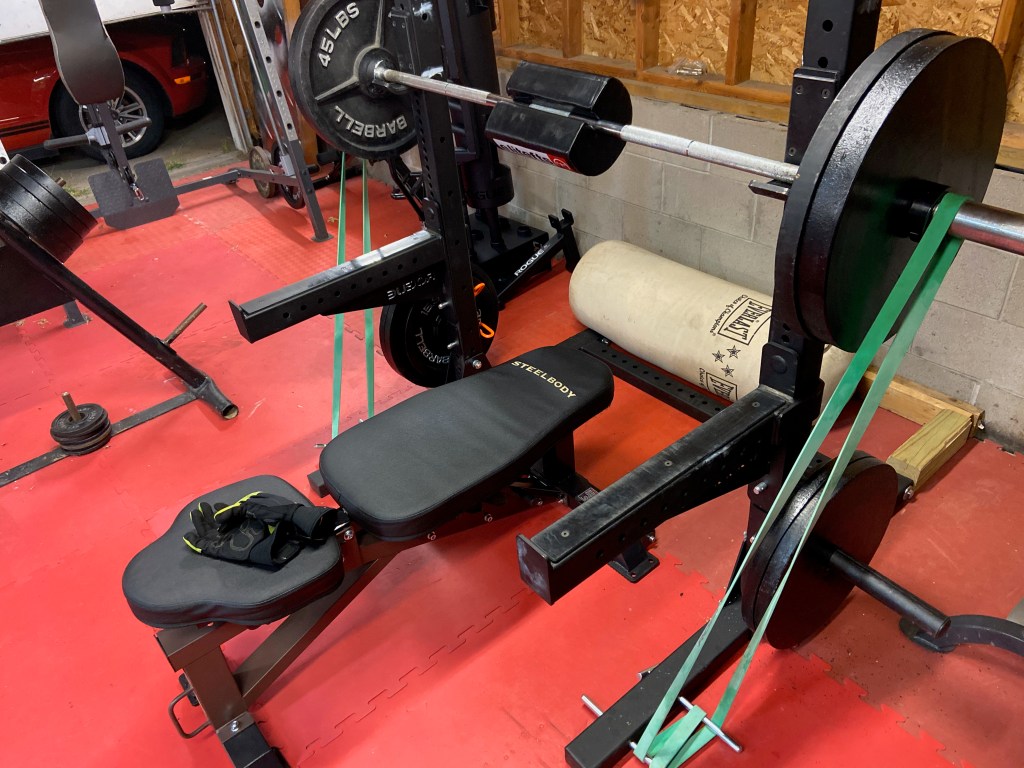
Bench Press – I would say this doesn’t require a lot of explaining why it is part of powerbuilding program but chest press could be done a variety of ways. This is my main chest press movement. During the Summer of 2021, I went down to my chest every Monday and did so with chains on Thursday. Currently, I am using chains on Monday for strength training and using the American Press bar by EliteFTS hypertrophy. I like to press twice a week and I have the equipment just about any variation of bench press I like. I very much like Banded Bench Press, but I haven’t done it solo yet because it is very, very difficult.
Banded Bench Press
Dumbbell Press – One of my main supplemental exercises, whether flat, incline, or overhead. I like training with dumbbells because each arm has to perform on its own. In the past, I have used it as a main lift.
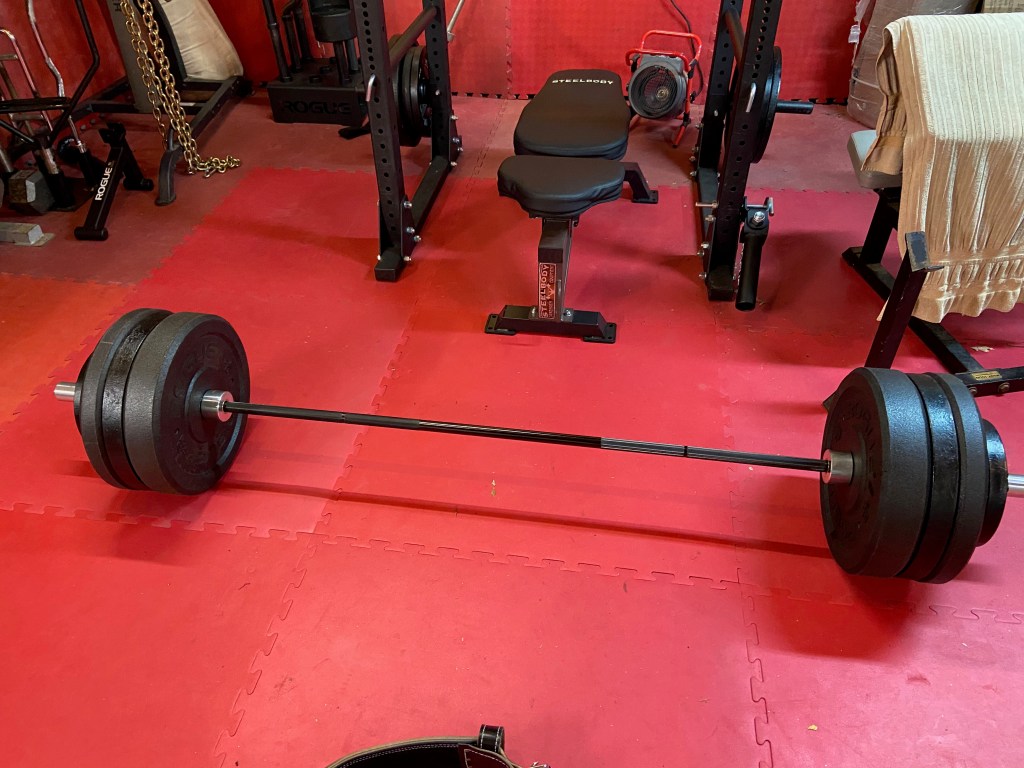
Deadlift/block pulls – Deadlifts are ever present in my plans. It is my best lift out of the three powerlifting mains. I use to pull from the floor a lot more than I do currently. I started doing rack pulls last year when my Rogue RML-390 was a squat stand, and that continued into this past summer before the deadlift mats from EliteFTS arrived in August. I’ve seen videos about the difference between block pulls and rack pulls, especially using deadlift bars, but not been able to do the former. The difference in height from my rack pull position to block pull position was about 4 inches lower. That made it a lot more difficult. I find a lot of value in pulling from the elevated position.
Squats – A little obvious because I don’t have equipment to really go after legs without doing them. I do, however, have 3 different bars for doing squats: a Rogue Ohio Power Bar, a Safety Squat Yoke Bar from EliteFTS and a Rogue Cambered Bar. The last one I got about a month and change ago. Squats with a straight bar puts quite a bit of strain on my shoulders and I sometime have difficulty getting into the best position on them. I do much more low bar squat and high bar so the Cambered bar is very helpful and gives a radically different feel. The Yoke bar makes many different kind of squat movements possible. I have recently learned about Hatfield Squats that use handles on the rack for an upper body leverage position. Really opened up the possibilities to leg training in the garage.
Banded Rack Pulls – This variation of pull is one of my very favorite because it is so effective. I have Rogue Monster Bands in 70 pound and 100 pound sizes and they make this lift very difficult. I found these last year messing around in the garage and felt their value immediately. This year I really wanted to focus on the last half of the deadlift and thought this would be a good supplement. I feel my entire back activating when I do this lift. Moreover, it helps train the lockout because both proper form and max effort must be used to achieve lockout using the bands.
Seated Overhead Press – I do these with both dumbbells and the American Cambered Bar.. The latter is easier to do because of the ability to place the bar in front rack position without having to move it through physical effort. I prefer a much more neutral hand position for overhead pressing. I do most of barbell press from a pinned position for safety reasons, but it also forces me to push up without the benefit of loading the muscle first. Dumbbell overhead press will always have the disadvantage of having to get to the front rack position until I get the attachment to the power rack that allows me to rest the dumbbell in that position.
Log Clean and Press – Standing overhead press is important to me but I am not a big fan of doing it with a barbell. This particular implement, the log, I found from watching Strongman competitions and found I very much like it. The clean is vastly different from a Weightlifting movement, and sometimes I even feel like I am doing more of a curl than a clean. This has done a lot for both strength and muscular development in my shoulders all around.
Viking Press – I do this with an attachment piece from EliteFTS in correlation with a Landmine from Rogue Fitness on my Rogue power rack. I know I just name dropped fitness brands but I feel it is important to be as honest as I can be with what equipment I am using. I got the attachment earlier this year and brought it into my program more when I realized how useful it was. It is a very complex movement. First, a deadlift and a continental clean to get into front rack position; second, once in position a press movement overhead and slightly forward in the concentric followed by what is essentially a lat pull in the eccentric. It is highly effective upper back training because I feel all of the muscles in that area firing, especially at the bottom position of the lat pull.
Tricep Pushdowns – The staple of tricep arm shaping has always been part of my plans. I did only pyramid style ones for the longest time until last year when I found the benefit of flat pronated grip pushdowns. I found they produce a better carryover to the bench press.
EZ Curl Bar curls – Bigger biceps can really come from a lot of curls. Strength based movements like deadlifts and other pulls employ the biceps more so than triceps but because they don’t isolate the movement, they doesn’t grow. If I was more purely a powerlifter, I wouldn’t do them as much if at all.
T Bar Rows – I do these because it allows me to hit lats at different angles than an overhead pull does. If my buddy didn’t have a T Bar Row I might not do this as often. This is part movement and part accessibility.
Rolling Tricep Extensions – I discovered this one recently from a video EliteFTS founder Dave Tate showed Jujimufu and Joey Szatsmary in a video about tricep training. I don’t often add in exercises I see from Youtube videos because some are ridiculous. This movement is easier to do than a JM Press for me. I fully endorse adding it to a program.
Most of these lifts listed above are strength based compound movements. These have had time tested results in my time lifting primarily in the garage. I have written before that lifting in a gym turns me into a different lifter. My program shades towards hypertrophy there because of the availability of isolation machines and my desire for bigger, denser muscles. The following list is the machines and exercises at the gym I take most advantage of:
Leg Press – The machine in the gym I miss the most. It is a major supplemental lift that I can overload. The selectorized seated machine leg press machine makes doing calf raises very easy to do very quickly.
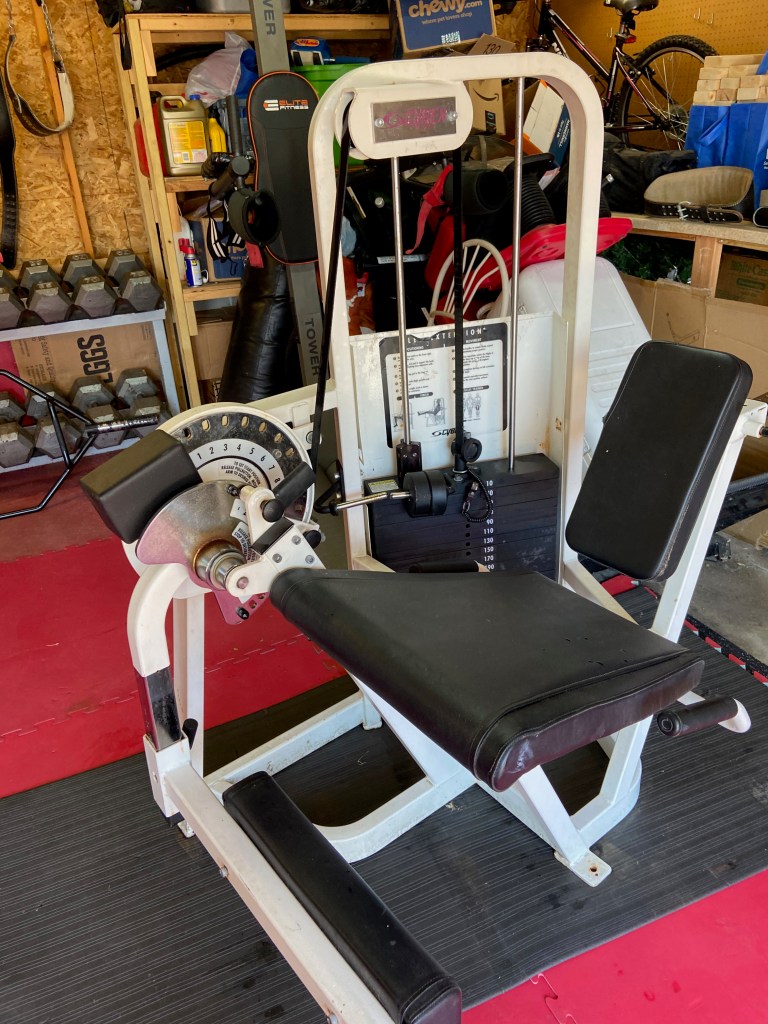
Leg Extensions – I could have put this in the above section because it is the one piece of isolation equipment I do have, but this is easier. I typically do this quite heavy but I have recently started doing less weight and for a longer length of time at the top. This lift can be quite intense so I use it often as a burnout exercise.
My Leg Extension machine.
Leg Curl – I cannot do this lift in the garage very well. I don’t have the equipment. I have tried figuring out ways to do it but it’s just about impossible to mimic. I typically do this as a unilateral lift standing rather than prone, but I have done both. I just prefer standing.
Sled Push – I would love to own a sled for pushing and pulling but I can’t justify spending the money on it right now. I have space in my house to do it but not the plates. When I do get the chance to do it, I take it because it’s a very different feeling moving heavy weight dynamically as opposed to in a static way, like a deadlift or squat. Most of the work ends up being done with the legs but it does put the full body to the test.
Chest Press Machine – This is the machine I use to burnout with when doing chest at the gym. I don’t have to worry about bar path or anything. Just push till I can’t push anymore.
Hammer Strength Iso-Lateral Chest – My commercial gym has 3 variations of this: Wide, regular, and incline. I tend to use the first and the third one mostly. Of those, I prefer wide to get more of my chest. It also tends to be the busiest one. It is an accessory lift that I can overload and I find those lifts to be the most productive.
Plate Loaded Preacher Curl – When I don’t feel like loading a bar or just want something different, like a very inner grip curl, preacher curl machines are very useful. I prefer the plate loaded version to the selectorized versions because I feel more in control of the weight used.
Cable Crossovers – This is the biggest upper body thing I miss from the gym. I cannot do these in my garage set up because I don’t have two cables. I have tried to these with one cable and found other exercises, close grip bench press and close grip dumbbell press specifically, work better. For hypertrophy, it’s hard to beat cable crossovers.
Side Lateral Raises – I do these in the garage but with dumbbells and an unloaded ez curl bar but the advantage the machine for this has is that I can overload it and get my work in. The side deltoid is very particular in the movement required to activate it and that machine does it very well.
Chest/Read Deltoid Fly – Another lift that can be done with dumbbells. The machine just makes the movement easier to do with heavier weight. It’s a different kind of weight, but more weight all the same.
If this looks like a lot of exercises, it isn’t. My lifting plan hits every muscle group twice a week and is broken down like a bodybuilding plan is. Strength development is what really makes me happy though so I deliberately work on that more. I am always looking out for new lifts that can be helpful gain mass and get me stronger and that won’t change.
Chain Bench Press – 135 x warm up, 225 x 5, 225 w/chain x 4 , 235 w/chain x 5, 245 w/chain x 2. Narrow Grip Incline Bench Press – 135 x 8, 185 x 6, 205 x 4, 185 x 6 Seated Overhead Press, American Cambered Bar – 128 x 6, 138 x 5, 148 x 2, 128 x 6 Tricep Pushdowns, pronated grip – 45 x 15, 55 x 12, 66 x 12, 71 x 12 Flat Dumbbell Press – 100 x 7, 110 x 5, 115 x 3, 95 x 9 Lat Pulldown – 90 x 12, 115 x 12, 125 x 10, 140 x 10 Preacher curls, super set EZ curl bar outer grip and inner grip – 45 x 15, 55 x 12, 65 x 10, 75 x 10 Standing EZ curl bar curls – 75 x 12, 65 x 15, 55 x 20, 45 x 20, 25 x 20 Flat Tricep Extension, Fat EZ Curl Bar – 75 x 12, 75 w/chain x 12, 85 w/chain x 10, 95 w/chain x 9
Tuesday Cambered Bar Squat – 175 x 8, 225 x 8, 275 x 6, 325 x 5, 345 x 5, 355 x 3 Calf Raise, Hatfield style – 245 x 15, 295 x 12, 315 x 10, 335 x 8 Block Pull, Romanian style – 315 x 6, 345 x 6, 365 x 4, 385 x 3, Hatfield Bench Squat – 245 x 8, 335 x 8, 385 x 7, 405 x 6 Leg Extensions – 170 x 8, 130 x 10
Wednesday Log Press, Strict Press – 101 x 8, 111 x 8, 121 x 6, 131 x 5, 141 x 4 Viking Press – 115 x 12, 140 x 12, 165 x 8, 165 w/chain x 8 Seated Overhead Dumbbell Press – 45 x 8, 55 x 7, 65 x 6, 75 x 3 Bent Over Rear Deltoid Fly, Dumbbells – 15 x 12, 20 x 10, 25 x 10, 30 x 10 Side Lateral Raises – 25 x 8, 15 x 8
Thursday Multigrip Press, cluster set outer two grips – 138 x 8, 178 x 8, 198 x 6, 218 x 4, 228 x 3 (outer grip only) Multigrip Press, cluster set inner two grips – 138 x 8, 158 x 8, 168 x 6, Banded Rack Pulls – 185 w/70 lb bands x 8, 205 w/70 lb and chain x 6, 225 w/70 lb and chain x 6, 225 w/100 lb and chain x 6, 235, w/100 lb and chain x 6, 245 w/100 lb and chain x 4 Preacher curls, super set EZ curl bar outer grip and inner grip – 45 x 15, 55 x 12, 65 x 10, 75 x 10 Incline Dumbbell Press – 100 x 6, 110 x 4, 115 x 2, 95 x 7 Standing Lat Pulldown – 70 x 15, 80 x 12, 91 x 10, 102 x 6 Rolling Tricep Press – 15 x 12, 20 x 10, 25 x 10, 30 x 8 Standing curls, EZ curl bar outer grip – 75 x 10, 65 x 12, 55 x 12, 45 x10, 25 x 20 Tricep Pushdown, Pyramid style – 45 x 15, 55 x 12, 65 x 12, 75 x 10
Friday High Bar Squat – 135 x 10, 185 x 10, 225 x 8 Leg Press – 388 x 15, 478 x 12, 568 x 12, 658 x 12, 758 x 10 Deficit Deadlift – 135 x 8, 225 x 6, 275 x 6, 325 x 3 Standing Leg Curl, per leg – 35 x 10, 60 x 10, 70 x 10, 85 x 8 Iso-Lateral Row, per arm – 45 x 8, 90 x 8, Calf Raises – 242 x 12, 264 x 12, 286 x 12, 308 x 12, 330 x 12 Leg Extension, held 5 seconds – 100 x 10, 130 x 10, 160 x 8, 190 x 8 Abduction and Adduction, both – 295 x 20
Notes Bench press once again a little laggy and unsure why. Could be lingering soreness in left shoulder or overuse. A change in the bench press routine is in order. Chest press feels like it is getting stronger when focusing on volume. The Multigrip bar is made for hypertrophy work and it is doing it’s job well.
I am still getting used to cambered bar squat. It feels very different from either a low bar straight bar squat or the SS Yoke bar. I know what weight range I need to be in now for it so now just gotta push it.
Overhead press is closer to getting back where it was before my 2 week break from lifting. Only other lift that has maintained close to the end of last program is the block pull. Even that was a battle this week. I tried to do 385 off the floor after block pulls and could barely get it off the floor. I think I need to work on quad strength now to help get the bar off the floor better.


 Life Through Lifting