My Current Plan

Updating my Winter Plan

Mark Brown

February 25, 2022

Since the second week of the new year, I have been working on a program of my own design in the gym. I wrote about my winter plan around the the turn of the year and I have followed what I said I was going to do. This entry is all about the specifics of that plan now that I am 6 weeks in to it. In my weekly logs, I share what lifts I have done in terms of load, reps and sets but they are not necessarily in the order of how they were done while at the gym. So my readers see only about 70% of the full plan. That changes today.

Lifting in a commercial gym is a pain in the ass if one lifts in the afternoons. One never really gets a sense of how a lifting session is going to go until they have lifted in that gym for at least few weeks. I know certain things about the Merle Hay location of Genesis Health Club in Des Moines, Iowa. I have a good feel for what other people are doing based on my observing everyone at the gym while I am lifting. That is an important thing to understand when I lay out the order of lifts. How other people lift will have a big impact on your personal lifting session. I have taken into account that Monday and Tuesday are major chest and shoulder days for most of the consistent gym goers. The goal is to have as little competition for the equipment I want to use when I need to use it so my first chest/shoulder day lands on Wednesday for that reason. Limiting exercises to only the most effective ones also helps achieve this goal. When I get off work, the open rack area almost always has a spot available for squats regardless of the day of the week. I remember Eddie Hall calling Mondays “International Leg Day” and laughed because I’d always heard it be called “International Chest Day” instead. I can see why it would be both. The consequence of my first upper body day landing so “late” in the week is that it pushes the second to a weekend day, which is fine because that second one is the more physically demanding of the two.

This video does a great job of explaining the basis of how I think about it.

This is the ideal lifting order for my plan:
Monday: Low bar straight bar squat, traditional deadlift, barbell row, barbell good morning, standing one leg curl, seated calf raise, abductor/adductor.
Tuesday: Pronated grip tricep pushdowns, cable two hand curls, lat pulldowns, seated overhead tricep press superset with curls, straight arm lat pulldowns, preacher dumbbell curls, conditioning work.
Wednesday: Flat dumbbell press, narrow grip incline press, seated overhead dumbbell press, floor press, rear deltoid fly, side lateral raises.
Friday: High bar straight bar squat, sumo deadlift, leg press, cable rows, prone leg curls, leg extensions, seated calf raise, abductor, adductor.
Saturday: Incline dumbbell press, bench press, pin press, standing overhead barbell press, Arnold press.

Most of what I do is done to build more absolute strength so I can lift more on the main lifts. That is reflected in what lifts I choose and total workload, which is load x reps x sets. Tuesday is an exception to that training structure because it is more hypertrophy than anything else. If someone has been following my logs, they will see that I have lifted a lot of sets for low reps at 70% or above. What the logs don’t show is that rest periods between the sets is about 2 minutes. That means a couple different things. First, that means that my lifting sessions take between 2 and 2.5 hours, especially the leg days. I have made strides in being more time efficient on chest and shoulder days but still about 2 hours there. Second, the clock truly is ruthless. I don’t lift till I am physically annihilated but the intensity in terms of effort is higher than I have done before. It is having the effect I intended it to have.

I’m guessing there are some questions about why some lifts come before others in my plan:

Why dumbbell press before bench press? This lift is done for as many reps as I can do in a set, unlike the other lifts, to push my chest and triceps to recruit more muscle at the beginning of the session. Yes, what I just described is muscular development but at the weights I am using for the lift, it really is about strength development. Dumbbells don’t translate over to bench press fully because of hand placement on the bar but they are a great tool for overall strength development. It’s especially useful for what I want out of them because of way I treat bench press sets under this plan. Wearing my chest out to a big degree helps the strain on the chest become greater over the series of 8-10 sets done with barely any rest.

Why squat and deadlift on the same day right after each other? Splitting up squats and deadlifts would make it harder to plan 2 of each in a given week. They are both hip hinge movements that are leg dominant so it makes sense to me to do them both on the same day. The 2 minute rest switch has really impacted these two lifts the most. It’s brought the intensity up on them to an extreme level. It helps keep the session on track in terms of time because squat alone is at least 50 minutes.

Why sumo as the second deadlift of the week? When I am in the garage, my primary hamstring builder is a Romanian deadlift, which is a straight leg deadlift started from a higher position. The point is raise the bar’s starting position off the floor so that I can be physically closer to the bar at the start of the pull. I have 3/4” thick mats, 8 of them, that accomplish this task. I have no such mats at the gym so I can accomplish a similar effect by using the sumo set up (hands gripped inside the knees on the inner most part of the knurling). By widening my feet, I make the pull shorter without raising the bar off the floor. It also makes the pull different because it feels more back heavy at the start with the way the hand placement leads the muscle contraction up the back. In essence, the bar “feels” heavier when I sumo deadlift at loads that wouldn’t be the case.

Why is standing overhead press not a main lift? It could very well become a main lift at some point in the future. It is the primary reason why the second upper body day is the harder of the two. The first reason is a powerlifting reason. Overhead press is a supplemental lift for powerlifting because it’s not part of the competition. The second is the fact that it is a very hard lift and I would rathe not do it after work. Third, I would rather devote the bulk of my energy into chest and bench press development. If I want to emphasize shoulder strength and development, it goes straight to the first exercise. Last, it’s an exercise done with a a healthy amount of space because of the consequences of a failed lift and busy gym days aren’t the time and place for it.

Why floor press Wednesday and pin press Saturday? This is fairly simple. I’m not a dick. There are 2 squat racks, which are half racks, and the place is relatively empty on the weekends when I lift so the half racks are more available for doing pin presses than on Wednesday. This isn’t the equivalent of doing curls in the squat rack but it is a cousin of that so I get it done fairly quickly to not hold up the half racks for squatters. Floor presses are the harder of the two lifts but both are all about power output. That’s why they are last in terms of strength development focused lifts as supplementals. I have noticed that sometimes the open rack area gets crowded about the time I want to do them so I do have to make a choice to switch up the order.

Why is there an ideal list for accessory work on Tuesday or leg accessories? I like to do pushdowns first and quickly to get blood into the arms but outside of that there isn’t one. The free weight area of the gym on Tuesdays is kind of a free-for-all equipment wise because the people who didn’t do upper body on Monday tend to do it on Tuesday so I can’t really be picky. That day only really takes about an hour or so to complete because of the lack of rest time between sets and that just adds another reason not to be picky. The accessory day on Tuesday definitely has an effect on Wednesday’s chest/shoulder session so I am careful to not overdo it. There’s no need to prioritize how the leg accessories get done in terms of order because Genesis has only 1 each of prone leg curl, leg extension, seated leg curl, and single leg leg curl machines. Someone can easily hop onto the next machine on the list while I am on the one I chose to do.

Using this plan, I have made quite a bit of progress in overall strength so far mainly due to the workload being higher. That is how I have progressively overloaded the last 6-7 weeks of training compared to the the prior weeks. The lack of rest time between my main lift and supplemental sets has let me scrunch the sheer number of reps into the same amount of time I was using before or less to get my session done. It has also kept me more active during my lifting sessions so they are more cardio friendly.
The Weight Loss Conundrum

Confidence is the Key

Mark Brown

February 22, 2022

I weighed myself on my scale at home Monday morning on February 21 after I showered and dried off. It said 282.2 pounds. This isn’t anything new. I have been hovering around this weight for almost 2 years now. Weight loss isn’t something I have not particularly emphasized over the last couple years but I am not blind to it. This entry stems from a very specific issue from frustrations posted by people at the Shaw Elite Club, which I am a member of. Brian Shaw, 4 times World’s Strongest Man, opened up a 10-week transformation contest to members about 5 weeks ago and the issue of weight loss has been brought up quite a few times by members. I find that confidence is the most important thing to the success of any goal. It keeps discipline in line and motivation high. The confidence I speak about comes in 2 different forms. Both are very important and require each other to get the job done. The first is an emotional confidence that keeps the psyche positive, especially on bad days. The second is confidence in the plan that one is using to achieve the goal, in this case weight loss. Loss of confidence is catastrophic the success of anything and must be avoided at all costs.

Scales are more damaging to one’s psyche and confidence than public derision because it stems from a deeper place: The Truth. There’s no blowing off the number that appears on the scale and no mental gymnastics one can do to wiggle around the issue. What makes the goal of weight loss frustrating is that weight fluctuates wildly from day to day. This isn’t exactly news. The only way to understand what is happening is to get on the scale everyday under the same circumstances the way a scientist employs a control in an experiment. That can lead to a lot of pressure accumulating over time if the numbers aren’t saying what is desired. Frustration is the expression one makes when they start to lose confidence in the plan that has been chosen. They think that they know what should be happening by a certain time but the lack of expected results causes one to question the plan. When one loses confidence in it, discipline wavers and they can start to “cheat” on their plan. This can result in anything from going off the planned diet, changing the exercise part of the plan, turning to medication or PEDs. The key thing to remember what is happening here: Frustration is the loss of confidence in the plan. That must be dealt with immediately. If one doesn’t, failure is all but guaranteed. The easiest and most effective way to deal with it is through emotional stability. This is when that emotional confidence I referred to becomes the more important of the two. It’s the thing that keeps motivation high and tells one they can do it, whatever “it” is. If one is mentally strong enough on their own, then a need for a team around them isn’t absolutely necessary but is helpful. For those lacking the mental training necessary to accomplish a task as daunting as weight loss, then having that team around them is necessary to keep a positive mindset. The acquisition of a sustained positive mindset is the thing that will ultimately bust through that frustration that builds up over time so that one can ride the daily changes. One might even get some enjoyment out of it. The “process” can’t all be business.

I weighed myself 3 weeks ago. The scale said 266.6 pounds. I laughed because the scale indicated that I had lot about 9 or so pounds in about 2 weeks. This is what I mean by the wild swings that can be seen on the scale. Is it more lean muscle, fat, water or all the above? I don’t know. If I had prioritized weight loss over this time period, the 282.2 would have provided more of a freak out moment than a semi-hearty laugh. Nothing in my diet has changed. My lifting schedule and plan hasn’t deviated, as seen in my training logs. I’m still getting the same amount of sleep. I’m still getting the same amount of steps and miles in a day. I literally couldn’t tell anyone why there is a 16 pound swing up in my weight over a 3 week period. Just like I couldn’t tell anyone why I had lost 9 pounds in 2 weeks because the same things were just as true during that time frame. This is a major reason why I don’t emphasize weight loss during this phase of strength training. If I was entering a competition and needed to make a specific weight, then that would be very different. It would also change everything about everything that I am doing.

These numbers need to be put in proper context. In August 2020, I weighed myself on the gym’s scale when I was there for leg days. It was consistently reading between 295 and 305 pounds when I weighed myself. I knew I was potentially that big but that wasn’t really the sign that I needed to drop some weight. That came from my freshly purchased $123 Rogue 13-millimeter-thick 4-inch-wide powerlifting belt. I had gotten the biggest size I could have and I was barely getting into the very first hole. Belts have always been a good way to judge weight loss or gain. A powerlifting belt is even better because they are worn around one’s true waist, which is navel height. I needed to lose weight to fit into my expensive powerlifting belt. By the start of 2021, I had dropped to about 280 and have stayed there since that time with fluctuations as low as just above to 260 and as high as 285 or so. I vacillate between the 5th and 6th holes on the powerlifting belt right now. I even reached the 7th last fall but it didn’t last long. I am comfortable where I am right now. I have always been big. It runs in my mom’s side of the family. It’s one of the main reasons I lift as hard as I do. I know what my genetics are telling me if I don’t do anything about my fitness.

Scales are not the devil and are just one tool in the shed for gauging weight loss and health. Belts, clothes and how one feels physically and mentally are fairly good indicators of what one could be doing better or worse. Weighing consistently the same way everyday will help read the tea leaves better. Wild swings in body weight have to be accounted for and understood so they don’t start to mess with one’s psyche and confidence. The most important thing to take away from this essay is that maintaining confidence is everything. Once confidence is lost, the loss of discipline is all but inevitable. If they are doing things right and just not seeing the results on the scale, then they have to maintain confidence in their plan to keep it on track. Do whatever it takes to keep that confidence high because the consequences of losing it are bad in every scenario.

By the way, the Shaw Elite Club is a very good place to go for positive group engagement if one is wanting to get better. It isn’t free but the the price is well worth everything that one gets by joining, especially getting to watch the Shaw Classic. I’ve gotten more engaged there since I started the blog and it’s been very helpful.

2022 Week 7 Training Log

February 14, 2022 – February 20, 2022

Mark Brown

February 20, 2022

Monday
Low Bar Straight Bar Squats – 135 x 8; 225 x 6; 315 x 6, x 6; 345 x 6, x 3, x 3; 365 x 3, x 3; 385 x 2, x 2
Deadlift, Power Bar – 315 x 3, x 3 x 3, x 3; 345 x 3, x 3, x 3, x 3; 365 x 3,
Calf Raises – 100 kg x 30, 120 kg x 20, 140 kg x 160 kg x 20
Barbell rows – 135 x 6, x 6, x 6, x 6
Straight Bar Good Mornings – 135 x 8, 155 x 6, 155 x 6
Single Leg Leg Curls, Each Leg – 35 x 10, 70 x 8 R (x 10 L), 80 x 8
Abduction – 295 x 20, x 20, x 20, x 20, x 20

Tuesday
Overhead Tricep Press – 55 x 12, 65 x 12, 75 x 10
EZ Bar Curl, superset with above – 55 x 12, 65 x 10, 75 x 8
Lat Pulldown 85 x 15, 100 x 12, 120 x 12, 140 x 12, 160 x 8
Tricep Pushdown, Pronated Grip – 50 x 12, 57.5 x 12, 65 x 12, 72.5 x 12, 80 x 10, 87.5 x 8
Tricep Pushdown, Pronated Close Gip – 80 x 10, 72.5 x 12, 65 x 12
Cable Curls – 42.5 x 12, 50 x 12, 57. 5 x 12, 65 x 10
Straight Arm Lat Pulldown – 65 x 12, 72.5 x 12, 80 x 12, 87.5 x 8
Dumbbell Preacher Curls – 35 x 10, 40 x 10, 45 x 8

Wednesday
Flat Dumbbell Press – 105 x 10, 110 x 7, 115 x 6, 120 x 5, 125 x 3
Narrow Grip Incline Press – 165 x 8, 185 x 6, x 6, x 3, x 3; 195 x 3, x 3, x 3, x 3
Seated Overhead Dumbbell Press – 50 x 12, 55 x 10, 60 x 8; 65 x 7, 70 x 5
Read Deltoid Flies – 85 x 15; 100 x 15, 115 x 15
Side Lateral Raises – 95 x 12, 110 x 12, 125 x 10, 140 x 6
Floor Press – 225 x 3, x 3, x 3, x 3; 235 x 3, x 3, x 3, x 2
Bar Push-ups, super set with Floor Press – Bodyweight x 10, x 10, x 10, x 10

Thursday
Scheduled Day Off – Recovery

Friday
High Bar Straight Bar Squats – 135 x 8, 225 x 6; 315 x 3, x3, x 3, x 3; 345 x3, x 3, x 3, x3; 365 x 3, x 3, x 3, x 3
Sumo Deadlift – 315 x 3, x 3, x 3, x 3, x 3, x 3, x 3, x 3
Leg Press – 658 x 12, x 12, 78 x 12, 838 x 12, 838 x 10; 928 x 10
Prone Leg Curl – 65 x 10, 80 x 10, 95 x 10, 110 x 10
Cable Rows – 35 x 12, 42.5 x 12, 50 x 12, 60 x 12, 70 x 10
Leg Extensions – 115 x 10, 145 x 10, 175 x 10, 205 x 10
Calf Raises – 100 kg x 20, 120 kg x 20, 140 kg x 20, 160 kg x 12,
Leg Extensions – 115 x 10, 145 x 10, 175 x 8, 205 x 8
Abduction – 295 x 50, x 50
Adduction – 295 x 10, x 10, x 10

Saturday
Unscheduled Day off – Rest

Sunday
Scheduled Day off – Rest

Picture time!

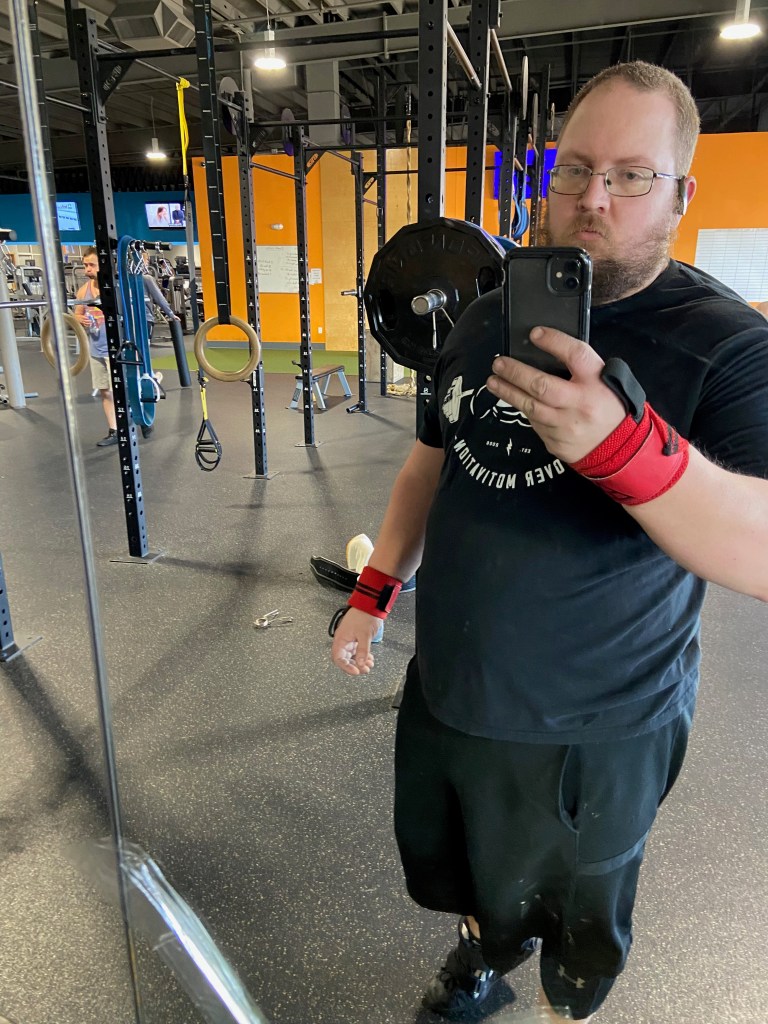
Picture taken before my lifting session earlier today really started to get going. Muscular development hasn’t been the main goal but I have felt a significant amount of it in my upper back, right where I have needed it for the 3 main lifts. I know a black t-shirt shirt, even as perfectly fitting and awesome as the Shaw Strength one I had on, doesn’t help show the development in upper back and traps but here it is nonetheless. Also seeing more development in my arms after adding that isolation day on Tuesday at the gym. For most of the 2021 I was about size 3.5 on the Evolution elbow sleeves, but now I am beginning to feel much more compression in the upper part of my arm when I wear the 4x size ones I got a full year too early.

Going Over Every Damned Hill

Stop picking and choosing which ones to die on

Mark Brown

February 16, 2022

Selecting a metaphor for figuring out what specific things hold more importance than others is far from a hard task. The media scene in 2022 is full of opinion pieces called “takes” in which a media member renders their verdict on what is happening in the sports world given all of the information currently at their disposal. Part of the “take” culture is attaching oneself to particular opinions and never deviating from that path. One of the most popular things to talk about in the mass media space, whether that’s ESPN or Facebook, is resting healthy players. This is because that space I just referred to is full of people from all generations and the way professional athletes used to play the games they did. It is a highly debated topic for a couple of reasons: Fans are demanding more entertainment value from spectator sports than ever before, comparing players of different generations, the importance of winning titles on legacies, the current direction of spectator sports and its effect on lower levels of competition. The last 2 reasons listed are the ones that are most important to me from a training perspective so that is what this entry will primarily address. It is the primary difference between practicing, playing and training between the “old” days and the current era of sports.

If we are talking about the current discussion about the importance of winning titles as drivers of legacy conversations, Michael Jordan gets top billing for being the force behind the mass media direction towards titles being the major part of a professional athletes legacy. I’m 37 years old and have taken in enough media in the 1990s to understand how MJ’s 6 titles positively or negatively effected older players accomplishments. How mass media at large highlighted the titles as a major part of his legacy effected how every professional athlete going forward was going to be judged. Statistical dominance matters less in the grand scheme of mass media. The result of that winning mattering more than statistical dominance led to Gregg Popovich, the long time head coach of the San Antonio Spurs, to prioritize rest for healthy players, especially aging superstars, during the regular season to preserve them for the playoffs. In the NBA, and other American professional sports, the playoffs have always mattered more than the regular season but prior to Popovich’s “Tim Duncan Plan” the latter still had some value. In 2022, that value has diminished to a startling degree. That has led to fan frustration with the entertainment value because superstar participation is key the NBA’s value as an entertainment product. The struggle to balance contending for NBA titles and being good entertainment has never been harder.

For those born around 1997 or later, the recently retired Tom Brady, who won the Super Bowl 7 times, filled the championship void left by Michael Jordan. What Brady shares with Jordan is that regular season dominance to go along with the titles won. The NFL will never deal with a coach who employed a rest plan to keep people ready for the playoffs because of the nature of their regular season, 17 games. The comparison of Tom Brady to Michael Jordan is much more apt than the one the mass media makes when comparing LeBron James to MJ. James, an NBA player since 2003, has used rest strategically to elongate his career, make long runs in the NBA playoffs and sign more lucrative contracts. This has not endeared him to multiple generations of fans and players where taking games off for rest wasn’t a major part of the plan. Games off for rest has become the norm for NBA teams in the last 15 or so years because Popovich’s plan successfully led to playoff success and lengthening Tim Duncan’s career. When one combines that fact with rising compensation for players, it’s obvious why resting healthy players works for both team and individual athlete, supposing their skills are wanted for that length of time. The success of plans that involve de-emphasizing the less intense “regular” season and overemphasizing the ultra intense “playoffs” has reset how athletes and coaches work to peak at the end. It is also endlessly frustrating to to fans who just want to see the best play every night.

Why is this important for the person who goes to the gym a couple times a week? Trends in sports tend to start at the top and work their way down the chain back towards youth sports, stopping by non-athletes along the way. There are 2 different trends at work: 1) Using game days as rest days and 2) devaluing everything before what really matters. These trends that have been active for almost a decade and a half directly run counter to what I did growing up and all of them bother me to some extent. The two trends have a cause and effect relationship. Using game days as rest days causes the devaluation of “regular” season by leading everybody watching to question the merit of playing the games in the first place. Practice is done to become better for when game time comes around. If the games become just practice with points being officially counted then why does anyone pay them and why pay to see the games? That’s the question that gets asked when stars skip games as a “healthy scratch – rest.” Colin Cowherd, of Fox Sports Radio and FS1 and a person whose opinion I am often in line with, is an example of a person who is okay with “healthy scratch – rest” because ultimately the playoffs is what matters more than anything else. He doesn’t care about random January games against Charlotte and cares about the one in May against Golden State. The fact that professional sports is mostly a television show no different from scripted series is compelling and I understand his point of view here.

That is the justification of picking and choosing which hill to die on, so to speak, instead of just going over every damned one like we used to in the past. As a strength athlete, I can’t abide by it. How I translate this to the gym, especially for people who will never compete at a meet, is that it sends the message that one can skip days they’d normally be lifting to get “extra” rest and still get the progress they want. That couldn’t be further from the truth. Missed lifting sessions cannot be caught back up even if one re-arranges them to “make up” for a day missed earlier in the week because the next week will be impacted by those changes. Players who miss games as “healthy scratches” are missing crucial team development that will be important at some point in the future. Even worse is if a lifter gets used to skipping sessions when they didn’t need to, it can create a pathway to excusing their actions to themselves and others, if they lift as part of a group. That particular act of skipping is damaging to the group and grounds for eviction from said group if it is done too often. For non-competitor lifters, hard days or max out days are our playoffs. Those are the days that have to be planned out well in advance to stand a chance at seeing the improvement one desires. I started to use short term periodization in the 12-16 week range last year to “peak” when the planned time comes to hit a 1 rep max on squat, bench press, deadlift or overhead press. That “regular” season lifting sessions aren’t practice. Those are our game days and should be thought of as such, not practice.

Getting better at whatever sport one chooses to do mean doing it at times that are disadvantageous to peak performance at said sport. That could mean something as general as training and playing without proper nutritional and sleep intake or specific as playing golf on wet and rainy day. There are cases where extra rest must be taken to ensure that the goal gets accomplished. I learned that in November of 2021 when I felt I needed to cut 1 day a week off my training schedule because I was running myself into the ground with the intensity, both physically and psychologically, of the lifting I was doing. There are times to pull back but I will always be in favor of going over every damned hill because the positives of constantly being on edge of failure outweighs the negatives.

2022 Week 6 Training Log

February 7, 2022 – February 13, 2022

Mark Brown

February 13, 2002

Monday
Low Bar Straight Bar Squats – 135 x 8; 225 x 6; 315 x 3, x 3, x 6; 345 x 6; 365 x 3, x 3; 385 x 3, x 2
Snatch Grip Deadlift, Power Bar – 315 x 3, x 3 x 3, x 3; 345 x 3, x 3; 315 x 3, x 3
Calf Raises – 230g x 20, 270 x 20, 310 x 12,
Barbell rows – 135 x 6, x 6, x 6, x 6
SSB Bar Good Mornings – 65 x 10, 115 x 10, 155 x 8, 175 x 6
Single Leg Leg Curls, Each Leg – 35 x 10, 60 x 10, 70 x 8, 85 x 8

Tuesday
Overhead Tricep Press – 45 x 12, 55 x 12, 65 x 10, 75 x 8
EZ Bar Curl, superset with above – 45 x 12, 55 x 12, 65 x 10, 75 x 8
Lat Pulldown 85 x 12, 100 x 12, 120 x 12, 140 x 12, 160 x 8
Tricep Pushdown, Pronated Grip – 50 x 12, 57.5 x 12, 65 x 12, 72.5 x 12, 80 x 10, 87.5 x 8
Tricep Pushdown, Pronated Close Gip – 80 x 10, 72.5 x 12, 65 x 12, 57.5 x 12, 50 x 12
Cable Curls – 42.5 x 12, 50 x 12, 57. 5 x 8, 65 x 8
Straight Arm Lat Pulldown – 65 x 12, 72.5 x 12, 80 x 12, 87.5 x 10

Wednesday Flat Dumbbell Press – 105 x 8, 110 x 8, 115 x 5 (failed to lock out #6), 120 x 5, 125 x 3 Narrow Grip Incline Press – 165 x 6, 185 x 6, x 6, x 3; 195 x 3, x 3, x 3, x 3 Seated Overhead Dumbbell Press – 50 x 12, 60 x 8, x 8; 65 x 8, 70 x 6 Read Deltoid Flies – 85 x 15; 100 x 15, 115 x 15 Side Lateral Raises – 95 x 12, 110 x 12, 125 x 10, 140 x 6 Seated Machine Press – 225 x 6, 240 x 6, 255 x 6, 270 x 3, x3

Thursday
Scheduled Day Off – Recovery

Friday
High Bar Straight Bar Squats – 135 x 8, 225 x 6; 315 x 6, x3, x 3; 345 x3, x 3, x 3, x3; 365 x 3, x 3; 385 x 2, x 2
Sumo Deadlift – 275 x 3, x 3; 315 x 3, x 3, x 3, x 3, x 3, x 3, x 3, x 3
Leg Press – 658 x 12, x 12, 838 x 10, 838 x 10; 928 x 8
Prone Leg Curl – 65 x 10, 80 x 10, 95 x 10
Calf Raises – 100 kg x 20, 120 kg x 20, 140 kg x 20, 160 kg x 12,
Leg Extensions – 115 x 10, 145 x 10, 175 x 8, 205 x 8
Abduction – 295 x 10, x 10, x 10, x 10

Saturday
Incline Dumbbell Press – 70 x 12, 100 x 10, 105 x 7, 110 x 6, 115 x 5, 120 x 4
Bench Press – 185 x 6, 225 x 6, x 3, x 3, x 3, x 3; 235 x 1
Standing Overhead Press – 95 x 6, 115 x 6, 125 x 6, 135 x 3, x 3; 145 x 3, x 3
Floor Press – 225 x3, x 3, x 3, x 3, x 3

Sunday
Scheduled Day off – Rest

Steps/Miles
Monday – 23,573 steps, 12.0 miles. Tuesday – 26,370 steps, 13.2 miles. Wednesday – 26,857 steps, 13.4 miles. Thursday – 21,394 steps, 10.9 miles. Friday – 24,027 steps, 11.9 miles. Saturday 9,391 steps, 5.01 miles. Sunday – No information Total – 131,612 steps, 66.41 miles.

Notes

I got back to a normal training week. Skipping last Saturday’s chest day gave me one less rest day so I ended up doing 3 chest/shoulder days in 7 instead of 8. It went well for the most part. Saturday’s chest/shoulder day was impacted by my indecision to do it so I didn’t get all I normally do in. However, all the lifts went well and I got the most important ones done well so that’s what counts. I can definitely feel improvement in all around pressing power. Saturday is a fuller, harder press day than Wednesday by far thanks to standing overhead press.

I got back to my typical leg and back routine. I made a a daily update post on Brian Shaw’s club about the difficulty of this week’s snatch grip deadlift. It is something I am going to have to figure out when wearing a powerlifting belt. I couldn’t get into position to lift what should have been very doable. Both squats went very well. Very high intensity in both load and effort. I can feel the my upper back getting stronger by the week. I am getting very comfortable under 365-385 pounds of load. I did cramp up very hard in the upper part of my right leg, centered more on the quad, Friday night right before bed. I know that the issue there is more hydration and sleep related than anything else so I know the problem.

I have also noticed a difference in my tricep and bicep since I started doing isolated lifting sessions to them and upper back and lats. The arm muscles feel and appear be at least slightly bigger. I can also tell some benefit because of the effort it takes to put on the bigger elbow sleeves I have been using since I started back in the gym in January. Those sleeves, the black 4x size Evolution Athletics ones I own, offer me less compression because they are about half a size too big right now. The 3x size gray ones I use are still in the garage.

The Bar’s Personality

Mark Brown

February 9, 2022

When I go to the gym or the garage to lift for the day I get locked in mentally and ready to go well before I get there. There’s no real warming up period before I get into my ideal mental state once I arrive. It’s there or it isn’t. In case of the latter, I lean on the discipline of getting the work done. That isn’t necessary in the case of the former. This mental state of readiness is extremely important to understand because definitely effects the day’s lifting session. Each piece of equipment and each lift requires different levels of readiness and therefore has their own personality. This use of metaphysical bullshit to describe how to lock in mentally is how I feel I can best explain my mentality in the gym and garage. This entry is definitely going to be less restrained in terms of language so you have been warned if you are sensitive to such language. This essay definitely falls into the “getting to know me” category of blog posts.

The personality of each individual lifter will be on display whether they realize it or not when they lift. No matter the words they use to describe it for someone, as is the case when talking with a coach or personal trainer, their actions in the gym will always be more truthful than whatever comes out of their mouth. That’s what makes gyms fascinating places to people watch. Some come to lift/cardio only while others come to lift and see “gym only” friends. I have been there enough to have a general idea what other gym goers do and use that information to progress through my lifting session accordingly. I generally fall into the first group. A minority part of that is that the only couple of people I talked to have moved on from the gym I lift at for whatever reason. The other, bigger part is that my gym mentality that started out pretty intense has become much more so in a “lifting is the only thing that fucking matters” kind of way. I’ve been told my co-workers who have seen me lift that I get kinda psycho. They aren’t wrong. I feel the psychotic rage come out when I lift.

How I got there was a realization of what was demanded by everything I do to make progress and get stronger. A “bar” is often used a metaphor for demarcations of achievement by people in writing or talk but in this case there is an actual bar. This is why the bar developed a personality in my brain as a way of readying myself to lift it. That personality I attached to it was one of defiance and challenging me to work “harder than last time,” as Greg Doucette would say. In my mind, there are simple truths about the bar. It doesn’t fucking care how my day went. It doesn’t give a fuck that work was crazy and required 3 hours of overtime to get stuff done. It doesn’t care I didn’t have optimum rest time or food intake. The only thing is gives a fuck about is if I can lift it or not. There are no pats on the back or knuckles for a lift done well. It just stares back up at me and demands I do it again. And again. Until I can’t anymore for the day. Doing this day after day is how I make progress. Thinking of the bar’s personality in this way only escalates because not only does the load go up but the intensity in my personality goes up to match it. This can become a dangerous cycle if I let it get out of control. I hold it in line with discipline and planning to prevent overtraining.

Giving personalities to inanimate objects isn’t anything new. We do it all the time in advertising to bring more eyeballs to products. Doing it for the barbell allows me to access a part of my mind that I reserve only for the task of strength training. It’s a less intense version of what Eddie Hall talked about preparing for the deadlift competition he performed the 500 kilogram deadlift in 2016. People often use music to find that mental place that allows them to lock it all in. I’m no different but it’s not completely mandatory for me to do so. I have forgotten my headphones before leaving for work putting me at the mercy of the gym’s music selection before and gotten through sessions. The song that best helps me lock in mentally is Under Siege by Amon Amarth. A major reason for that is that the song brings into focus the reality of the lift being a success or a fail, nothing in between, and the mentality of attacking as hard as I can. The lyrics of the song really push the message of the reality of controlling one’s destiny. Lifting with an “under siege” mentality means to make the lifts or fail while going as hard as I can. Failed lifts can be exceedingly instructive and necessary, but they cannot be viewed as successes in order to shield oneself from certain realities just to keep a positive mindset. Deluding oneself is never healthy.

Heavy objects at the gym tend to have different personalities for me than lighter ones do, though weight is situational based on the lift being done. Perhaps that’s just me attaching more danger and respect to the heavier loaded barbells and dumbbells. I fully understand injuries can happen at “lower” weighted dumbbells and such but the mindset of “not fucking around” is easier to get into with 115 pound dumbbells in my hand rather than 65 pound dumbbells. My switch to more powerlifting centric programming has me doing less exercises that are heavier in nature so that “not fucking around” mindset is constantly on. The programming definitely makes me prepare more mentally and focus more so I am ready to go before I even open the doors at the gym. The metaphor given to moving from one mental state to the next is “flipping the on/off switch.” It is generally seen as a hard task to actually do because it requires a high level of a discipline. I believe a person can achieve the ability to control their mental state through training, not necessarily physical but it does help. I would say for the most part that I am locked in most times but it manifests itself at the gym differently than when I am at work or at home.

I dislike most metaphysical analogies because most of them are used to excuse failure. In this instance, I use what I dislike to help me get to that place mentally that I am both calm and excited at the same time. That development has taken place over years. The last few have produced major development in the area of mental strength. I definitely make and accept less excuses now than I have in years past and I can thank the bar for that. The transition from general purpose lifting to more powerlifting made the personality of the bar stand out and created a more intense gym personality in me. I’m better for it. Finding out what the personality of the bar you lift will help you understand who you are as a lifter.

2022 Week 5 Training Log

January 31, 2022 – February 6, 2022

Mark Brown

February 6, 2022

Monday
Low Bar Straight Bar Squats – 135 x 8, 225 x 8; 315 x 3, x 3, x 3, x 3; 345 x 3, x 3, x 3, x 3
Snatch Grip Deadlift, Power Bar – 225 x 6, 275 x 6, 315 x 3, x 3 x 3, x 3; 365 x 3
Calf Raises – 100kg x 20, 120 x 20, 140 x 12, 160 x 12,
Barbell rows – 135 x 6, x 6, x 6
Barbell Good Mornings – 135 x 6, 155 x 6, 175 x 6
Single Leg Leg Curls, Each Leg – 35 x 8, 60 x 8, 70 x 8, 85 x 8

Tuesday
Overhead Tricep Press – 45 x 12, 55 x 12, 65 x 10, 75 x 10
EZ Bar Curl, superset with above – 45 x 12, 55 x 12, 65 x 10, 75 x 8
Lat Pulldown 85 x 12, 100 x 12, 120 x 12, 140 x 12, 160 x 8
Tricep Pushdown, Pronated Grip – 50 x 12, 57.5 x 12, 65 x 12, 72.5 x 12, 80 x 10, 87.5 x 8
Tricep Pushdown, Pronated Close Gip – 87.5 x 8, 80 x 10, 72.5 x 10, 65 x 10, 57.5 x 10
Cable Curls – 42.5 x 12, 50 x 12, 57. 5 x 8, 65 x 8
Standing Dumbbell Curls, One at a time – 35 x 8, 40 x 6, 45 x 6
Straight Arm Lat Pulldown – 65 x 12, 72.5 x 12, 80 x 12, 87.5 x 10
Weighted Crunches, Machine – 110 x 12, 125 x 15, 140 x 12
14 pound medicine ball over shoulder for 10 minutes – 6 min, then 4 min
10 laps, Down and Back (80 feet total) with 45 pound bumper

Wednesday
Flat Dumbbell Press – 105 x 8, 110 x 8, 115 x 6, 120 x 5, 125 x 3
Narrow Grip Incline Press – 165 x 8, 185 x 6, x 3, x 3; 195 x 3, x 3, x 3; 205 x 2
Seated Overhead Dumbbell Press – 50 x 12, 55 x 10, 60 x 8, 65 x 8, 70 x 5
Floor Press – 185 x 6, 205 x 6, 225 x 3, x 3, x 3, x 3; 235 x 3, x 3
Bar Pushup- 5 sets x 10
Read Deltoid Flies – 85 x 15; 100 x 15, 115 x 15
Side Lateral Raises – 95 x 12, 110 x 12, 125 x 10, 140 x 6

Thursday
Scheduled Day Off – Recovery

Friday
High Bar Straight Bar Squats – 135 x 8, 225 x 6; 315 x 3, x3, x 3, x3, x 3, x 3, x 3, x 3
Sumo Deadlift – 275 x 3, x 3; 315 x 3, x 3, x 3, x 3, x 3, x 3; 335 x 3
Leg Press – 478 x 15, 658 x 12, 838 x 10, 838 x 8
Prone Leg Curl – 65 x 10, 80 x 10, 95 x 8
Calf Raises – 230 x 30, 270 x 20, 310 x 20, 350 x 12,
Adduction – 295 x 10, x 10, x 10, x 10, x 10
Abduction – 295 x 10, x 10, x 10, x 10

Saturday
Unscheduled Day Off – Recovery

Sunday
Incline Dumbbell Press – 70 x 12, 100 x 10, 105 x 8, 110 x 6, 115 x 5, 120 x 3
Bench Press – 185 x 6, 225 x 3, x 3, x 3, x 3, x 3 x 3; 235 x 2, x 2
Pinned Bench Press, 2 Board – 185 x 6, 205 x 6, 225 x 6, 235 x 3, x 3
Standing Overhead Press – 95 x 6, 115 x 6, 125 x 6, 135 x 3, x 3; 145 x 3, x 3
Arnold Press – 45 x 12, 50 x 10, 55 x 8, 60 x 8, 65 x 6
Cable Crossover – 42.5 x 15, 50 x 15, 57.5 x 12, 65 x 12

Miles/Steps
Monday – 24,101 steps, 12.1 miles. Tuesday – 27,548 steps, 13.8 miles. Wednesday – 21,883 steps, 10.9 miles. Thursday – 19,708 steps, 10.0 miles. Friday – 22,412 steps, 11.1 miles. Saturday – 6,669 steps, 3.7 miles. Sunday – 9,343 steps, 4.6 miles. Total – 131,664 steps, 66.2 miles.

Notes

I hit a pretty normal de-load week after feeling a bit beat up following the last 4 weeks of intense lifting, especially on legs. The log above reflects a shift this week to a flat curve on lifts instead of increasing the load with every set on legs and back. It was a different feeling not increasing weight every set but I could tell it was good idea with each set I did, especially the sumo deadlift. Chest and shoulders didn’t get much of a de-load but I could tell they were a bit fried, too. Overall, a good hard week of training.

Introduced snatch grip deadlifts on Monday as an alternative to my normal hand placement on traditional deadlifts. I did a little of both a Romanian deadlift style, where I grip the bar then let get my feet into position with fairly straight legs to begin the lift, and the traditional stance, where I get feet placed then grip the bar and basically do a leg press. I found it easier to do the former than the latter so I will continue to mix it up over the next few weeks.

Standing overhead press is of special note this week because I felt some discomfort in my neck and upper back area after completing the sets at 135 and 145 pounds. It’s not anything I can’t deal with but it will bear paying attention to over the next week.

Cues and Hints Part 2

Finding the Starting Line

Photo by Andrea Piacquadio on Pexels.com

Mark Brown

February 2, 2022

Cues in the gym aren’t just meant to alert a lifter to straining in the muscle or when to end a set. They also tell the lifter when to start the lifting and/straining process. I gave one of them as an example in the introduction of last week’s entry. Deadlifting with a deadlift bar is not like lifting with a regular power bar. The increased whip of the deadlift bar means that the load will come off the ground, mat, box, etc in stages rather than all at once. That has the effect of the loaded plates not moving when the lifter makes his initial movement upward. The physical cue to begin the pull is when the slack of the bar has been pulled out of it. The bar will make a tick sound when the slack has been pulled from it. Deadlift bars make deadlifting easier and the pull feels smoother in my experience when the equipment is used as it is intended. If one is deadlifting for competition, then it might be necessary to train with both a deadlift bar and a stiffer power bar. Bar position on this lift is extremely important to the leverage a person can get when lifting the bar off the ground. For the easiest possible pull, the bar should be right up against the lifter’s shin. The further out the bar is, the more back will be required to do right off the bat. Remember, most of the work of a deadlift is done with the legs. Making sure the bar is where it needs to be at the starting position is easiest thing to do, but can get overlooked if one isn’t paying attention.

Cues on the squat are interesting to explore because I’m not entirely qualified break down all of them. I’m just going to talk about the ones I am most familiar with. The lift starts with the loaded bar on the shoulders in the rack. There is no real physical cue out of the rack other than getting your breathing and bracing in order. Take a good hard breath from the stomach and brace the core for the weight it is about to be responsible for holding up after un-racking. As a lifter starts the eccentric part of the lift on the way down to the bottom position, also known as “the hole,” the strain on the legs begins to increase the further one goes down. How far a lifter goes down into the hole before returning back to a standing position determines how much they are going to get out of the lift. The deeper one goes in the squat the more hamstring and glute development they will get. Squats are good general physical preparedness, or GPP for short, for any athlete because it helps with explosive movements like jumps or sprints and throwing motions by allowing one to better use their leverage. I start the concentric part of the lift when I feel the strain the greatest on my legs. If I am lifting in the garage I am more likely to push my squat depth lower because I am lifting inside a full power rack unless I am using the cambered bar, which doesn’t fit inside said rack.

The cue for coming back up from the hole largely comes from the lifter’s estimation of how much strain their legs and back can take before they need to push their body plus the load on the bar back to the starting position. Failure to get that estimation correct can result in either a mediocre squat session or severe injury. We’ve all seen the videos of blow quads in Youtube videos. It’s both a mental and physical cue that only improves with training. If a lifter wants to learn how to squat down to parallel a good way of doing that is box squatting. Placing the box at exactly parallel, when the knee and hips joints line up parallel to the ground, will help a lifter understand exactly where that is through telling them the how strained their leg muscles are at that point of the lift. Training squat depth is hard to do by oneself without training aids like boxes or safety pins (or straps) in racks primarily because it’s done almost completely done by feel. I have used those pieces of equipment as external physical cues to tell me when begin standing up. I find them very helpful. Understand that a box squat is not the same as a free squat done with safety pins in place to remind one where parallel is.

The big point I want to get across here is that staying mentally clear while the strain on the central nervous system and the muscles only increases is imperative. I remember a squat I did last year where I was so focused on trying to get to parallel on a straight bar free squat that I lost the bar on my left shoulder. It only fell a few inches so I was able to keep the bar on my upper back because it was a low bar squat and I tried so, so hard to save it before giving up and going down to the safety straps. It would have easily been in one of those gym fail videos on Youtube if it had been recorded and uploaded. I can easily imagine someone yelling “Just go down! You’re in a power rack! Just go down!” at their screen in part because that’s what I was telling myself to do as I was fighting 365 pounds unevenly balanced on my upper back for about 20-30 seconds. It was a very instructive lift to me because I remember being very intent on squatting to parallel on that day so I set the safety straps lower to account for it. My mind wandered midway down wondering where the bottom of the lift was because I kept lowering and the strain on my leg wasn’t adding up mentally. I missed every single physical and mental cue I had on that lift because I wasn’t focused on the lift itself. The end result could have been much worse than it was. I got lucky it was only a missed lift.

In my experience, upper body lifts with dumbbells require just getting myself mentally ready to get the lift done then getting my body back into position to do them. I just give myself a backwards countdown from 5 to 1 and get on with the set. That’s a lot easier said than done with dumbbell shoulder press is the lift. Getting those 75 pound dumbbells up into position is the hardest thing about the lift. Cues on a bench press are different if one has a spotter or not. The liftoff a spotter gives keeps the lats pressed back into the bench tight and ready to go quicker. Doing it solo means kind of doing that with the barbell in hand at the top of the lift then performing the reps. That’s what I usually end up doing. I did have to adjust the J cups on my power rack down an inch or so because it was too hard to un-rack and re-rack solo. The only cue for bench press that I really think about as I am doing it is if I can feel lats contracting the way they should be. I prefer a lift that descends slowly down to my chest followed by a brief pause at the bottom and finished with a pause at the top to reset for the next rep. This is true if I am dumbbell or barbell pressing. One interesting part of an incline press, barbell or dumbbell, is that I can really feel my lats working. Feeling those muscles go is why I prefer a bench that is shorter and wider than taller and narrower.

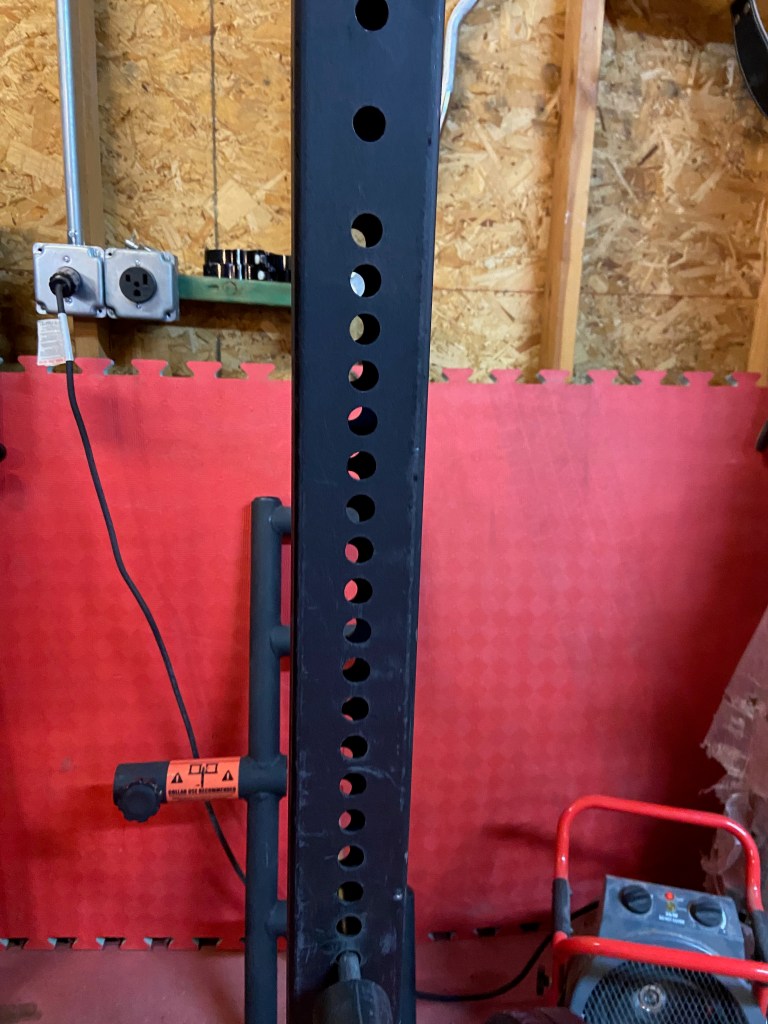
These “Westside” holes in the Rogue power rack are primary used to benching. I initally starting them at the top hole but moved them down 2 holes last year.

Starting cues in my experience are mostly about clearing one’s mind so they can concentrate on the lift they are doing. If a lift fails or requires help to get back to the racked position because the muscle was worked correctly but just worked beyond it’s capabilities then the lifter can feel good about it. However, if a lift fails because the mind wasn’t clear leading to a lack of concentration then that’s a major problem that needs to be addressed. Yes, there are physical cues like bar/dumbbell position, breathing, bracing, muscle readiness, etc that need to be addressed at the start but I do firmly believe that a lifter must have a clear mind to be able to listen to their body as the lift is being performed. The results of not having it can be catastrophic.

2022 Week 4 Training Log

January 24, 2022 – January 30, 2022

Mark Brown

January 30, 2022

Monday
Low Bar Straight Bar Squats – 135 x 8, 225 x 8; 315 x 3, x 3; 345 x 3, x 3; 365 x 3, x 3, 385 x 2, x 2
Deadlift, Power Bar – 315 x 6, 345 x 6, 365 x 3, x 3; 385 x 3, x 3; 405 x 1
Calf Raises – 100kg x 20, 120 x 15, 140 x 12, 160 x 12,
Barbell rows – 135 x 6, x 6, x 6, 155 x 6
Barbell Good Mornings – 135 x 6, 155 x 6,
Abductor – 295 x 20, x 20, x 20, x 20
Single Leg Leg Curls, Each Leg – 35 x 8, 60 x 8, 70 x 8, 85 x 8
Leg Extensions – 115 x 10, 130 x 10, 175 x 10, 205 x 8

Tuesday
Overhead Tricep Press – 45 x 12, 55 x 12, 65 x 10
EZ Bar Curl, superset with above – 45 x 12, 55 x 12, 65 x 10
Lat Pulldown 85 x 12, 100 x 12, 120 x 10, 140 x 10, 160 x 8
Tricep Pushdown, Pronated Grip – 50 x 12, 57.5 x 10, 65 x 10, 72.5 x 10, 80 x 10, 87.5 x 8
Cable Curls – 42.5 x 12, 50 x 12, 65 x 8
Preacher Dumbbell Curls, One at a time – 35 x 10, 40 x 10, 45 x 8, 50 x 6
Straight Arm Lat Pulldown – 65 x 10, 72.5 x 10, 80 x 8, 87.5 x 8
Weighted Crunches, Machine – 110 x 12, 125 x 15, 140 x 12, 155 x 12
14 pound medicine ball over shoulder for 10 minutes – 6 min, then 4 min

Wednesday
Flat Dumbbell Press – 105 x 10, 110 x 9, 115 x 7, 120 x 5, 125 x 3
Narrow Grip Incline Press – 165 x 6, 185 x 3, x 3, x 3; 195 x 3, x 3, x 3; 205 x 2
Seated Overhead Dumbbell Press – 50 x 12, 55 x 10, 60 x 8, 65 x 8, 70 x 7, 75 x 3
Floor Press – 185 x 6, 195 x 6, 205 x 6, 225 x 3, x 3; 235 x 3, x 3
Bar Pushup- 4 sets x 10
Read Deltoid Flies – 85 x 12; 100 x 10, 115 x 10

Thursday
Scheduled Day Off – Recovery

Friday
High Bar Straight Bar Squats – 135 x 8, 225 x 6; 315 x 3 , x3; 345 x 3, x3; 365 x 3, x 3; 385 x 2, x 2
Sumo Deadlift – 275 x 3, x 3; 315 x 3, x 3; 335 x 3, x3; 355 x 2, x 1
Leg Press – 478 x 15, 658 x 12, 838 x 10, 928 x 8
Prone Leg Curl – 65 x 10, 80 x 10, 95 x 8, 110 x 8
Calf Raises – 100kg x 20, 120 kg x 20, 140kg x 20, 160kg x 12,
Seated Cable Rows – 27. 5 x 12, 35 x 12, 42.5 x 12, 50 x 10, 60 x 10
Abduction – 295 x 20, x 20, x 20, x 20, x 20
Abduction – 295 x 10, x 10, x 10, x 10

Saturday
Incline Dumbbell Press – 100 x 9, 105 x 8, 110 x 5, 115 x 5, 120 x 3
Bench Press – 185 x 8, 225 x 3, x 3, x 3; 235 x 3, x 3 x 3; 245 x 2, x2
Pinned Bench Press, 2 Board – 185 x 6, 205 x 6, 225 x 6, 235 x 3, x 3
Standing Overhead Press – 95 x 6, 115 x 6, 125 x 6, 135 x 3, x 3; 145 x 3, x 3
Arnold Press – 45 x 12, 50 x 10, 55 x 8, 60 x 8, 65 x 4
Cable Crossover – 42.5 x 15, 50 x 15, 57.5 x 12, 65 x 12

Sunday
Scheduled Day Off – Recovery

Miles/Steps
Monday – 26,898 steps, 13.6 miles. Tuesday – 27,096 steps, 13.8 miles. Wednesday – 24,954 steps, 12.6 miles. Thursday – 23,777 steps, 12.1 miles. Friday – 23,935 steps, 11.9 miles. Saturday – 11,498 steps, 5.9 miles. Sunday – 4,245 steps, 2.3 miles. Total – 142,403 steps, 72.2 miles.